
Breaking down a low-block is one of the most demanding problems in modern football. When an opponent defends deep with many players behind the ball, space disappears quickly, central areas become congested, and even technically dominant teams can look short of ideas. These matches are rarely open or chaotic. Instead, they are controlled, tense, and often decided by whether one team can maintain pressure long enough for small structural cracks to appear.
Teams that consistently succeed against low-blocks do not rely on one clever pattern or one moment of individual quality. They rely on a connected attacking framework, where spacing, structure, movement, threats, overloads, and tempo all support each other. When one element is missing, the block survives. When they work together, it eventually gives way.
What Defines a Low-Block (and Why It Is Hard to Break)
A low-block is defined more by behaviour than by formation. Whether it appears as a 5-4-1, 4-4-2, or 5-3-2, the principles are the same: defend close to the penalty area, minimise vertical space between the lines, protect central zones, and force the opponent to play in front of the block.
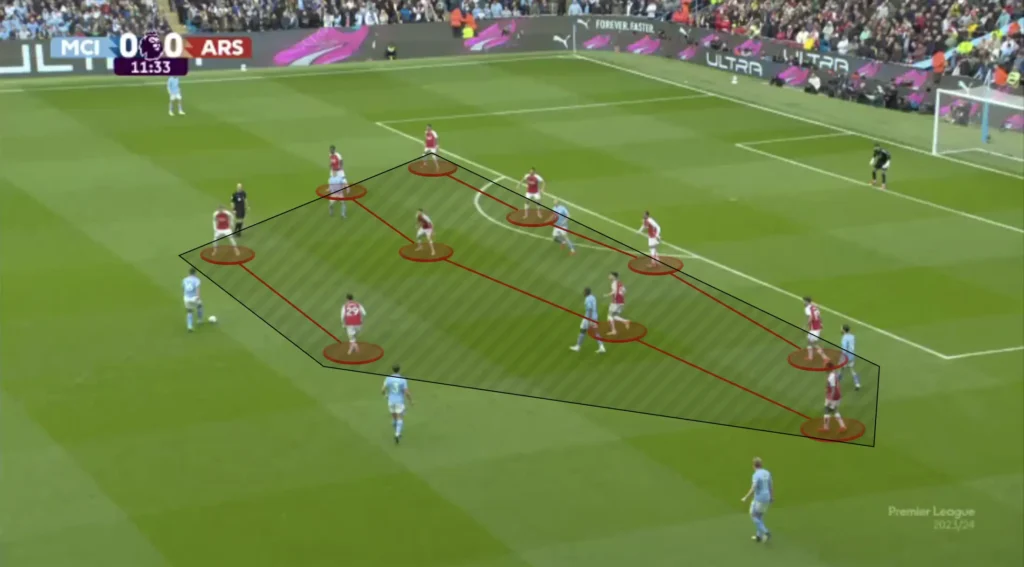
Because space is so compressed and central access is limited, attacking teams must create their own time and separation. The challenge is not only creating chances, but doing so without losing structure, patience, or control — exactly the situations a low-block is designed to provoke.
Building the Conditions to Attack
Breaking down a low-block does not start in the final third. It starts with how the attacking team positions itself before the decisive action even becomes possible.
Short Distances: The Foundation of Everything
Before any attacking idea can work against a low-block, distances between players must be right. This is not a detail; it is the foundation.
When distances are too large, ball circulation slows, passing angles disappear, and defenders can slide comfortably as a unit. Shorter distances, especially between the defenders and midfielders, allow the ball to move quickly and reduce the time defenders have to step, cover, or double up. This is what makes progressive one- and two-touch combinations possible in the first place, and it always gives the ball-holder more passing options.
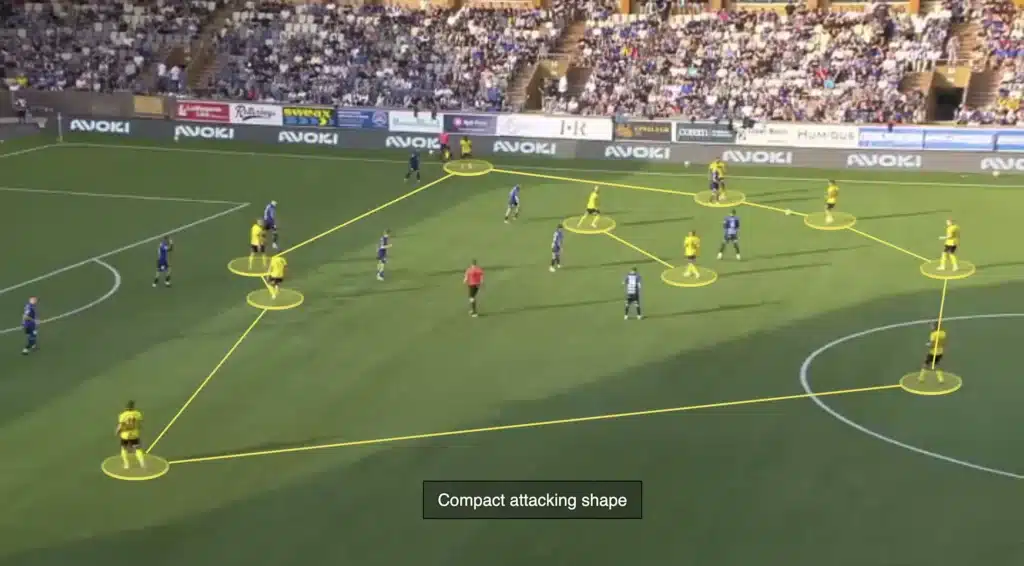
Crucially, short distances do not mean crowding the same space. The best teams stay compact within zones while still stretching the pitch horizontally. Central players remain close enough to combine, while wide players hold positions that pin the block and create room to switch play — for example, circulating on one side to draw the block over before quickly isolating a winger 1v1 on the far side.
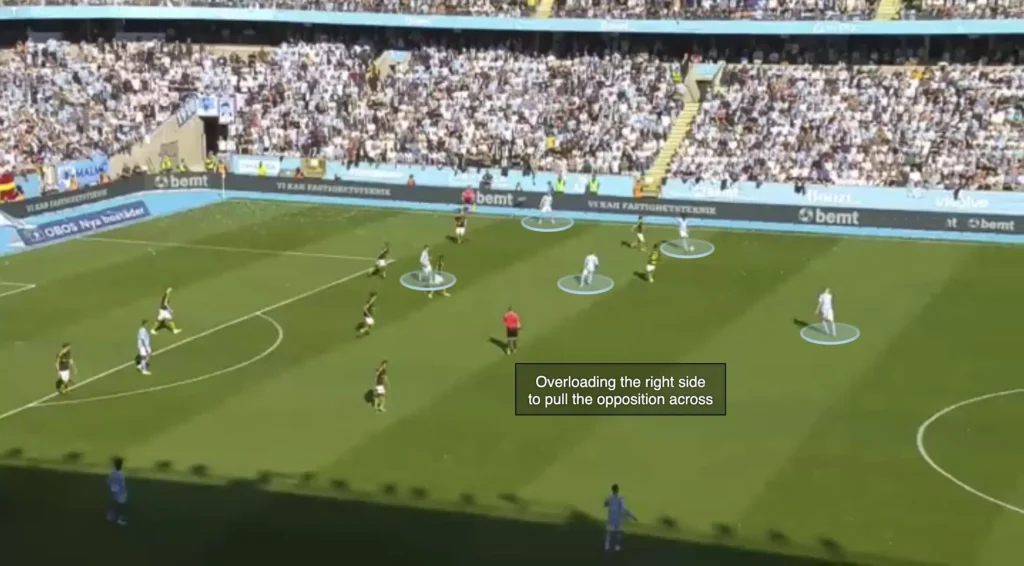
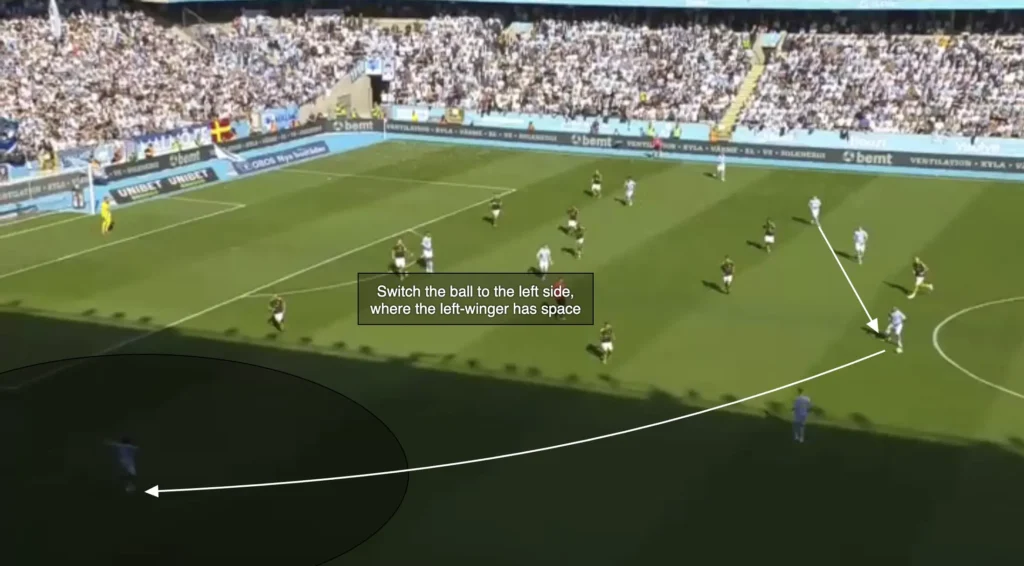
Against a low-block, spacing is less about creating immediate gaps and more about enabling everything that follows.
Structural Preparation: Overloads, Advantages, and Access
With distances set, structure determines whether progression is clean or forced.
Against compact defences, teams rarely succeed by trying to dominate every zone at once. Instead, they prepare attacks by creating clear numerical or positional advantages in specific areas.
One of the most important appears early in possession. Creating a +1 in the first line against the opponent’s forwards allows the attacking team to progress the ball easily. A dropping pivot, a fullback-back coming in next to the center-backs, or the goalkeeper acting as an extra outlet can all create this advantage.
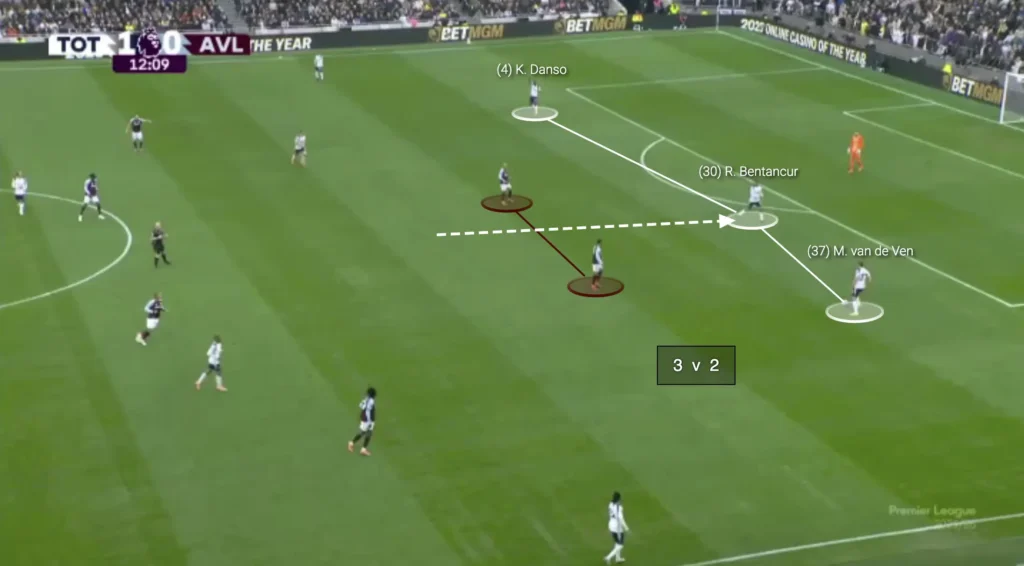
Once the first line is beaten, the low-block is forced to retreat and reorganise, often creating small but meaningful disconnections further up the pitch.
Higher up, structure continues to matter. An interior midfielder positioned slightly wider can support a winger and create a 2v1 against a fullback. A striker occupying or dropping off a centre-back can open space for others. These overloads are not the attack itself; they are the conditions that allow destabilisation to occur later.
Destabilising the Block
Once the structural conditions are in place, the attacking team can begin to stress the block itself.
Movement as the Trigger, Not the Decoration
Good spacing without movement eventually becomes predictable. Low-blocks are comfortable if attackers stand in the right zones but do not move with purpose. To destabilise a compact defence, movement has to be constant, coordinated, and connected to the structure behind it.
Underlapping and overlapping runs from midfielders or fullbacks force wide defenders to make uncomfortable choices, often creating brief moments of disorganisation.
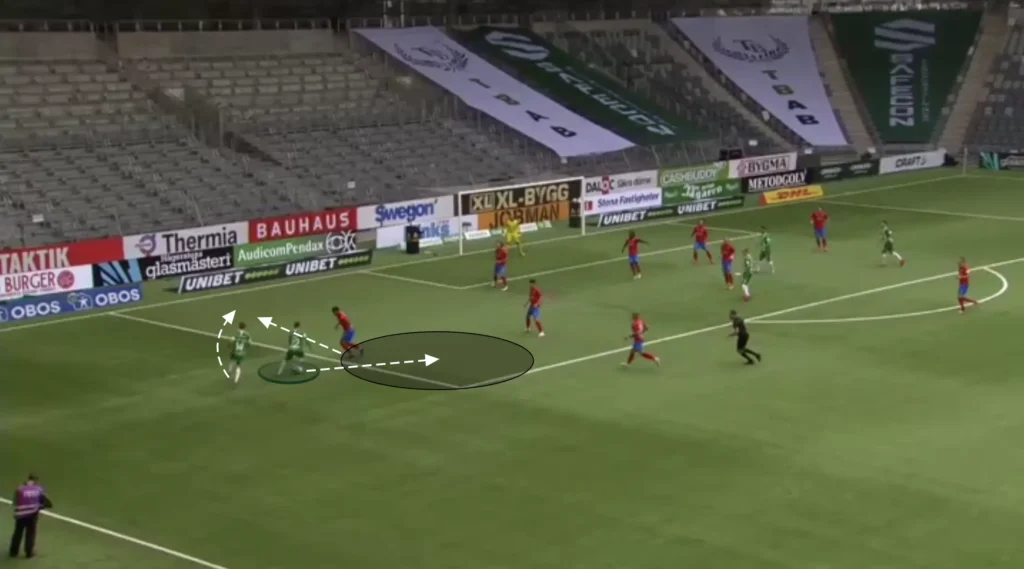
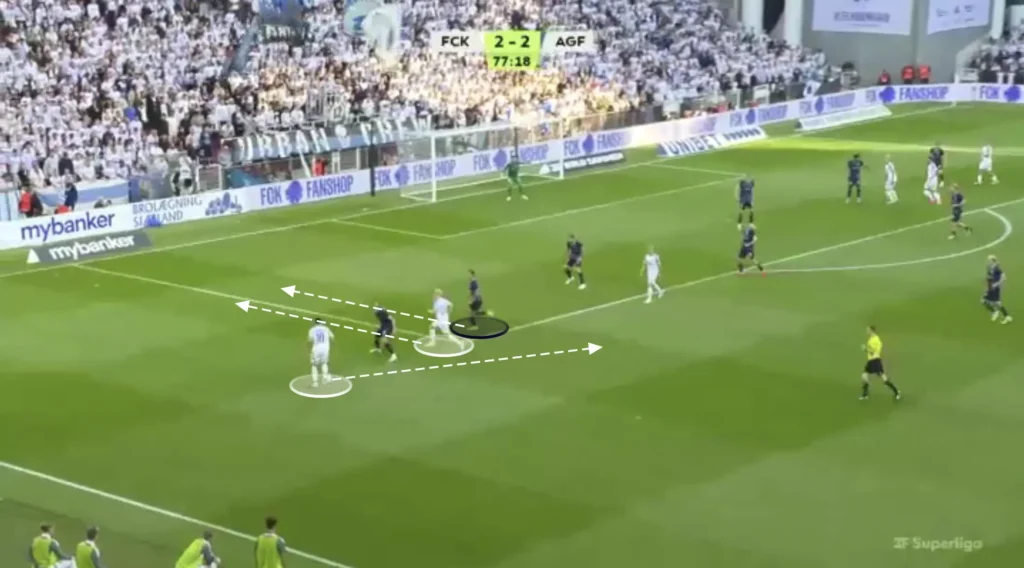
Counter-movements — one player dropping short while another attacks the space he leaves — remain one of the most reliable ways to manipulate a backline that wants to stay compact and narrow.
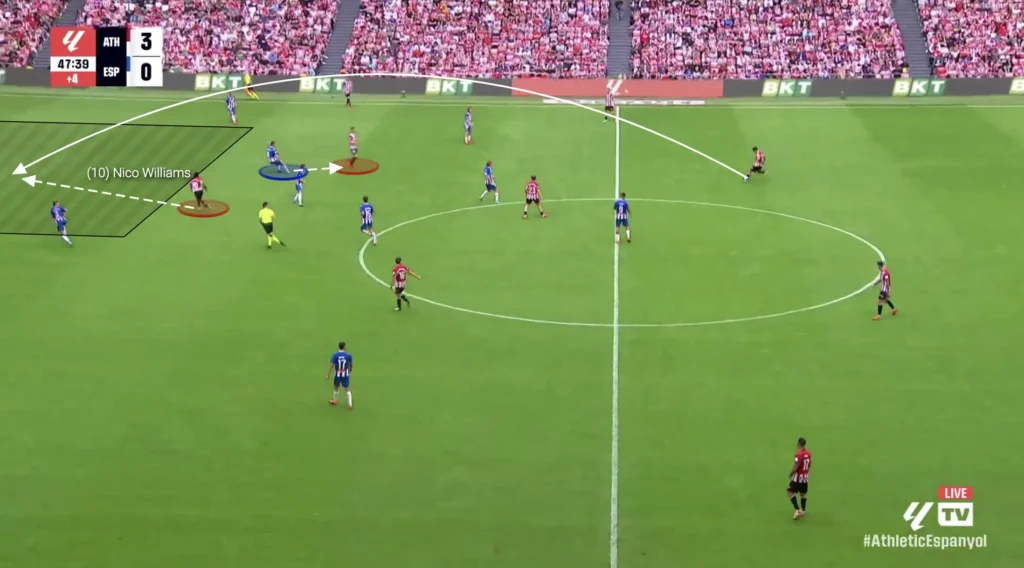
Rotations matter for the same reason. When interior midfielders rotate with wide players, or when a striker drops into midfield, and someone else runs beyond him, defensive reference points begin to blur. Even disciplined low-blocks rely on clarity. Movement takes that clarity away, forcing defenders to communicate, pass on runners, and adjust under pressure.
Threatening Depth to Control the Line
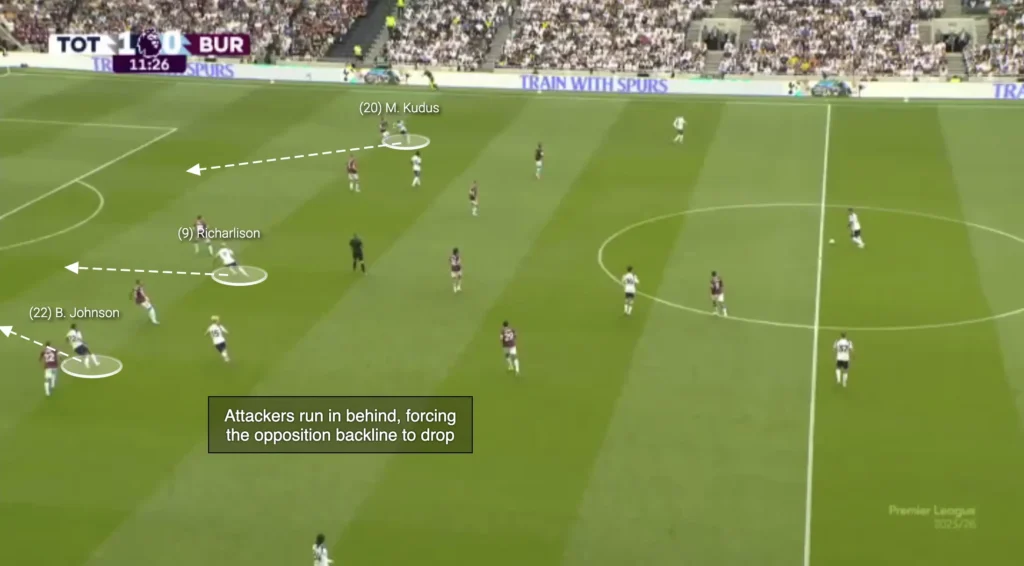
Movement does not only happen toward the ball. Runs in behind play a crucial role, even when they are not used directly.
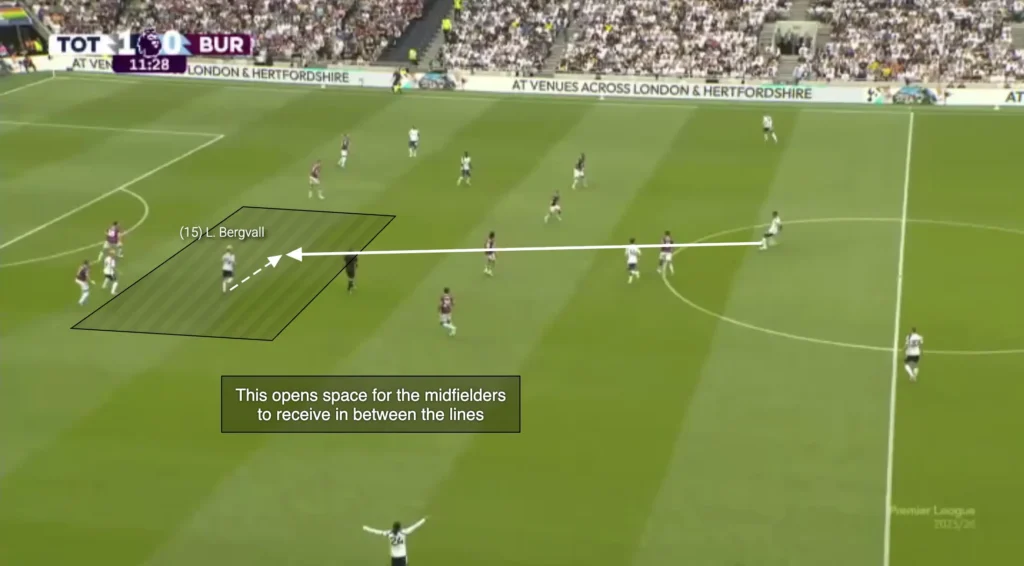
When attackers consistently threaten the space behind the backline, defenders are forced to drop, adjust their body orientation, and prioritise protecting depth. Stepping out becomes risky, and the line naturally sinks.
As the line drops, space opens up in front of it. Interior attackers begin to receive with more time in between the lines, facing forward instead of being pressed immediately. If the space behind the line becomes accessible, it should be attacked decisively. But even when it is not, the threat alone reshapes the block and improves the conditions for combination play in between the lines.
Attacking the Box and the Second Phase
Low-blocks may be designed to protect the penalty area, but they can still be broken down by consistently committing multiple players into the box, creating a chaotic environment for defenders and increasing the probability of scoring. When the ball enters the final third, attackers and midfielders should make aggressive forward runs to overload the defensive line. These overloads make defending significantly harder. With multiple targets to track, defenders struggle to mark everyone effectively, which increases the likelihood of connecting with crosses and cut-backs.
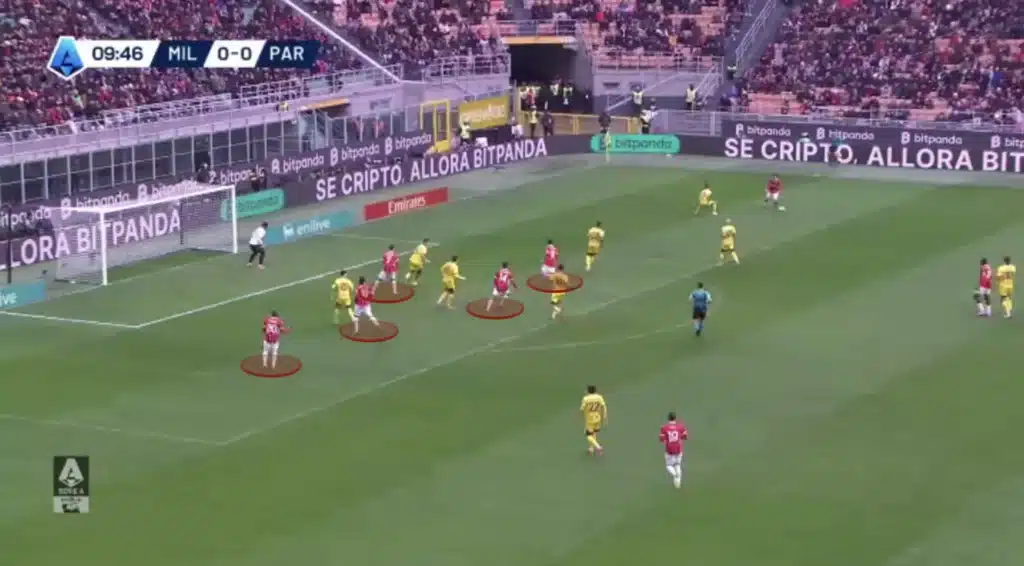
Just as important is what happens outside the box. Players positioned around the edge of the area are responsible for winning second balls, collecting clearances, and immediately restarting attacks. Many low-blocks are not broken by the first action, but by what happens after it.

Sustaining Pressure Over Time
Against a low-block, individual attacks rarely decide the game on their own. Crosses are cleared, shots are blocked, and combinations break down. What separates teams that eventually score from those that become frustrated is their ability to sustain pressure and turn each defended action into the start of the next attack. By keeping the opponent pinned deep, attacking teams force repeated defensive actions, increase physical and mental fatigue, and gradually create the conditions for mistakes to appear.
Rest-Defence, Control, and Wearing the Block Down
Sustained pressure is only possible if the attacking team can prevent the opponent from escaping.
When distances are short and attacks are well structured, rest-defence becomes a natural outcome. Center-backs can hold high positions, midfielders can counterpress immediately, and clearances are recovered quickly. The opponent stays pinned deep, forced to defend again and again with little opportunity to breathe.

Over time, this constant pressure takes its toll. Distances grow, reactions slow, and decisions become less precise. Attacks that were defended comfortably early on become harder to manage later, not because the attacking team changed dramatically, but because the pressure never stopped.
Clarity, Tempo, and Collective Decision-Making
There are several ways to attack a low-block — through the centre, via the wings, through the half-spaces, etc. — but no team can threaten all of them at once without a clear structure. The key is deciding which spaces the team wants to access and building a structure that makes those spaces reachable.
Circulation is never the objective in itself. Possession only becomes valuable when every player understands why the ball is moving and what reaction it is meant to provoke. Without that shared understanding, circulation becomes passive, and even well-built attacks lose their edge.
Tempo plays directly into this. Low-blocks thrive on predictability. Endless slow circulation allows them to rest; constant speed leads to rushed decisions. The balance lies in variation — slowing the game to move the block, then accelerating to exploit moments of disorganisation.
Conclusion
Breaking down a low-block is not about one solution. It is about stacking advantages over time: short distances, strong structure, intelligent movement, credible depth threats, well-timed box attacks, second-ball dominance, sustained rest-defence, and a clear collective idea of where and how to attack.
When these principles work together, the defending team is forced to move, decide, and react again and again. Eventually, even the most disciplined low-block gives way — not because of a single action, but because the pressure never ends.