
Sunderland have been one of the Premier League’s most impressive overperformers this season under Regis Le Bris, currently sitting 4th in the table despite modest expectations. Their success is built on a clear tactical identity: structured build-up, efficient use of wide areas, and rapid transitions. Sunderland balance intelligent possession with direct attacking moments, all while maintaining a disciplined defensive base that allows them to absorb pressure and control key spaces.
Attacking Tactics
Régis Le Bris has brought a clear positional framework to Sunderland’s attacking play, combining structured build-up mechanisms with flexible patterns that adapt to pressure and match context. His side balances patient construction from deep with direct, vertical progressions — a blend that reflects both analytical preparation and dynamic execution on the pitch.
Low Build-Up
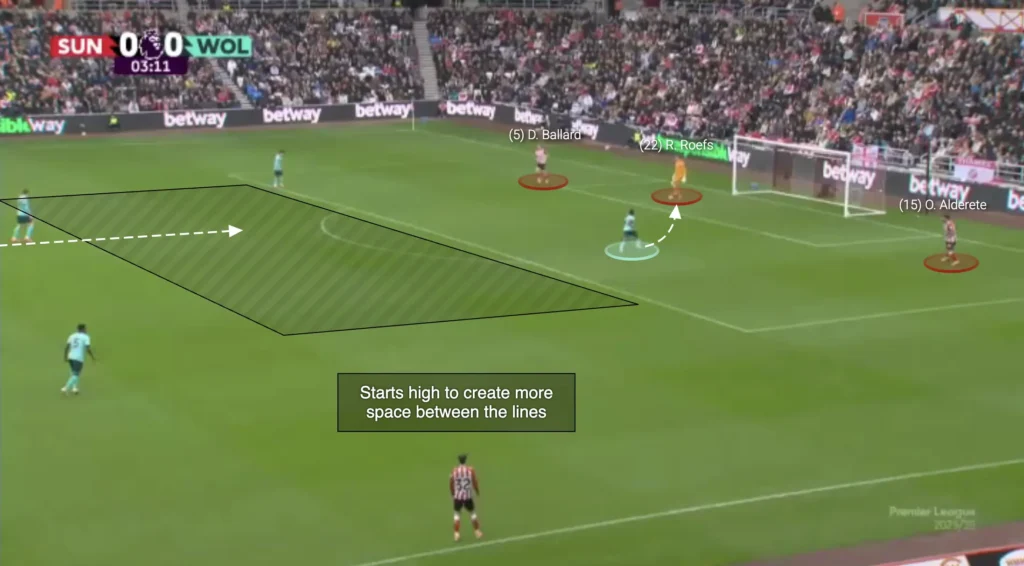
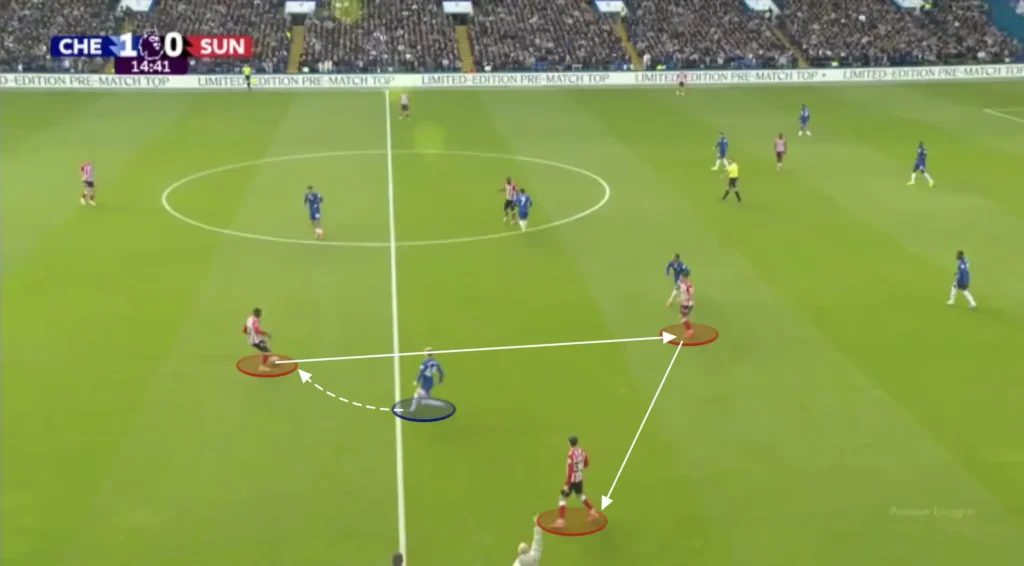
In the first phase of possession, Sunderland typically build from a 4-3-3 structure, with both fullbacks and number-eights pushing high — often positioning themselves close to the halfway line. This movement intentionally stretches the opposition, isolating their first line in a large area. If the opposition presses man-to-man, Sunderland will generate a 4v3 numerical advantage in the first line, using the goalkeeper, the two center-backs, and the number six against the three opposition attackers.
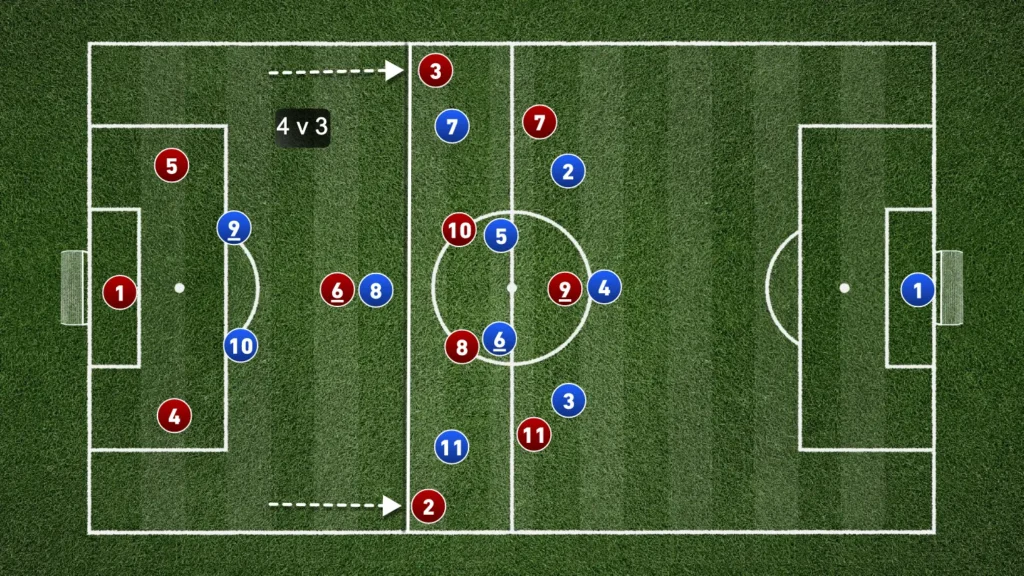
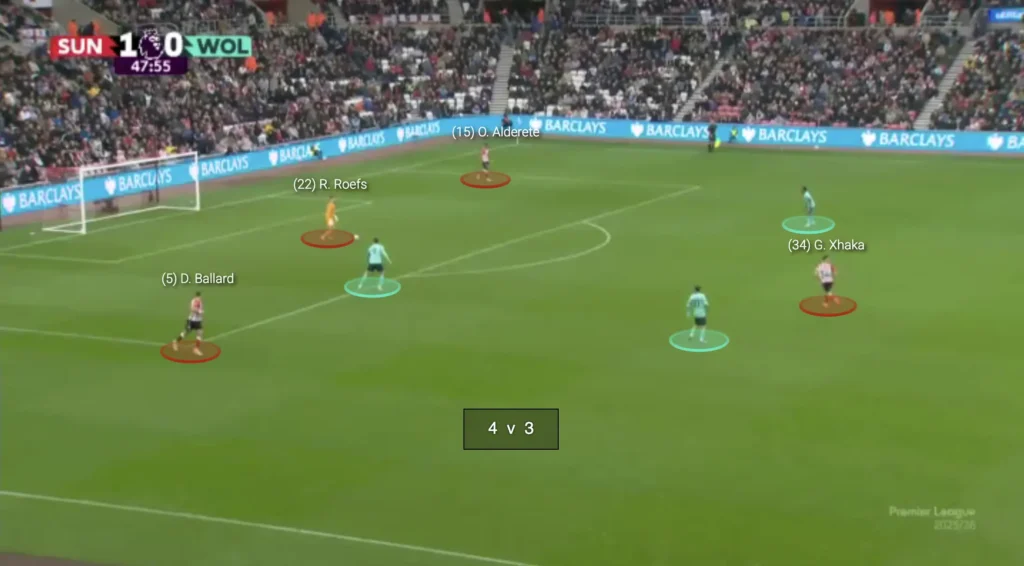
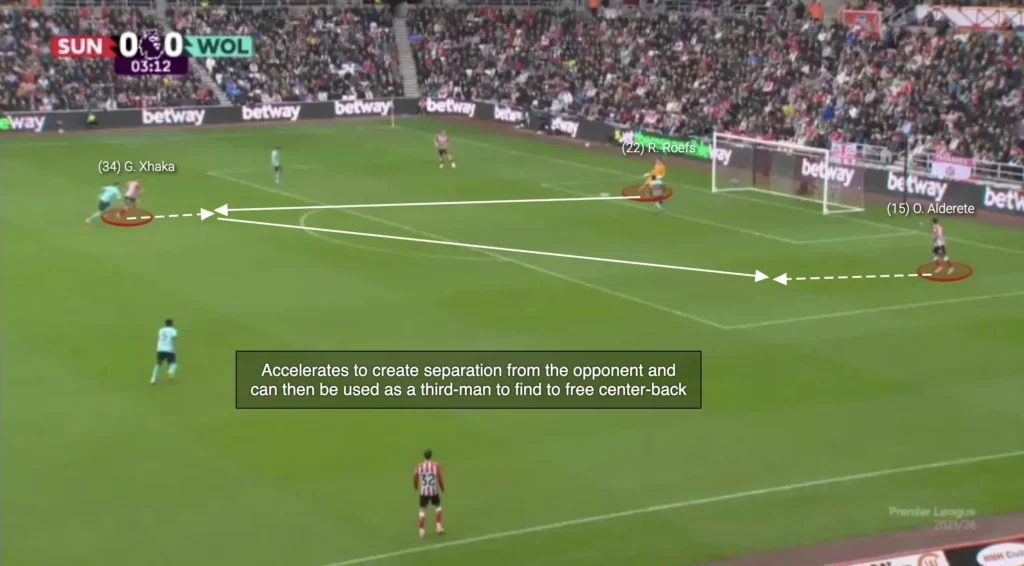
The core idea is to draw out the opposition’s first line and exploit the space that opens up behind it. When an opposition attacker steps forward to press the goalkeeper, he naturally abandons his direct marking responsibility — one of Sunderland’s center-backs. This moment creates an opportunity: the now-free center-back becomes available, but the passing lane is initially blocked by the pressing forward’s cover shadow.
To solve this, Sunderland use a third-man mechanism involving the number six. The goalkeeper cannot play directly into the free center-back, so instead, he plays into the number six, who has dropped toward the ball to escape his marker. The number six receives and releases the ball back into the center-back, who is now open and facing forward.
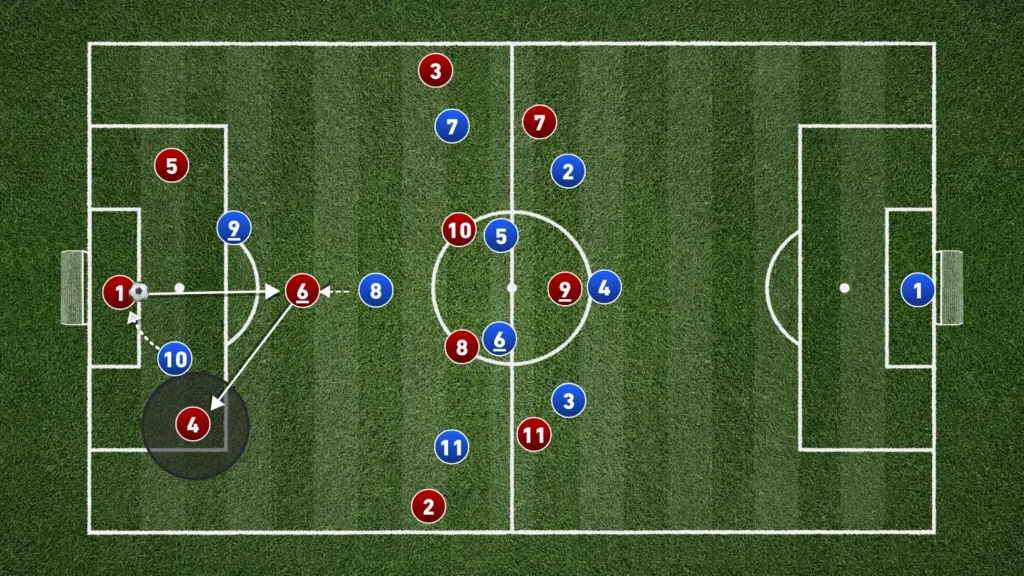
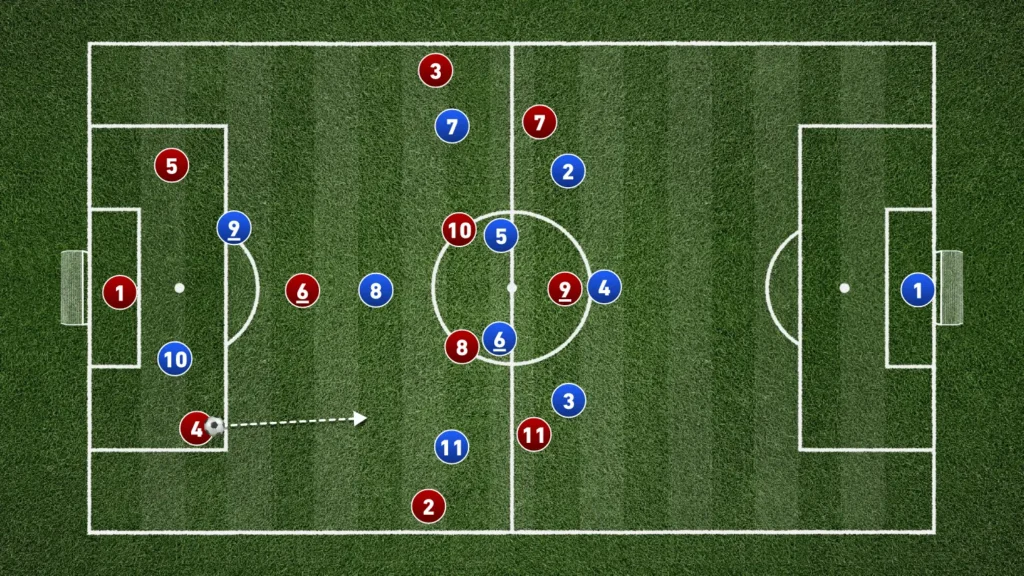
Once the center-back receives in space, Sunderland immediately look to carry forward beyond the first pressing line. From there, the play can progress through central channels or switch wide to advancing fullbacks.
Creating Seperation From the Marker
For this mechanism to work, the holding midfielder must time his movement precisely. He typically begins higher before accelerating back toward the ball as the opposition attacker presses the goalkeeper. This dynamic movement creates separation from his marker, ensuring he can play the next pass cleanly. By starting higher, he has more space to run into, which not only increases his passing angle but also makes it easier to get away from the opponent.
Going Long
When under more aggressive pressure or against opponents who commit many players forward, Sunderland also show a pragmatic alternative: the goalkeeper will occasionally go long directly to the striker, supported by the two wingers tucking in close to contest second balls.
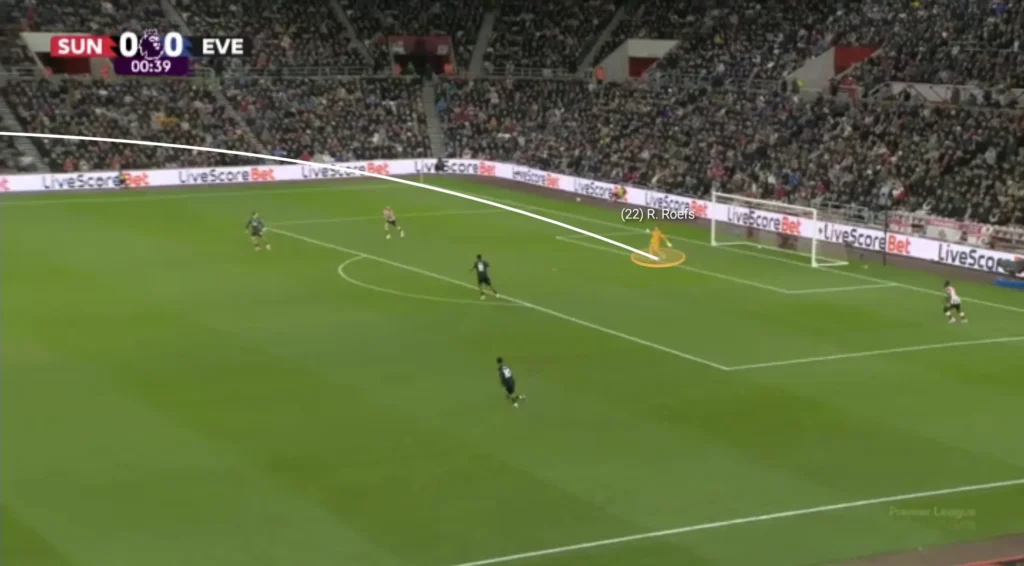
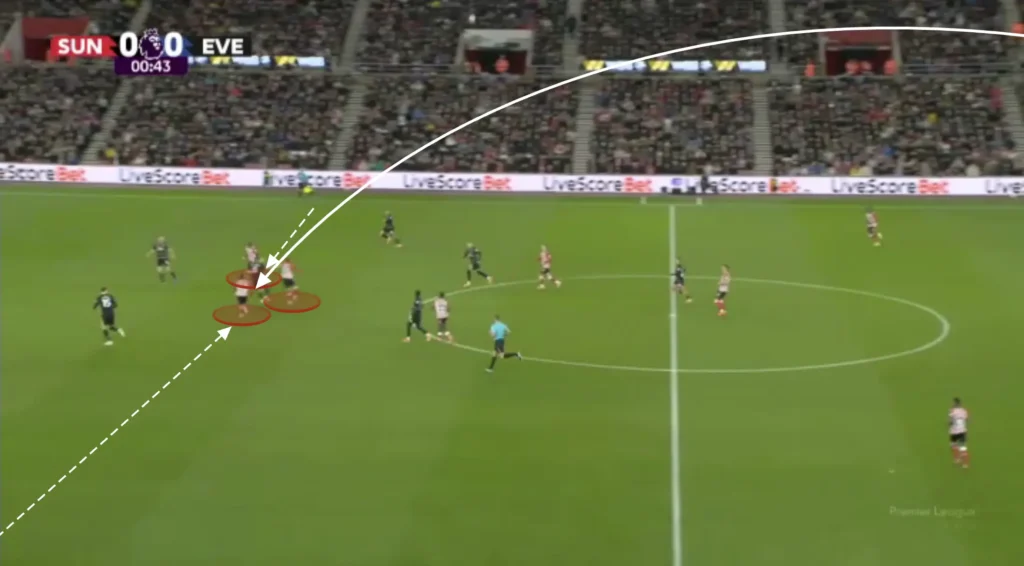
This dual threat — playing through or over the press — keeps opponents hesitant and prevents them from pressing too aggressively.
High Build-Up
As play moves into the middle third, Sunderland maintain their 4-3-3 shape, though the structure becomes more fluid.
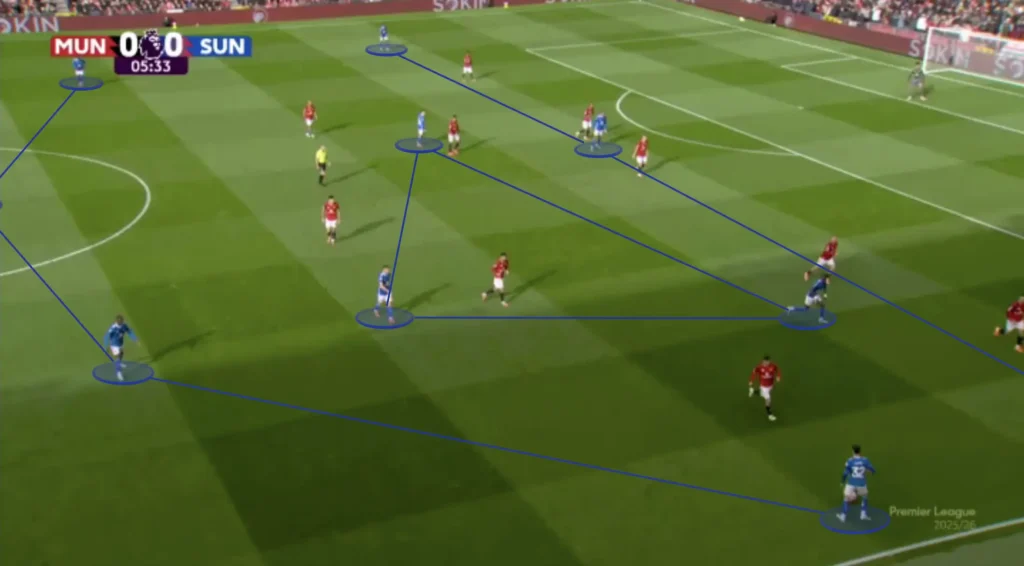
The number eights remain high and wide to form close triangles with the fullbacks and wingers, while goalkeeper Roefs — excellent with his feet — often steps forward to operate just behind the center-backs, giving Sunderland an additional passing option.
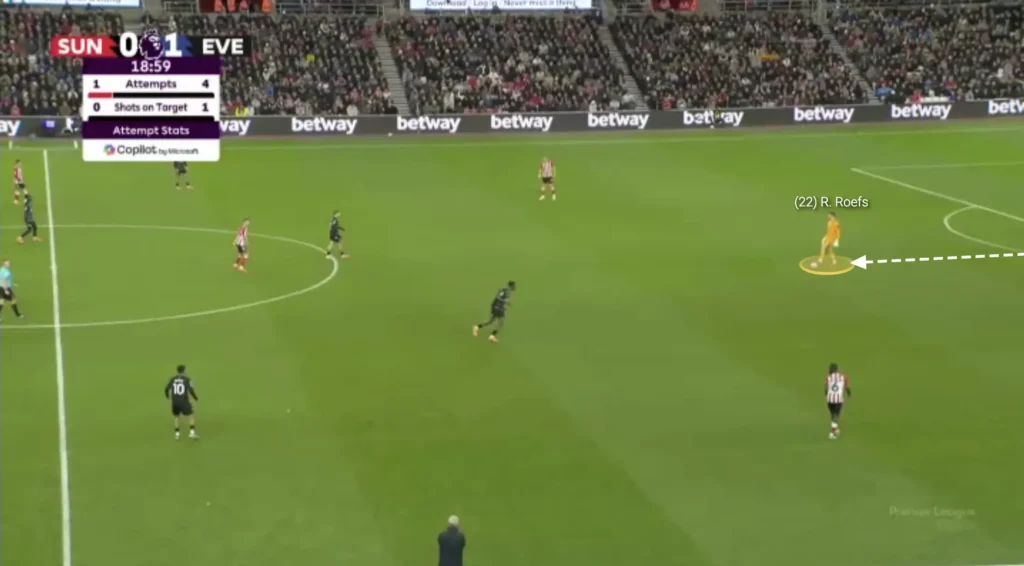
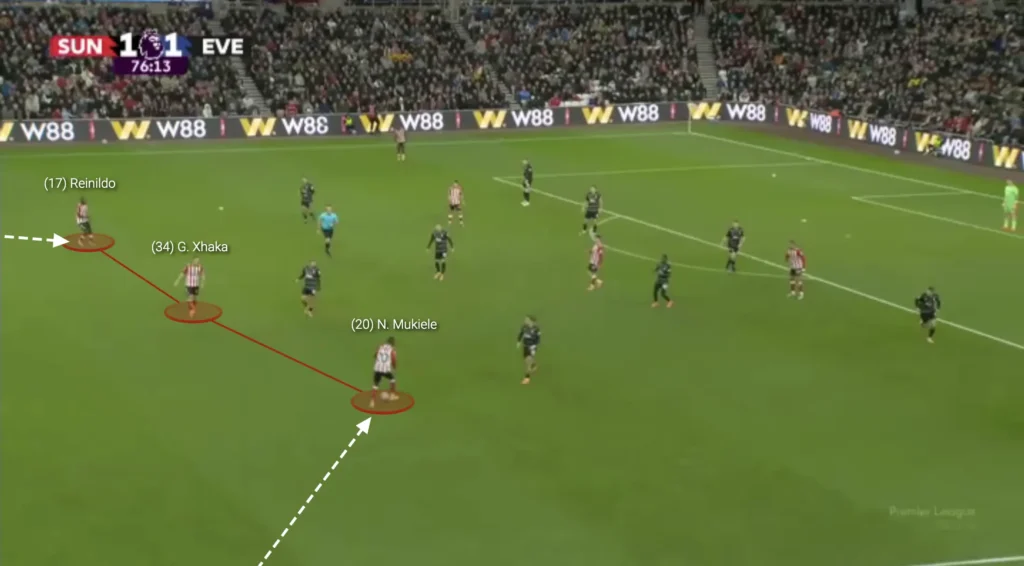
In higher zones, the fullbacks often invert into central positions next to the number six(Xhaka), forming a three-player holding line ahead of the center-backs.
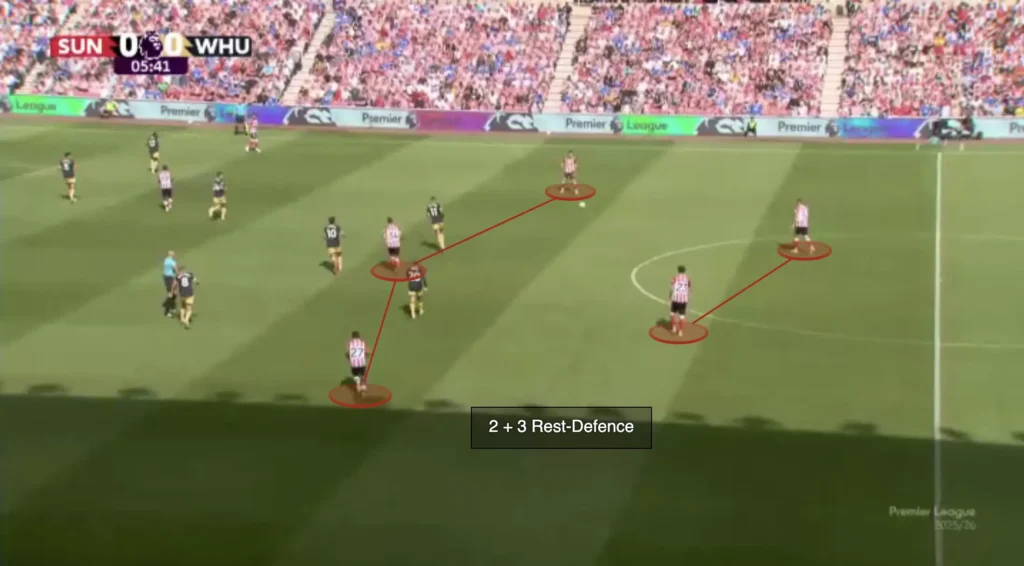
This creates a 2+3 rest-defence structure that provides security while allowing the midfield to maintain positional balance. It ensures immediate compactness after losing possession, with the two center-backs covering depth and the three midfielders positioned to counterpress or recover loose balls.
Balanced Ball Progression
Sunderland’s approach to ball progression blends controlled possession with direct penetration, adapting fluidly to the demands of each match situation. They often use third-man combinations and fast side-to-side switches of play to disorganize the opposition block, shifting defenders horizontally to open new vertical lanes for forward passes.
However, Le Bris’s side is not rigidly attached to possession. When space appears behind the defensive line, they are quick to exploit it — playing early, longer balls toward attackers making runs in behind, or contesting second balls to sustain attacking momentum higher up the pitch.
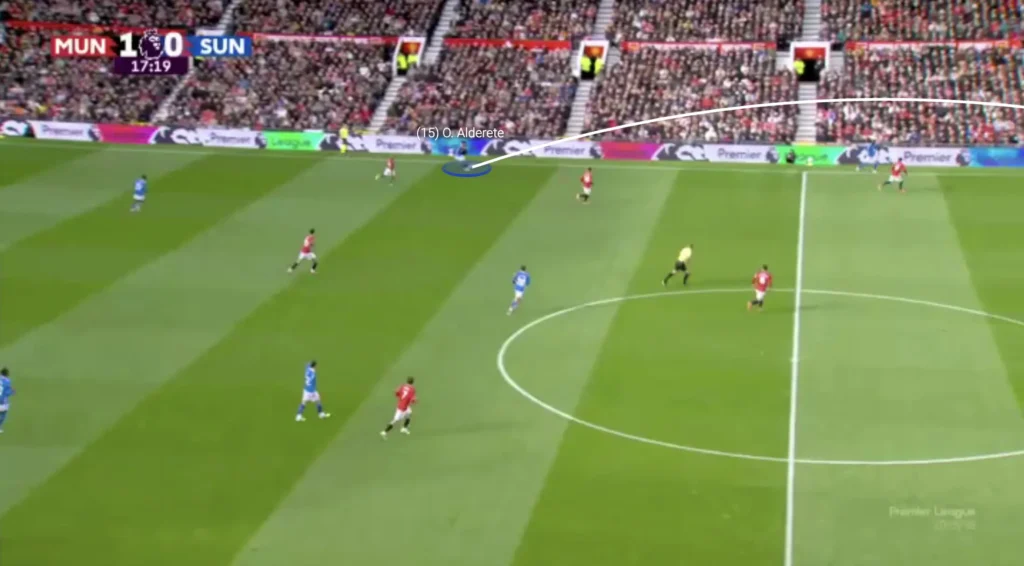
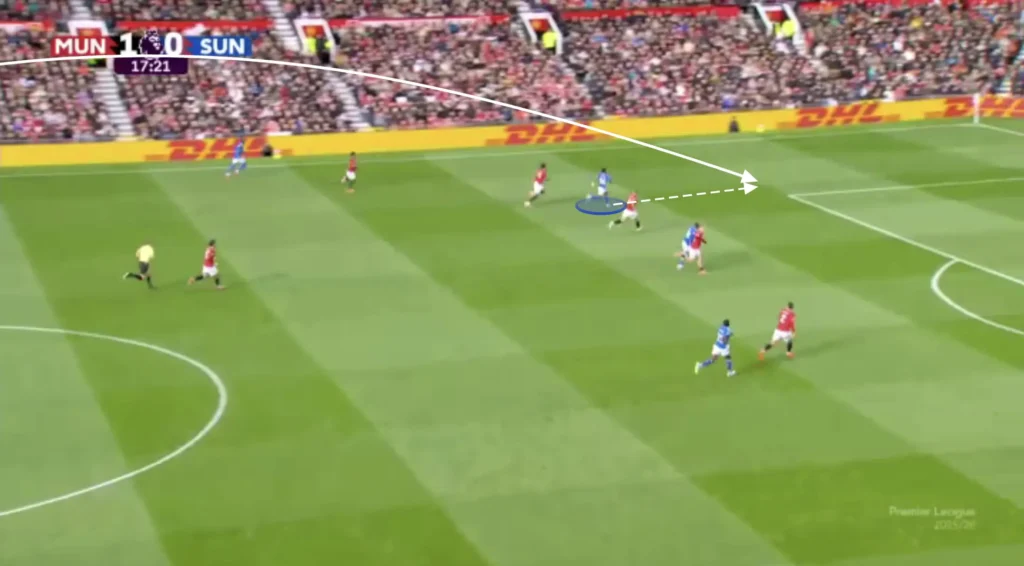
This balance between patience and pragmatism is reflected statistically: Sunderland rank 17th in the Premier League for PPDA against (10.5) — indicating opponents can engage them due to more direct sequences — and 16th in total passes per 90 (336.6). These figures highlight a team that values purposeful progression over sterile circulation, always seeking the most effective route forward.
Active Center-Backs
The center-backs play a central role in Sunderland’s build-up. They are not static distributors but active movers, constantly adjusting to provide passing lanes behind the first pressing line.
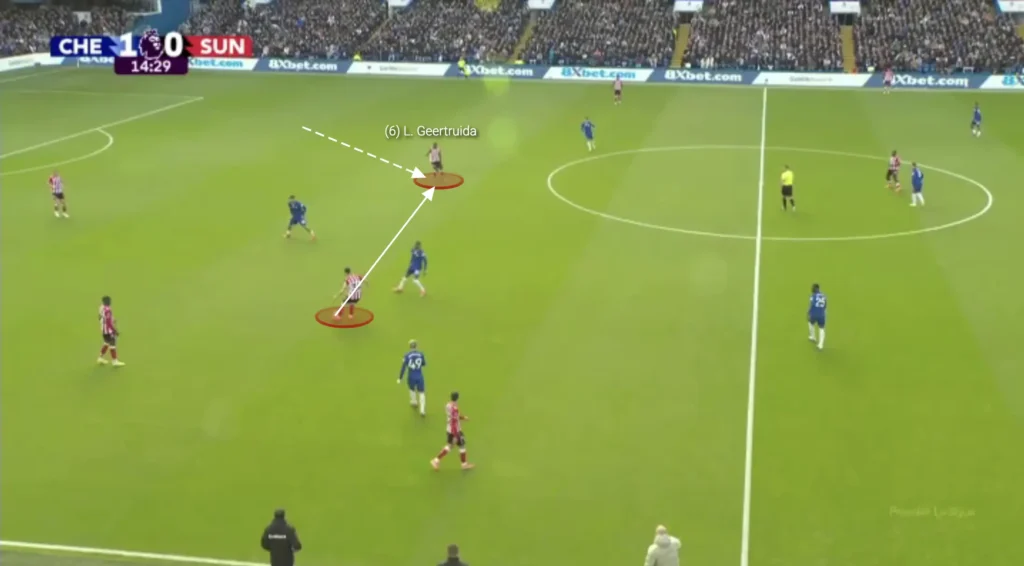
Both are comfortable carrying the ball forward, breaking the initial press, and then finding vertical passes into the eights or switches toward the wingers. Their willingness to drive forward with the ball forces opponents to step out, which in turn creates new passing lanes between or behind defenders.
Xhaka’s Role
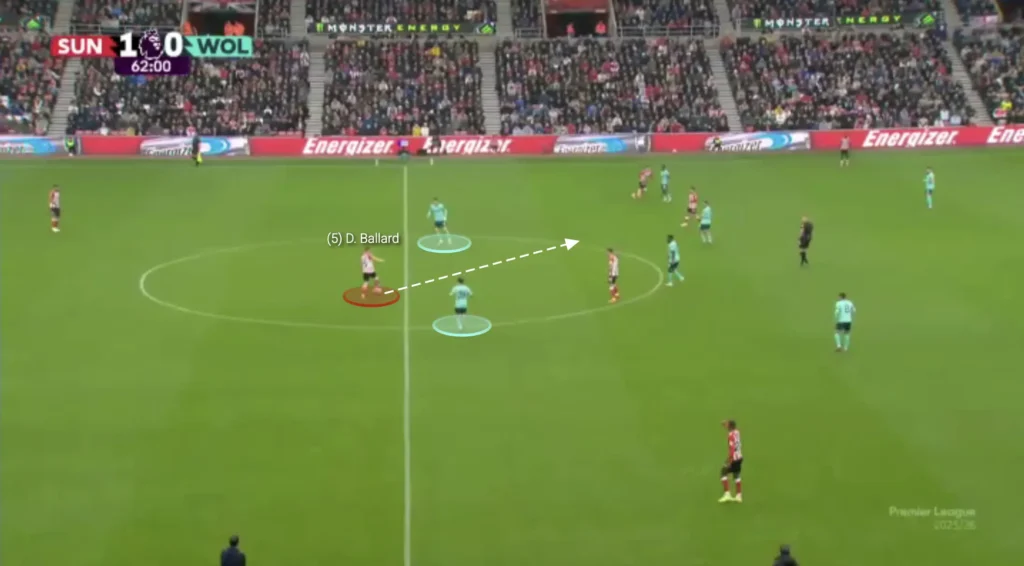
Everything Sunderland do in possession flows through Granit Xhaka. His positional sense, leadership, and technical quality make him indispensable. Defensively, he provides balance and coverage, but it’s in possession where his influence is most visible. Xhaka often drops deep between or beside the center-backs to dictate play from the base of midfield.
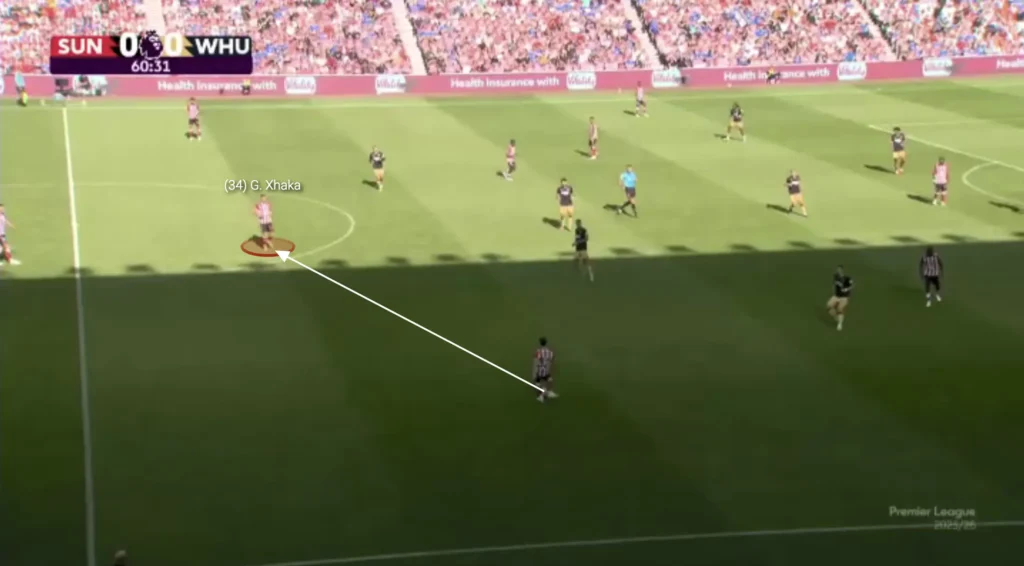
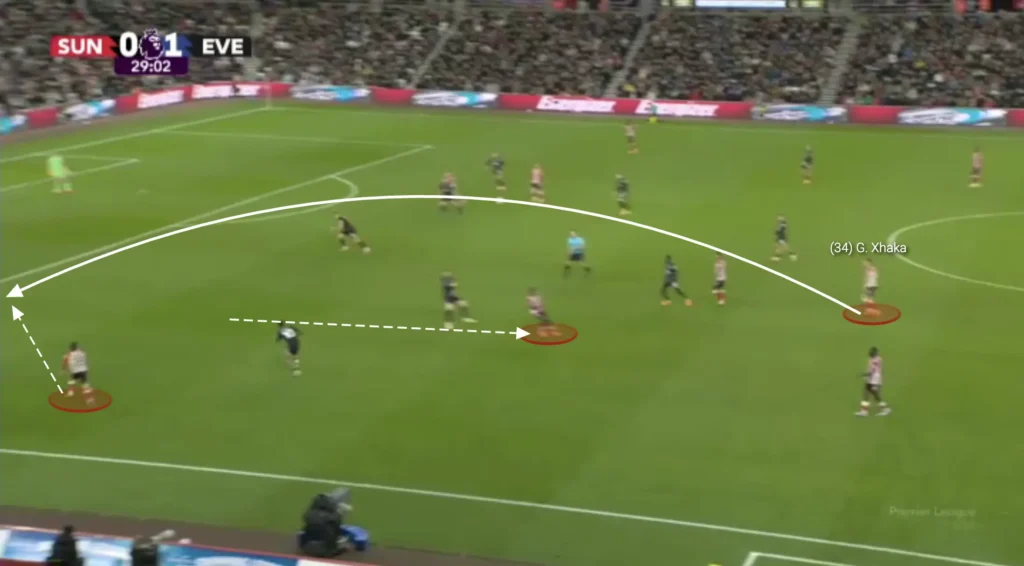
From there, he can thread progressive passes into the attacking midfielders, hit switches of play to isolate wingers in 1v1s, or play incisive through-balls in behind for runners attacking the space. His range of passing allows Sunderland to vary the tempo depending on the pressing and positioning of the opponent.
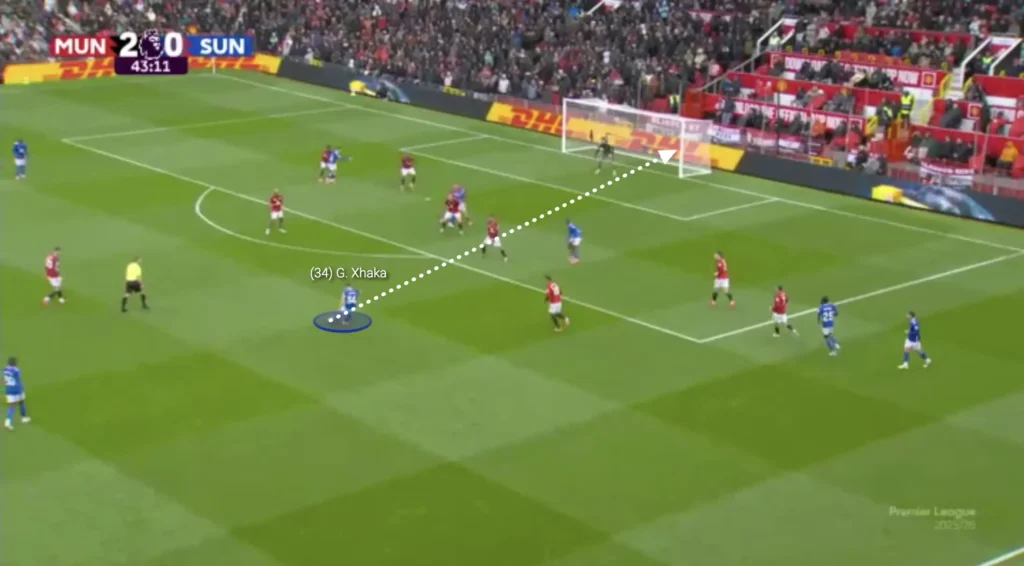
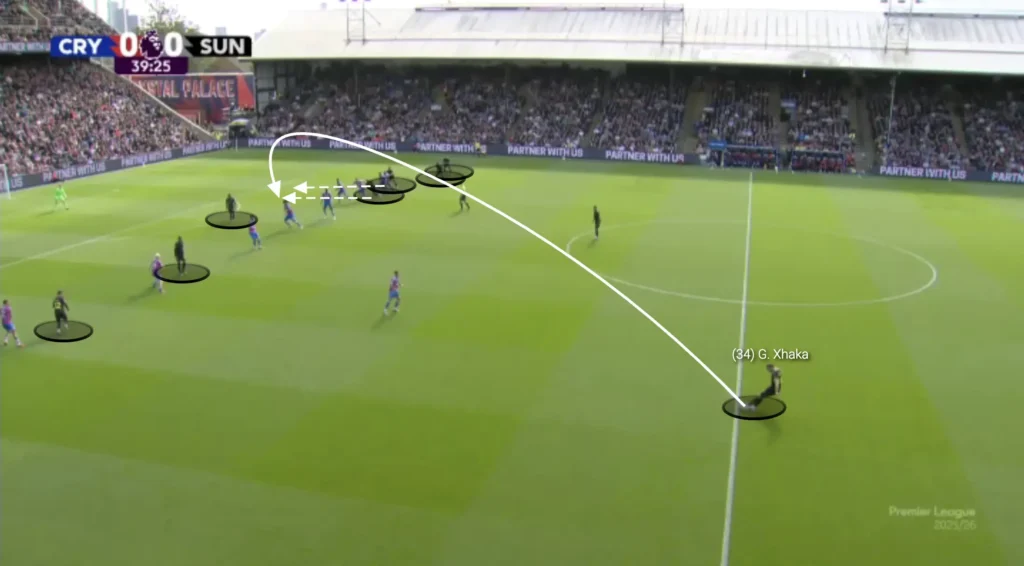
His powerful shooting from distance is also a major weapon in Sunderland’s attacking arsenal. Xhaka consistently threatens from 20–25 yards, capable of scoring directly or forcing goalkeepers into saves that create rebound opportunities. This threat changes defensive behavior — opponents are often forced to step out earlier to close him down, giving valuable space higher up for Sunderland’s attackers.
Beyond the technical and tactical aspects, Xhaka’s leadership, composure, and communication make him the anchor around which Sunderland’s attacking rhythm revolves. He dictates the team’s tempo, provides structure when the game becomes chaotic, and serves as a reliable outlet under pressure, ensuring that Le Bris’s system maintains both control and clarity in its build-up.
Finding Space Between the Lines
Sunderland’s attacking midfielders are tasked with constantly finding and exploiting pockets between the opposition’s midfield and defensive lines. They position themselves carefully just beyond the opposing midfielders, offering clear vertical or diagonal passing options that the defenders can find.
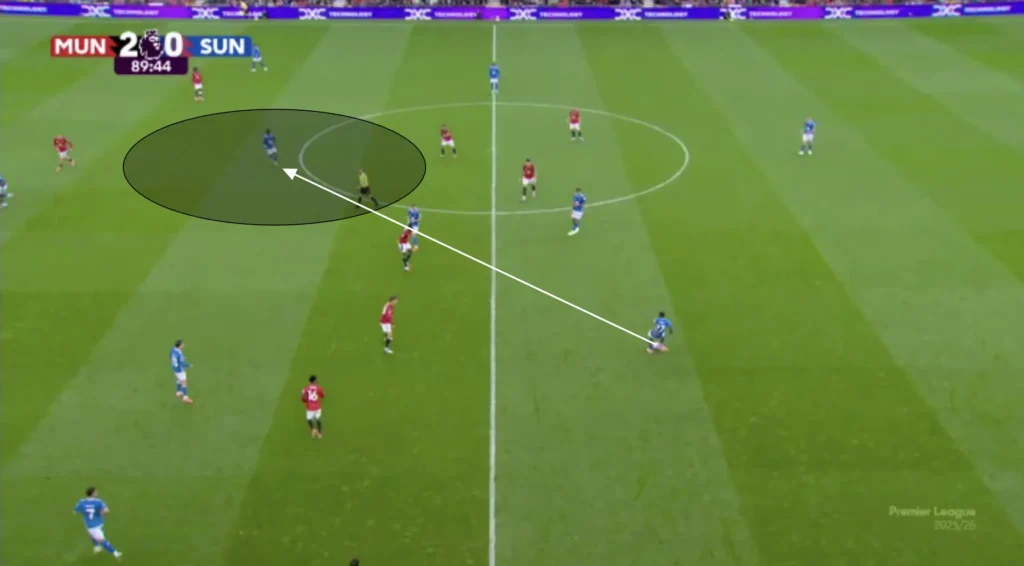
When these passes are found, the midfielders can quickly turn and attack the backline or slide runners through on goal.
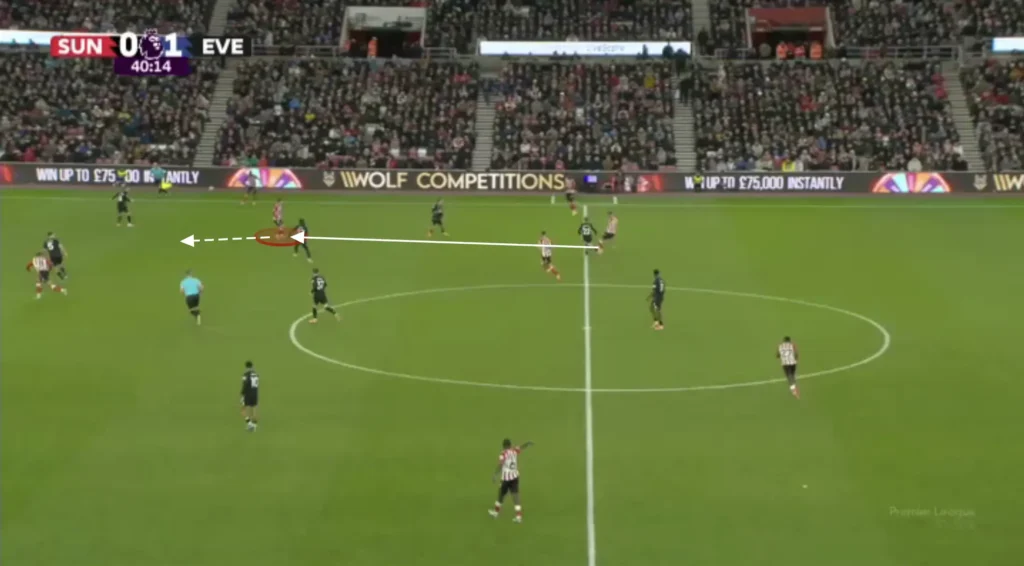
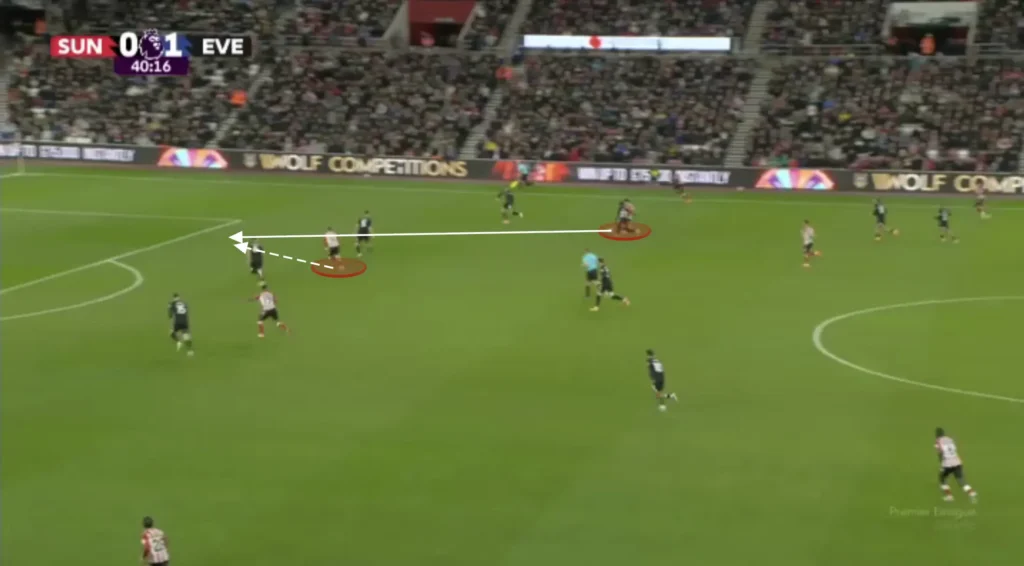
The forwards’ runs in behind play a pivotal role in this system. By making timed, depth-oriented movements, the strikers force the backline to retreat or hesitate, which naturally enlarges the spaces between the midfield and defensive units. This creates gaps that the number-eights can exploit, receiving the ball with time and room to turn and progress play forward.
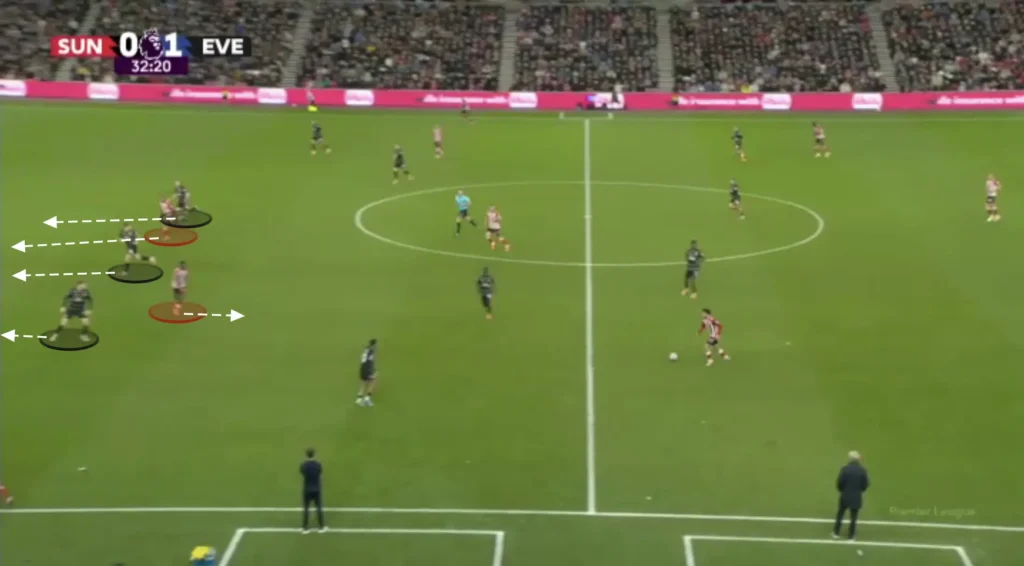
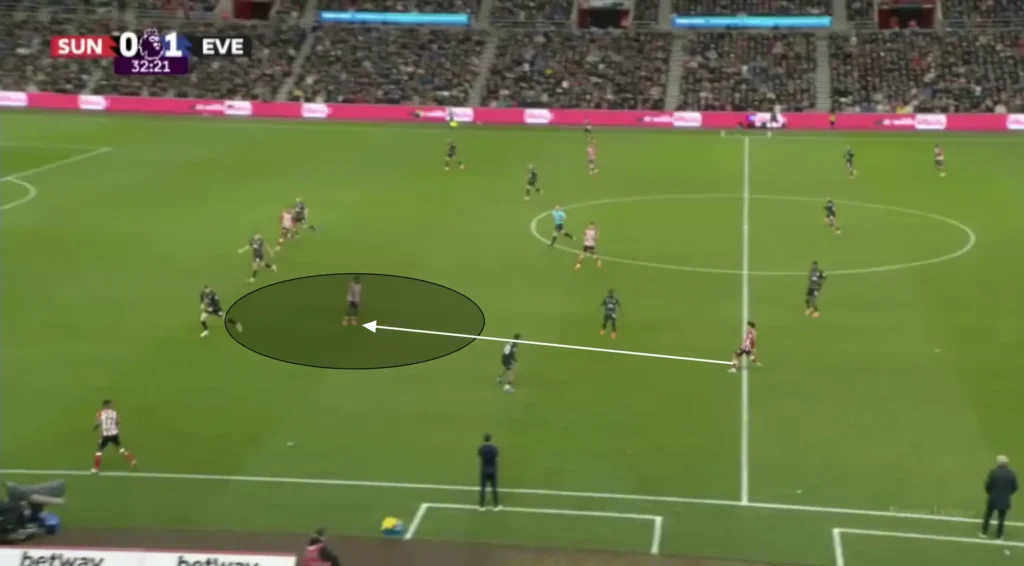
Chance Creation Through the Wings
While central progression is key to advancing possession, Sunderland’s most dangerous attacking patterns emerge from wide areas. Le Bris emphasizes coordinated movement between the winger, fullback, and nearby midfielder to create overloads against the opposition fullback and dynamic crossing opportunities.
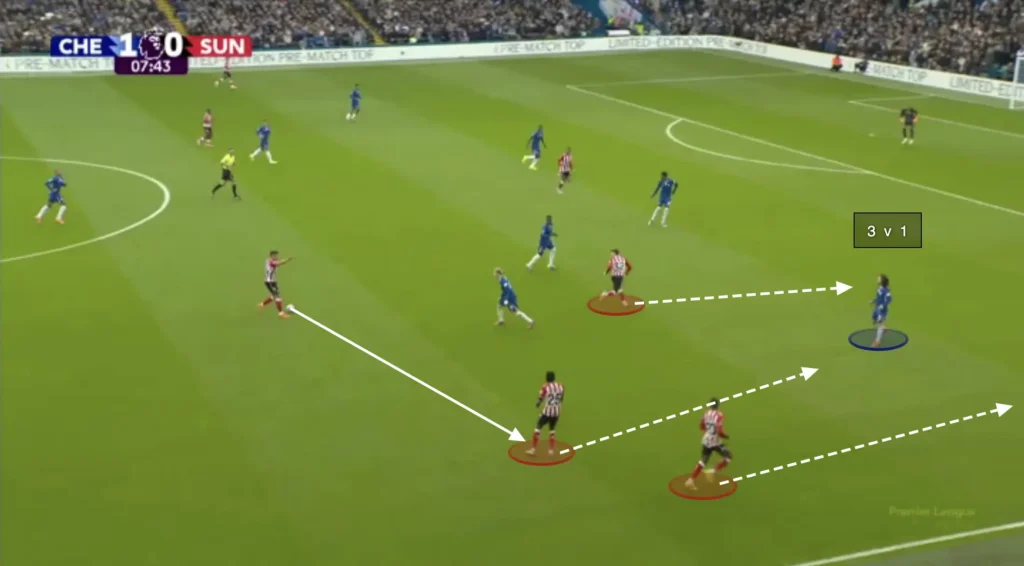
Overlaps are a recurring theme. As the winger drives inside, the fullback bursts around the outside to receive in stride and deliver low crosses or cut-backs.
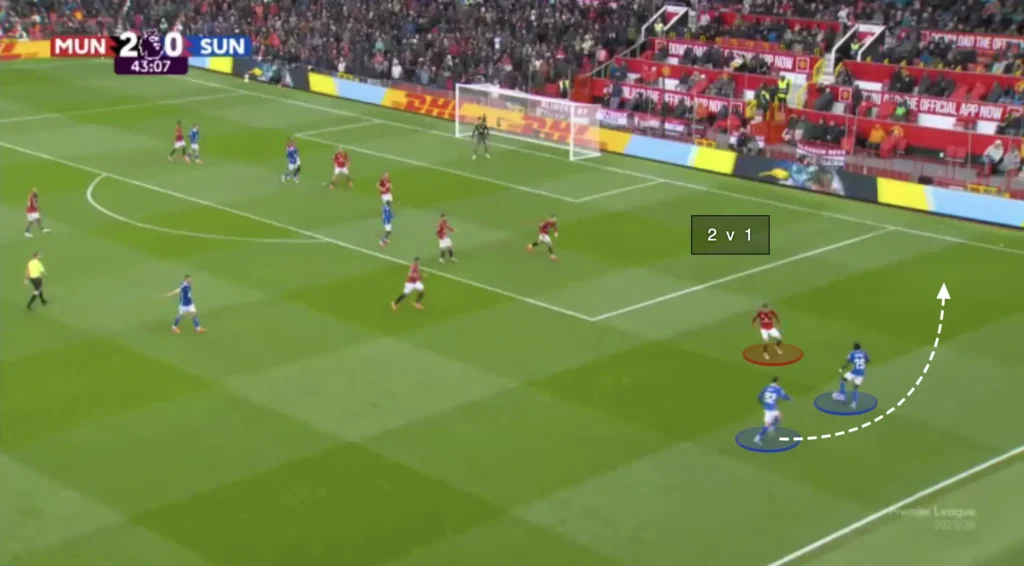
Underlaps are also very common in the final third — the fullback or inside midfielder runs between the opposition fullback and center-back, attacking the half-space with speed.
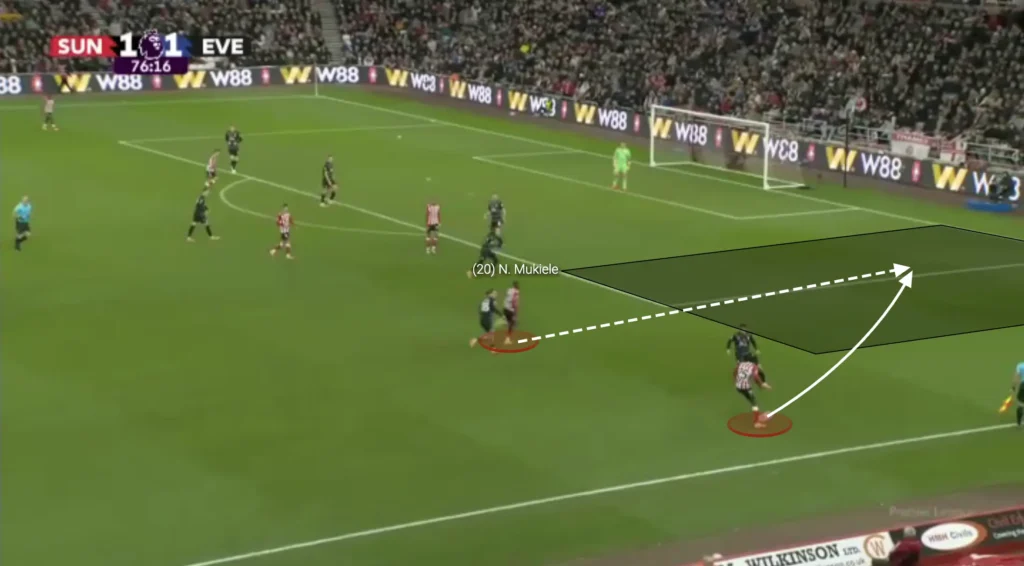
These movements disorganize the opponent’s defensive line, creating both depth and width simultaneously.
Sunderland also rely on third-man runs in wide areas. A typical sequence might see the fullback play into midfield and continue forward on the inside; the midfielder then finds the winger, who releases the fullback into space.
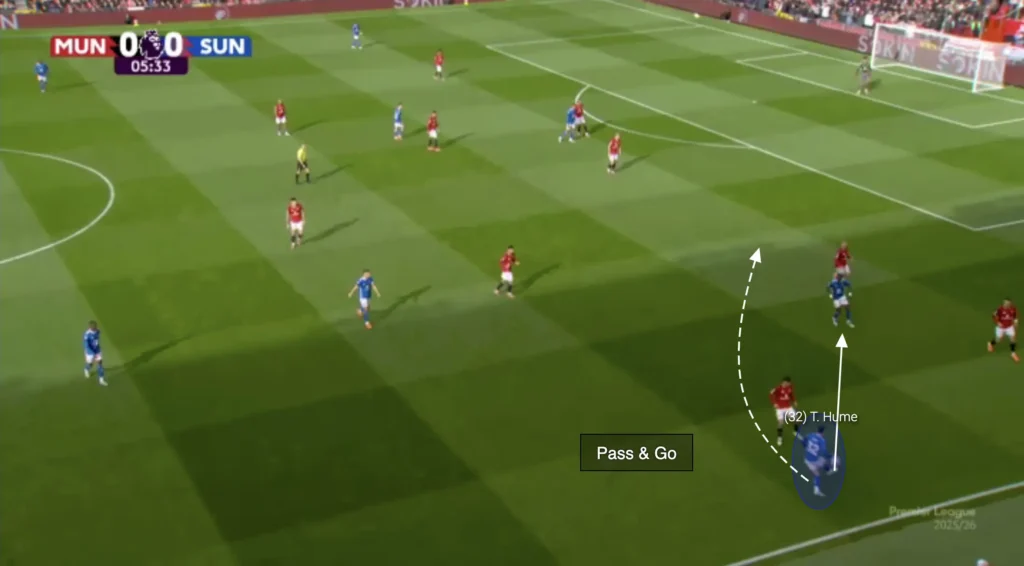
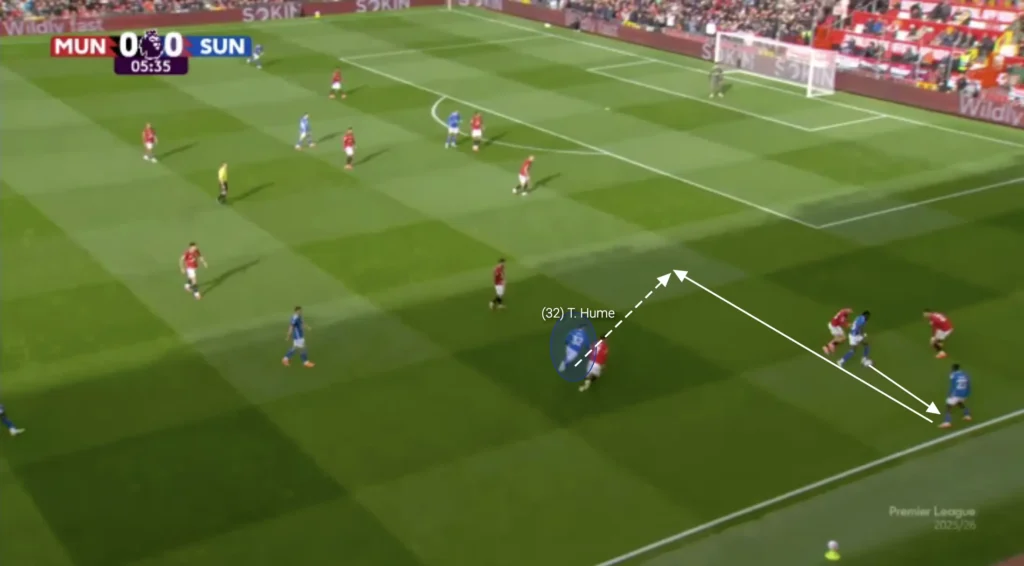
These actions rely on synchronized timing rather than speed alone, allowing Sunderland to progress fluidly even against compact defensive blocks.
Set-Pieces as an Offensive Weapon
Le Bris has also placed great emphasis on set-pieces as a consistent source of goals. Sunderland’s corners, free-kicks, and throw-ins are highly rehearsed, with specific patterns designed to exploit opposition setups.
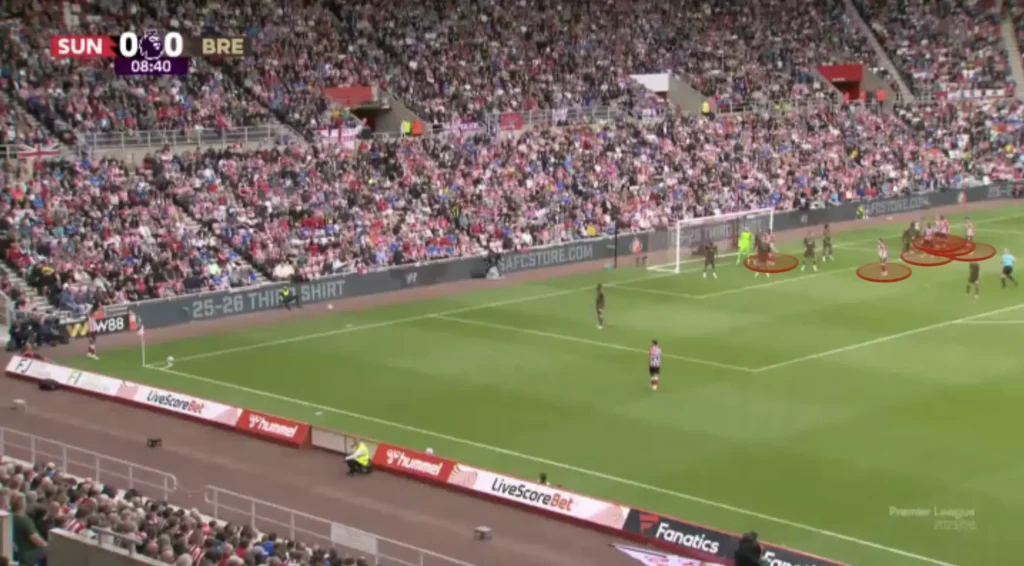
- Corners: Sunderland often load the back post, using blockers to disrupt zonal defenders and free up aerial targets like Dan Ballard. Deliveries are typically inswinging, aimed toward the back-post zone where the target players can head the ball at goal or back across goal for runners arriving from deeper positions.
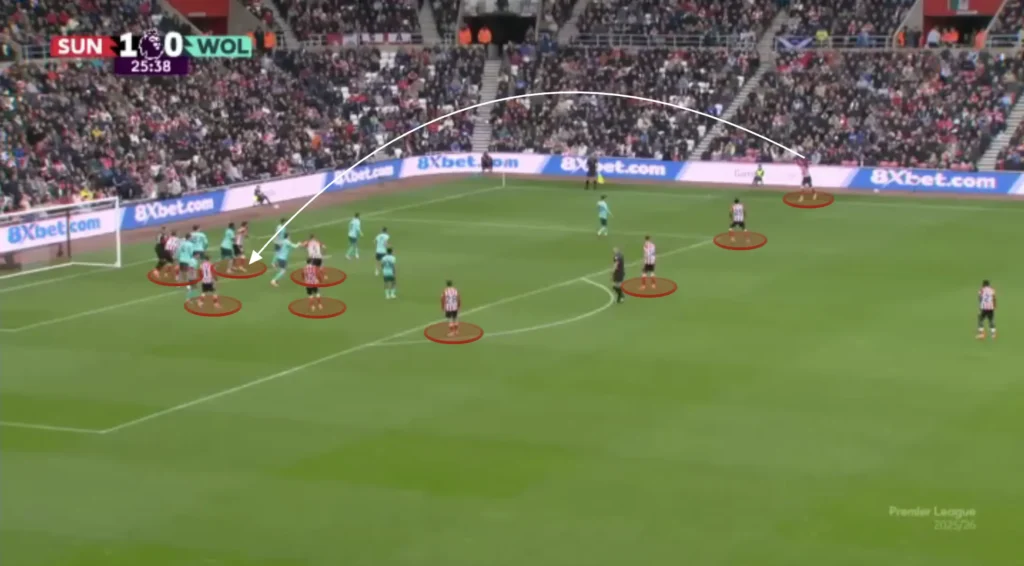
- Throw-ins: In advanced areas, Sunderland turn throw-ins into attacking opportunities, frequently opting for long throws into the box. Multiple players attack the near post for flick-ons, while others make delayed runs toward the far post.
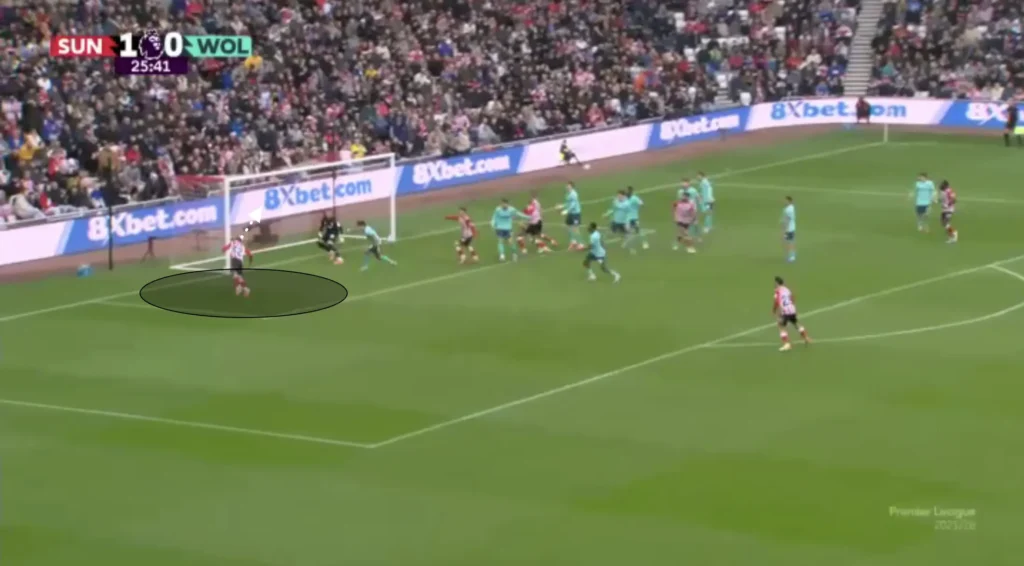
- Free-kicks: Xhaka’s delivery and range allow Sunderland to use deep crossing free-kicks as a territorial tool. These longer deliveries toward a high line of attackers invite second-ball battles in the final third — a deliberate tactic to sustain pressure and generate chaotic, dangerous situations.
Counterattacking Threat
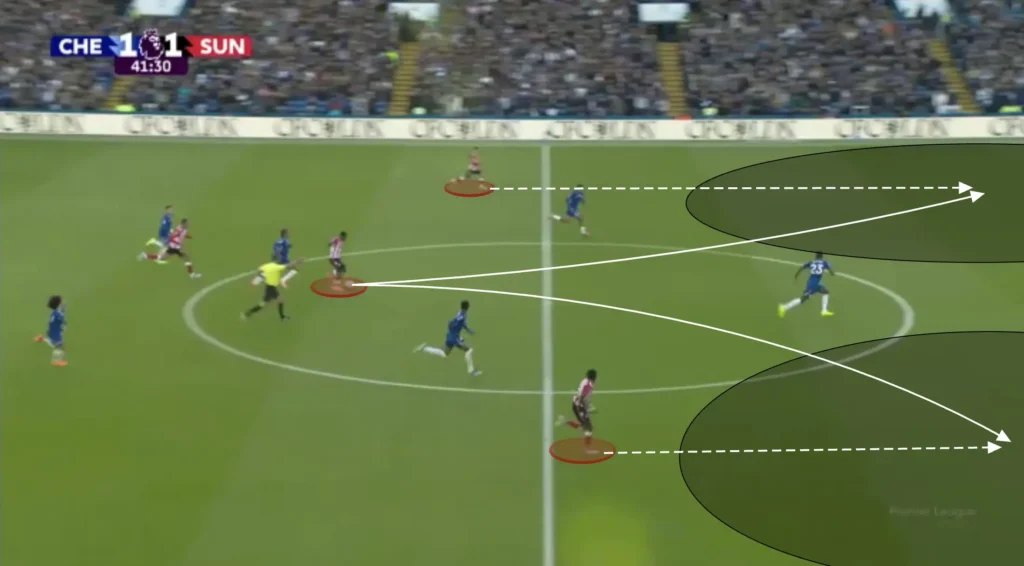
When possession is won, Sunderland transition with speed and intent. Despite defending with numbers deep, they attack vertically through quick forward passes, often exploiting the channels outside the opposition’s center-backs. Their counters may be outnumbered — typically 1v2 or 2v3 — but the precision of their first pass and the directness of their movement make them a constant threat in open space.
Defensive Tactics
High Press
Under Regis Le Bris, Sunderland defend in a structured man-to-man system when pressing high. Each player is responsible for closely marking an opponent, limiting passing options and forcing the opposition into rushed decisions.
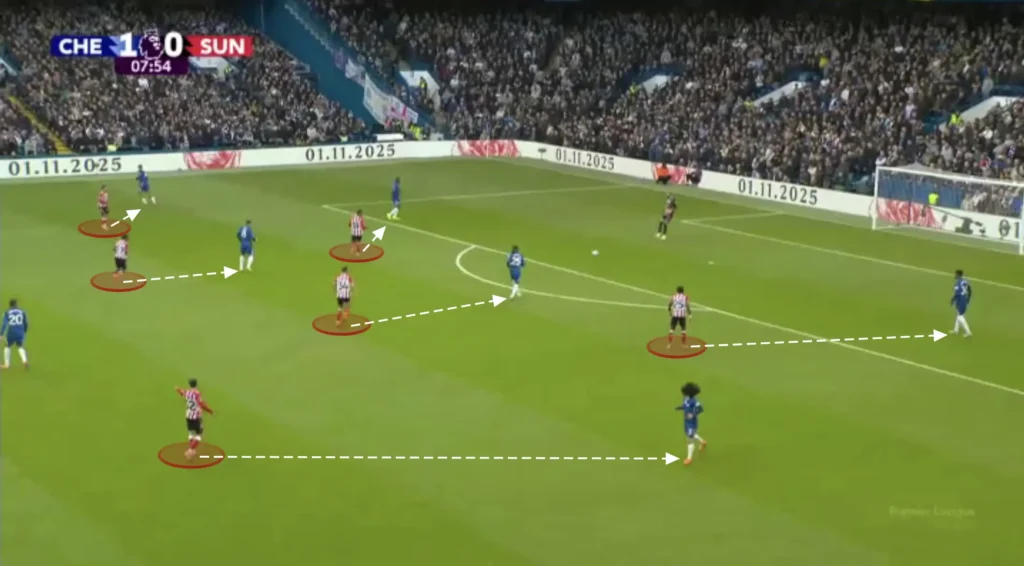
This approach frequently results in turnovers in dangerous areas. However, Sunderland are not an overly aggressive pressing side; they rank 15th in the Premier League for PPDA at 12.95, indicating a moderate intensity. Unlike teams that commit all-out to immediately win the ball, Sunderland’s players maintain their positions, shadowing opponents near the ball to cut passing lanes without overcommitting and leaving themselves vulnerable.
The success of this high press relies heavily on distance management and prioritization. Players marking opponents far from the ball do not follow blindly but instead move inward to help close central spaces, preventing isolated 1v1 duels that could be exploited. Essentially, the closer a player is to the ball, the closer they should be to their opponent.
While effective at constraining opposition movement, the system carries inherent risks: a single misjudged duel or lapse in communication can unbalance the press entirely, leaving large open spaces behind and putting Sunderland’s backline under immediate pressure.
Low Press
In deeper defensive phases, Sunderland have combined man-oriented marking with more compact team shapes. Early in the season, they often used a 4-2-3-1 or 4-2-4 structure in a mid-block, focused on man-marking across the pitch and especially in midfield.
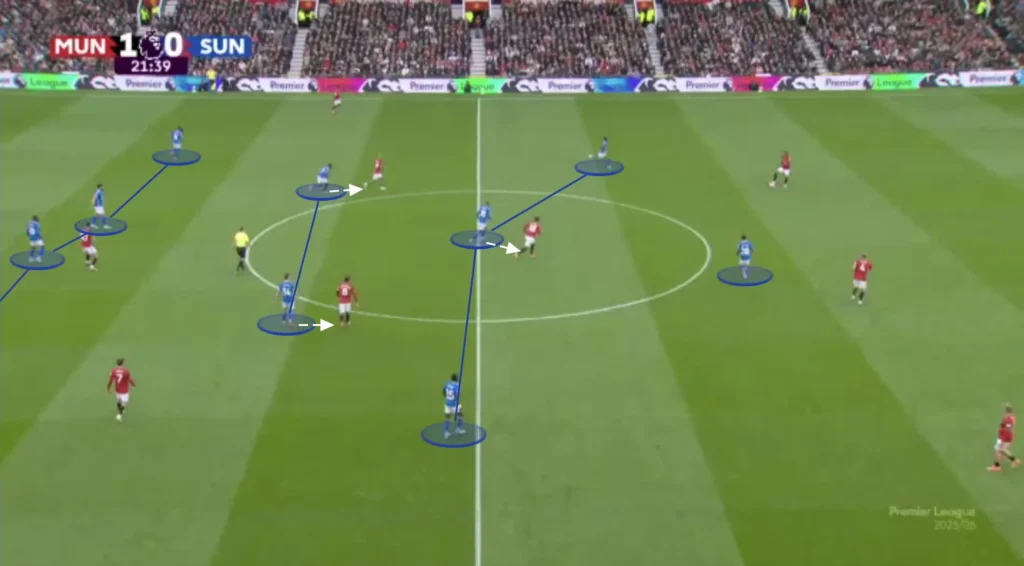
This setup created a 2v1 numerical advantage with the center-backs against the opposition striker, while far-side defenders were loosely marked due to limited threat. The key principles involved close marking, aggressive duels, and collective shifting toward the ball side, reducing options for the ball-carrier and maintaining activity even without possession.
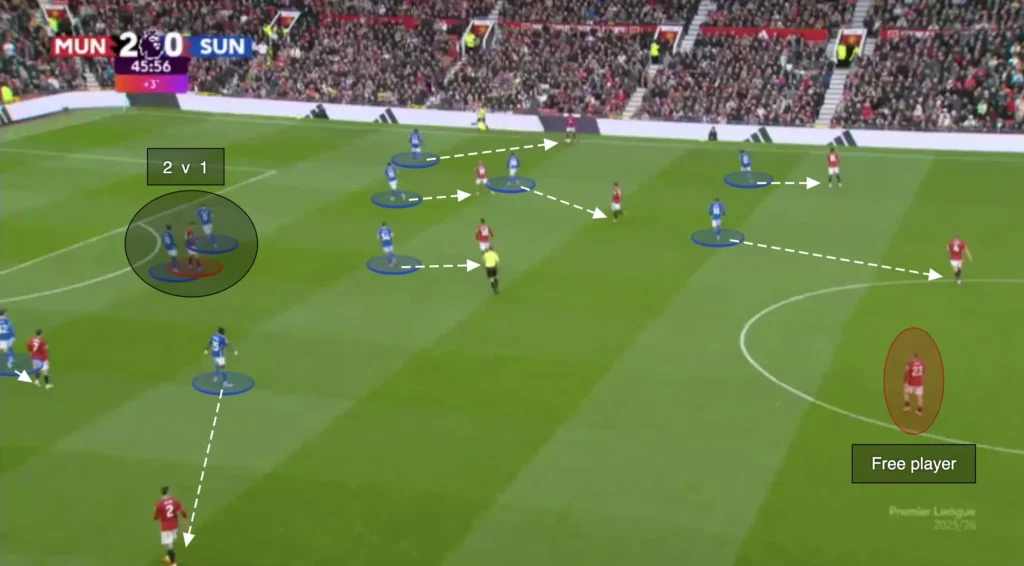
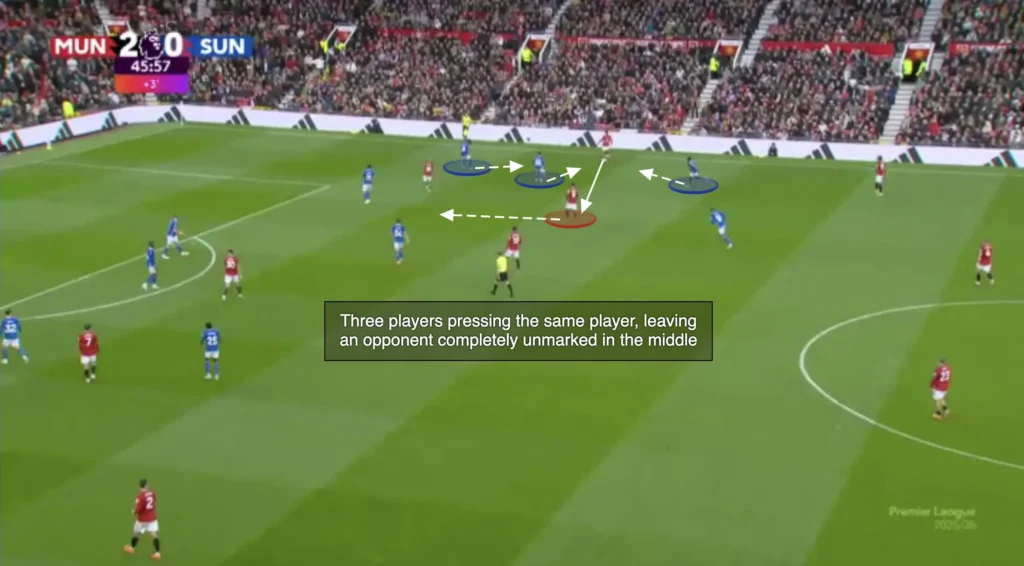
However, this man-oriented approach carried significant risk. If one player overcommitted or followed his mark too far, gaps appeared between the lines that technically capable teams could exploit. Overlaps in marking sometimes left other opponents completely free, creating clear opportunities to break through the defensive unit.
To address these vulnerabilities, Le Bris has recently adapted Sunderland’s low-pressing strategy to a more compact and zonal 5-4-1 low-block structure.
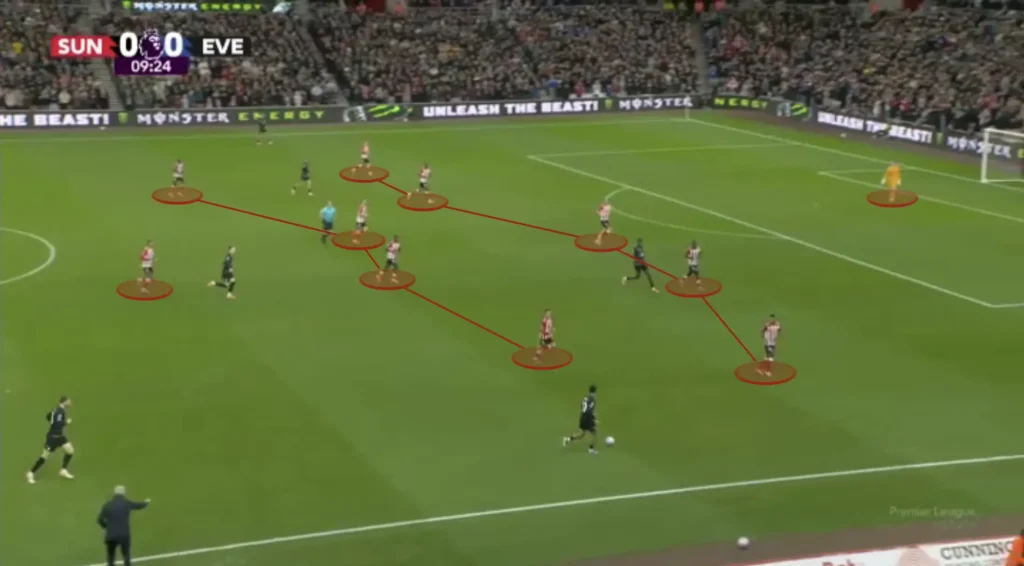
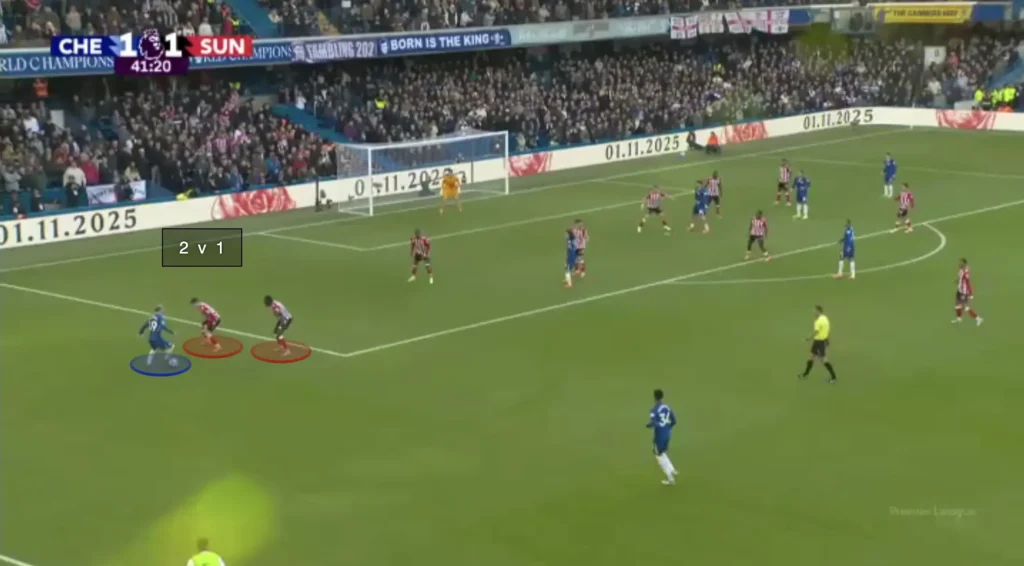
This shape prioritizes central compactness, making it difficult for the opposition to penetrate through the middle while maintaining defensive balance. Wide midfielders drop deeper to support the wing-backs, often creating 2v1 situations against wingers rather than isolated 1v1s.
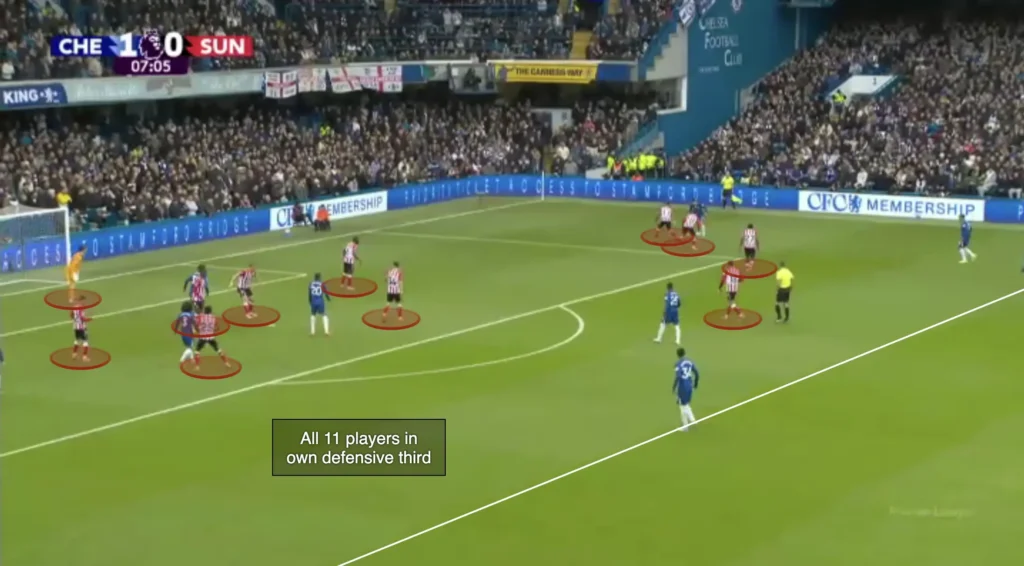
Sunderland’s team defend collectively, with all 11 players frequently positioned in their defensive third, working as a cohesive unit to limit space and force opponents into less threatening channels.
This evolution in defensive strategy has been critical to Sunderland’s success this season. The team currently ranks 3rd in expected goals against (xGA) in the Premier League, allowing only 11.23 xGA over 10 games, highlighting the effectiveness of Le Bris’s compact, disciplined approach.
By blending man-oriented principles with zonal adjustments and collective compactness, Sunderland maintain a defensive identity that balances aggression with control, reducing vulnerabilities while remaining capable of initiating counterpressing and transition plays.
Conclusion
Sunderland’s strong performance this season reflects a side built on defensive solidity and efficient attacking mechanisms. Offensively, they mix patient build-up, third-man combinations, and wide overloads with direct passes behind the defensive line, while key players like Granit Xhaka orchestrate possession, vertical threats, and long-range shooting opportunities. Defensively, the team combines man-oriented pressing with zonal compactness, ensuring they remain difficult to break down.
Their statistical profile reinforces this balance: Sunderland rank 18th in xG, indicating a modest offensive output, but sit 3rd in xGA, showing exceptional defensive efficiency. This disparity highlights a team that excels in structure, positioning, and tactical awareness, allowing them to overperform their expected metrics and secure a place at the top of the table. Maintaining defensive discipline while improving offensive efficiency will be key if Sunderland are to sustain and build on their impressive start to the season.
What do you think — can Sunderland maintain their top-four form, or will the Premier League catch up to them?