
“Control” has become one of the most commonly used — and most misunderstood — concepts in modern football analysis. Teams are often described as being in control simply because they dominate possession, complete a high number of passes, or spend long stretches in the opponent’s half. Yet possession alone does not guarantee control, and many sides with the ball for extended periods still look fragile, reactive, or exposed the moment the game turns chaotic.
In modern football, real control is not about having the ball. It is about dictating what happens next. You see it when a team decides where the game is played, how it develops over time, and which options the opponent is allowed to access. At its core, control is about shaping the match rather than responding to it.
Territory as the Foundation of Control
One of the clearest expressions of control is territorial dominance. Teams that truly control matches consistently force the opponent to defend closer to their own goal, limiting their ability to step out, stretch the pitch, or establish possession higher up the field. This does not require endless circulation for the sake of it, but intelligent occupation of space that keeps the opposition pinned in uncomfortable areas.
You can usually feel this type of control in the flow of the game. Clearances come straight back. Second balls are recovered almost automatically. The opponent struggles to string together any meaningful possession outside their own half. Even when the ball is briefly lost, the match continues in the same zones, gradually wearing down defensive organisation and physical capacity.
This is one of the few moments where data can genuinely support the eye test. Field tilt, which measures the share of possession in the opposition half, often reflects which team is imposing territorial pressure over longer phases. It does not explain how control is achieved, but it does help confirm when one side is consistently pushing the game in the same direction.
Rest-Defence and Structural Security
Territorial pressure only has value if a team feels secure behind the ball. That security comes from rest-defence, the structural organisation maintained while attacking.
Teams that control games attack with clear coverage behind the ball: center-backs positioned high and narrow to compress the pitch, midfielders close enough to react instantly, and clear reference points for counterpressing. When possession is lost, these teams do not drop instinctively. Instead, they step forward, close space aggressively, and deny the opponent clean transition routes.

This is a crucial part of control. When opponents repeatedly fail to counterattack cleanly, they lose their main escape mechanism. Over time, this leads to sustained pressure, territorial dominance, and a growing sense that the match is being played on one team’s terms.
Threatening Depth to Shape Defensive Behaviour
Another important dimension of control comes from how a team threatens the space in behind the defensive line. When attackers consistently make runs beyond the backline, defenders are forced to drop, adjust their positioning, and prioritise protecting depth over stepping out.
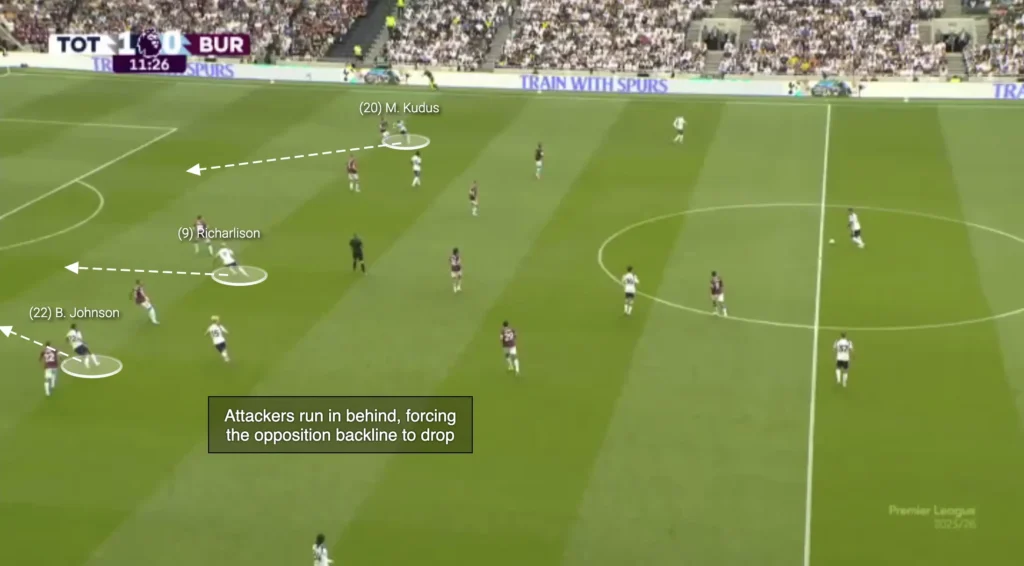
This has knock-on effects. As defenders sink deeper and hesitate to step forward, space opens up naturally in front of the backline. Players operating there gain more time to receive, face forward, and combine.
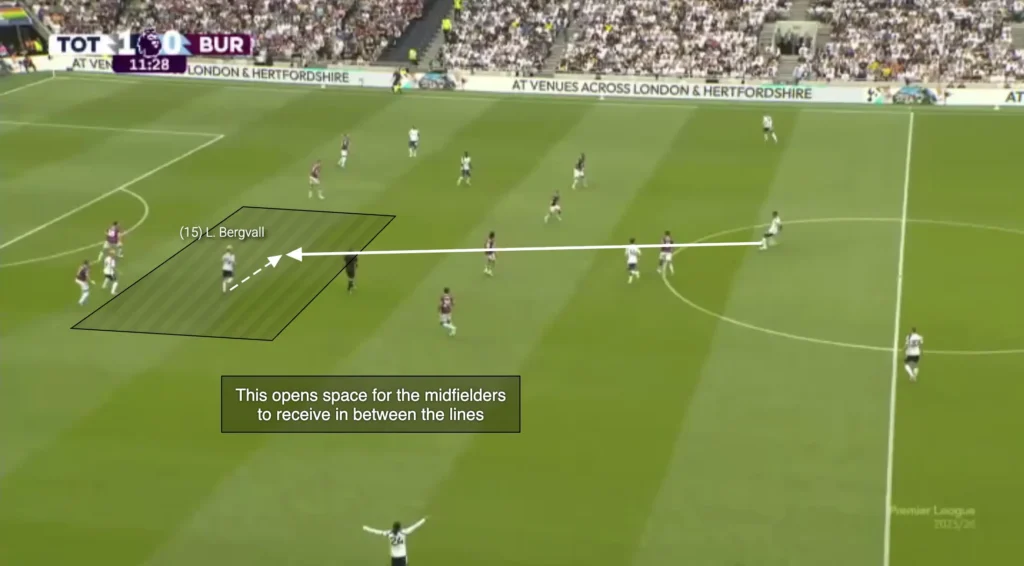
Crucially, the attacking team does not need to play the through ball every time. The possibility of it is enough to dictate how the opponent defends.
This is why control is not about constant penetration. Often, it is about maintaining a credible threat of penetration. By owning depth, a team pins the opposition back, reduces defensive aggression, and allows possession to develop into sustained pressure rather than rushed or forced actions.
Tempo Management and Decision-Making
Another pillar of control is tempo management. Teams that control matches do not play fast or slow by default; they vary tempo deliberately, depending on context.
They accelerate play when an advantage appears and slow it down when structure or stability is required. This relies on collective decision-making rather than individual impulses. Teams that lack control often confuse intensity with effectiveness, forcing actions regardless of the game state. In contrast, teams with control accept recycling possession and wait for the right moment to attack.
By managing tempo intelligently, these teams reduce unnecessary turnovers, protect their structure, and keep the opponent reacting rather than dictating the flow of the game.
Defending as a Means of Control
Control is not limited to attacking phases. In many games, teams reveal their grip on the game most clearly when defending.
Sides that control matches defend compactly, protect central zones, and willingly concede possession in low-value areas. Rather than always chasing the ball aggressively, they focus on maintaining structure, closing key lanes, and denying access to dangerous spaces. This pushes the opponent toward harmless circulation, predictable wide progression, or rushed decisions under pressure.
When pressing, these teams do so with clear intention. Their pressing structures guide the opponent into specific areas, restrict forward options, and force long or low-quality passes. Even without dominating possession, they continue to influence the rhythm and direction of the game.
Just as importantly, they remain calm when forced to defend deeper for short periods. They absorb pressure without losing organisation, regain possession without chaos, and quickly return to imposing territorial pressure. Defensive phases, in this sense, reinforce control rather than interrupt it.
Why Control Accumulates Over Time
Control rarely produces immediate rewards. Instead, it builds gradually. Sustained territorial pressure, repeated recoveries, constant threats, and intelligent tempo management slowly wear opponents down. Distances grow, organisation slips, and mistakes become more frequent.
This is why teams that truly control matches often dominate second halves or score late goals. They do not rely on isolated moments or chaos, but on pressure accumulating until the opponent can no longer maintain discipline.
Conclusion: Control as a Competitive Advantage
In modern football, control is not a stylistic preference but a competitive advantage. It is the ability to dictate space, depth, tempo, transitions, and decision-making across all phases of the game. Possession can support control, but it never defines it.
Statistics can help confirm control — field tilt being a useful example — but they cannot replace tactical understanding. When the eye test and the numbers align, they usually point to the same conclusion: a team that reduces randomness, protects itself structurally, and forces the opponent to play on its terms.
Ultimately, control means making the game predictable for yourself — and uncomfortable for everyone else.
I’m very impressed by the materials here.