
Over the past decade, FC Nordsjælland have become one of the most unique and influential clubs in European football. While they do not operate with the financial power of the traditional Scandinavian giants, their identity, philosophy, and youth development model — built around the Right To Dream project — have positioned them as leaders in producing young talent and creating a clear pathway from academy to professional football. FC Nordsjælland are not only a football club; they are the competitive expression of a much broader developmental mission centered on opportunity, character, and long-term growth.
This article breaks down the foundations of the Right To Dream project, the philosophy behind FCN’s playing model, and how the club has created one of the most coherent development ecosystems in world football.
The Origins of Right To Dream
Right To Dream (RTD) began in Ghana in 1999, founded by Tom Vernon, a former Manchester United scout, with a simple but powerful idea: talent exists everywhere, but opportunity does not. The academy created a holistic environment where young players received:
- Football education
- Formal schooling
- Character development
- International exposure
- Personal support structures
From the start, RTD emphasized that football should be a vehicle for personal transformation, not the endpoint itself. Players were taught to value leadership, responsibility, and discipline as much as passing, pressing, and finishing. Many RTD graduates secured scholarships around the world, while others earned professional contracts, but all left the program with a framework for life beyond football.
The Connection to FC Nordsjælland
In 2015, the Right To Dream group acquired FC Nordsjælland, creating a fully integrated development model that went far beyond a traditional academy-to-club relationship. RTD merged its values, methodology, and long-term vision with FCN’s Scandinavian training environment, producing a club where academy graduates genuinely form the backbone of the first team, young players are consistently trusted in real competition, and a clear tactical identity is taught from the academy upward. The result is a structure in which football education and opportunity are aligned from the earliest stages.
This approach has also shaped a multicultural environment built on shared values and expectations across players and staff. By connecting academies in Ghana, Denmark, and Egypt with scouting networks across multiple continents, FC Nordsjælland have created a global development system that remains cohesive, unified, and remarkably effective despite its international reach.
Football Philosophy: Play with Purpose
FC Nordsjælland’s football identity is built on proactive, positional, and high-intensity principles. Their teams — first team and academy — consistently show the same tactical ideas:
1. Ball Dominance
FCN value structured possession, not for aesthetic reasons, but because controlling the ball creates stability, facilitates development, and allows young players to express themselves with clarity and confidence. Circulation patterns, rotations, zonal occupation, and central progression are taught consistently from youth teams to the senior side.
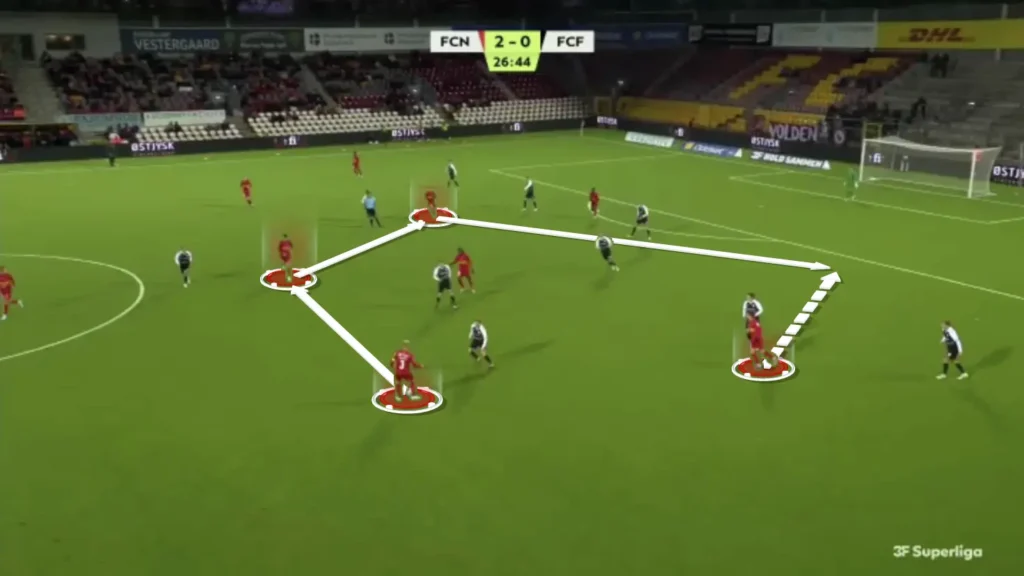
2. Aggressive Pressing
The club emphasizes high pressing, immediate counterpressing, and strong collective reactions. The pressing structure is less about pure physicality and more about synchronized movement, correct distances, and high scanning frequency.
3. Fluidity Between Lines
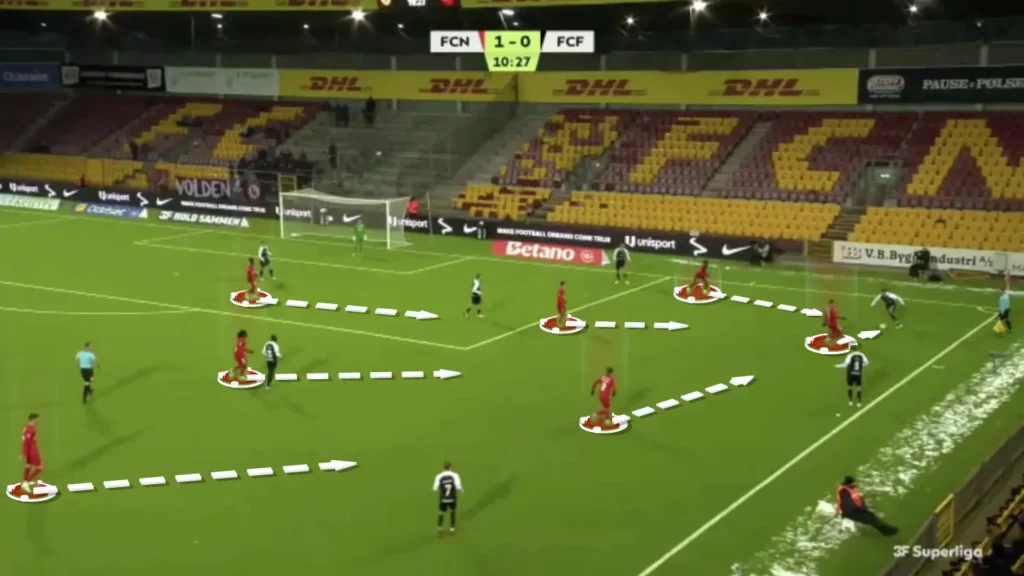
One of FCN’s trademarks is how players move between zones while still respecting positional principles. Wingers drift into half-spaces, midfielders rotate to support progression, and fullbacks step inside to secure possession — creating multiple triangles around the ball and always offering a safe option.
4. High Playing Responsibility
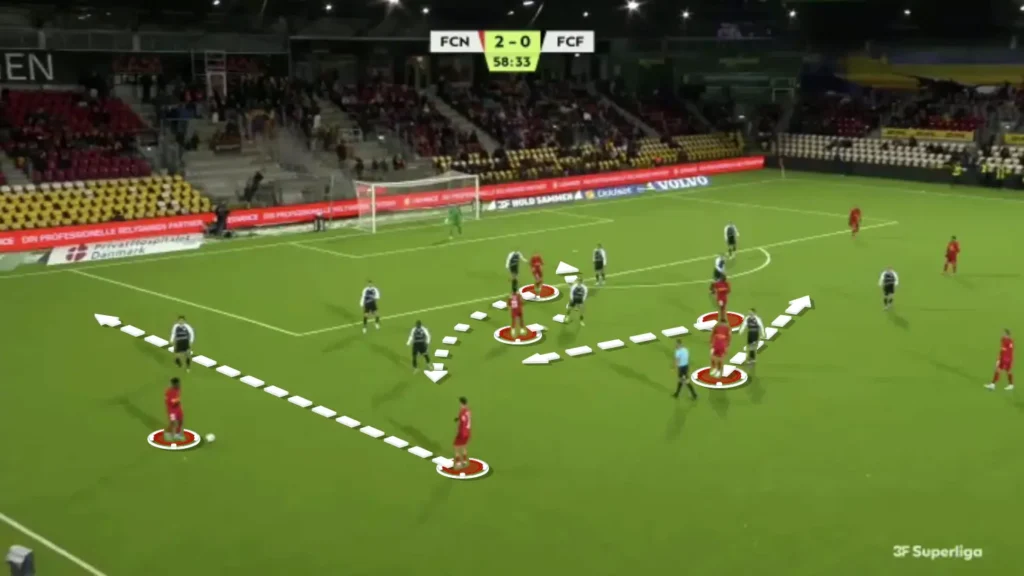
Players must make decisions independently, adjust their position dynamically, and take responsibility both in and out of possession. This leads to teams where 18- and 19-year-olds play with a maturity typically associated with much older squads.
The Importance of Character and Culture
Right To Dream is fundamentally a character-driven project. While many academies focus almost exclusively on football ability, RTD invests equally — and sometimes more — in personal development. This emphasis carries directly into FC Nordsjælland’s environment.
Players are evaluated on:
- Leadership values
- Responsibility
- Resilience
- Integrity
- Community mindset
This creates a dressing room culture that is unusually mature for such a young squad.
A Global but Unified Club
Despite bringing players together from different continents, FC Nordsjælland maintain a strong sense of internal cohesion thanks to clear and consistent structures. All age groups work with the same tactical principles, staff regularly move between academy and first team to preserve alignment, and Right To Dream graduates from different countries arrive with the same foundational values.
The pathways between the academies — from Ghana to Denmark and then further into Europe — are well established, giving young players a transparent and realistic route through the system. FCN benefit from being small enough to remain connected and agile in their daily work, yet large enough to operate a sophisticated multi-academy development network without losing their shared identity.
Preparing Players for the Next Step
FC Nordsjælland are also known for producing players who transition seamlessly to higher levels. Their graduates are technically refined, tactically educated, and comfortable with responsibility — qualities that translate well into stronger leagues. Clubs trust FCN-trained players because they arrive with:
- Strong build-up fundamentals
- Knowledge of pressing triggers
- Familiarity with structured positional play
- High decision-making frequency
- Maturity in possession
This reputation attracts both talent and transfer interest, reinforcing the sustainability of the model.
Final Thoughts: Why FC Nordsjælland Matter
FC Nordsjælland and the Right To Dream project represent a rare and valuable model in modern football — one where long-term development, character, and identity outweigh short-term results. They operate not only as a competitive team, but as an institution built to transform people, broaden opportunities, and provide a pathway that extends far beyond the pitch.
Their success challenges long-held assumptions within youth development, proving that young players can carry responsibility, that values and culture truly matter, that a global network can remain unified, and that a clear tactical identity from academy to first team accelerates learning. Above all, FCN show that investing in education, character, and purpose creates a sustainable football ecosystem. In a sport often driven by immediate outcomes, they stand out as a club fully committed to long-term growth — on the pitch and beyond.
All images and visuals in this article are made with Once Sport — a powerful and easy-to-use tactical analysis platform. It helps you annotate clips, visualize movements, and create professional analysis videos. Readers of The Football Analyst get 10% off plus one month free with the code TFA10 at checkout.