
Mjällby AIF are on the verge of completing one of the most extraordinary seasons in Swedish football history. From the small fishing village of Hällevik, with fewer than 1,000 inhabitants, they now sit eight points clear at the top of Allsvenskan with just eight games remaining.
This is not a story of financial muscle or marquee signings. It is a story of structure, clarity, and a team built with purpose. For coaches, scouts, and analysts, Mjällby offer a perfect case study in how tactical discipline and smart recruitment can close the gap to bigger clubs.
This article examines the key tactical principles that have powered Mjällby’s rise — from their defensive solidity to their fluid attacking structure — and why they are on course to lift the league title.
Background: From Survival to Title Race
Mjällby AIF’s journey to the top of Swedish football has been anything but straightforward. The club has historically been a yo-yo team, bouncing between divisions and frequently fighting for survival. In 2016, they were even relegated to the third tier and faced a serious risk of financial collapse. The turnaround has been gradual and deliberate, driven by a mix of local dedication and clever decision-making behind the scenes.
Sporting director Hasse Larsson, a club legend who has been involved with Mjällby since the late 1970s, played a key role in rebuilding the team’s structure. Working without pay for several years, he helped stabilize the finances and laid the foundation for a sustainable future. When Anders Torstensson returned as head coach, he brought with him a mix of old-school mentality and modern tactical ideas.
Unlike many fairytale stories in football, Mjällby’s success is not the result of a wealthy owner or a one-off golden generation. Instead, it is a product of alignment between leadership, recruitment, and coaching. The squad is a blend of loyal club servants like captain Jesper Gustavsson and shrewdly scouted players such as Abdullah Iqbal and Elliot Stroud, who were brought in from less conventional markets.
Now, with just 8 games left in the season, Mjällby find themselves leading Allsvenskan — a position that seemed unthinkable only a few years ago. What makes this rise so compelling is that it has been achieved through a clear and consistent game model that has allowed them to compete toe-to-toe with Sweden’s elite clubs.
Base Formation: 3-4-3 as the Starting Point
Mjällby AIF’s tactical system is built around a 3-4-3 base formation.
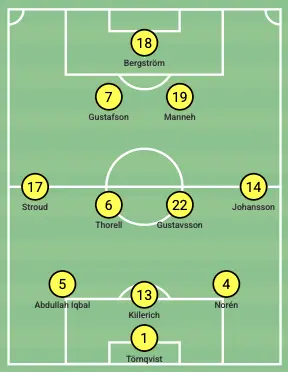
This structure provides balance and flexibility, allowing them to shift smoothly between attacking and defensive phases. The three center-backs give them defensive security and license for the wing-backs to push high, while the double-pivot midfield offers control and support in build-up.
Mjällby AIF’s Offensive Tactics
Mjällby’s offensive identity is one of the key reasons behind their unexpected title charge. Their attacking play is built on compactness, fluidity, and intelligent occupation of space, allowing them to break down opponents in multiple ways. Below is a detailed look at how they construct attacks and create chances.
Low Build-Up: Creating Security and Options
In their low build-up phase, Mjällby often rotate into a 4-2-2-3 structure. The goalkeeper steps higher, forming a back four and allowing the wing-backs to push forward to join the striker. The two holding midfielders and two attacking midfielders start centrally to create numerical superiority in the middle of the pitch.

Mjällby use short passes, third-man combinations, and constant player rotations to progress the ball. Midfielders may drop into wide areas to receive under less pressure, giving the team more flexibility and forcing the opposition to shift defensively.
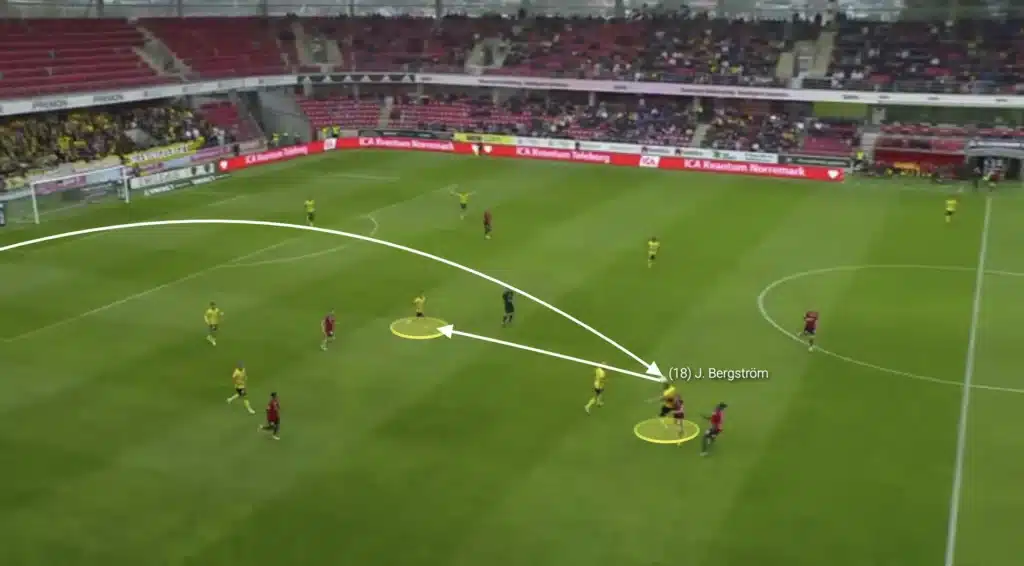
That said, Mjällby are not dogmatic. If the opposition’s press is too aggressive, they are happy to play direct — targeting Jacob Bergström, their physical striker, with a long ball. Bergström’s ability to hold up play and bring midfield runners into the game adds a valuable variation to their attack, ensuring they are not predictable.
High Build-Up: Compact and Controlled
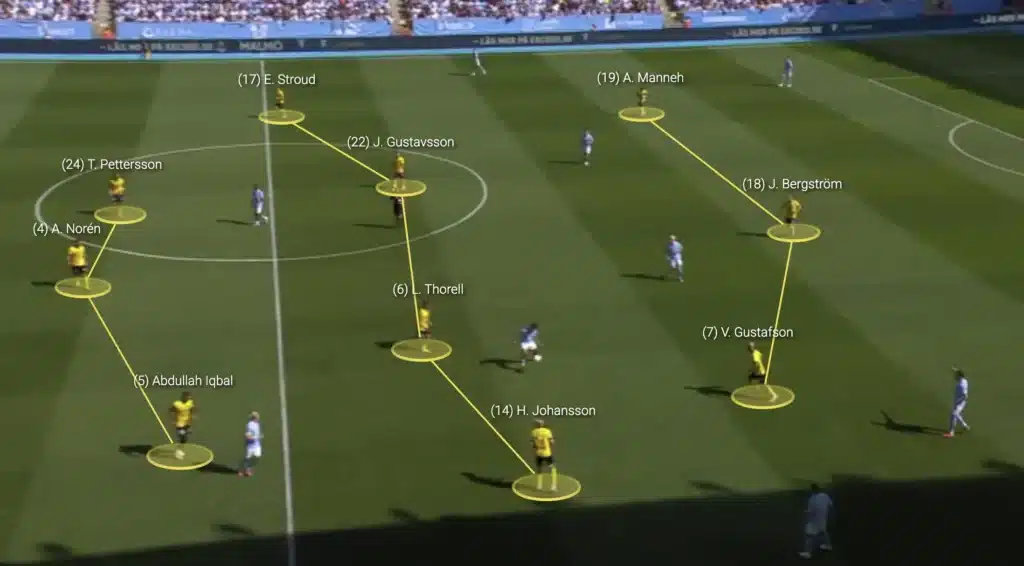
When they advance into the middle third, Mjällby push their wing-backs even higher, transforming into a 3-2-5 shape. This creates width and depth simultaneously, stretching the opponent’s defensive line while maintaining control of central areas.
Their attacking shape is extremely compact, with short distances between players.

This serves multiple purposes:
- Faster ball circulation – shorter passing lanes reduce time on the ball and accelerate tempo.
- Security in possession – if they lose the ball, they are well-positioned to immediately counterpress.
- Rest-defence stability – the high backline keeps the team connected, preventing counterattacks from becoming dangerous.
This compactness makes it very difficult for opponents to step forward or disrupt their rhythm, as any pressing action can quickly be bypassed with a quick passing combination.
Central Overloads and Positional Fluidity
Mjällby’s goal in possession is to progress the ball through the center whenever possible. They do this with quick, sharp passes between midfielders and forwards, breaking the opposition’s lines and exploiting gaps. Because of their compact shape, they can use one-touch combinations to advance the ball rapidly and destabilize the opposition block.
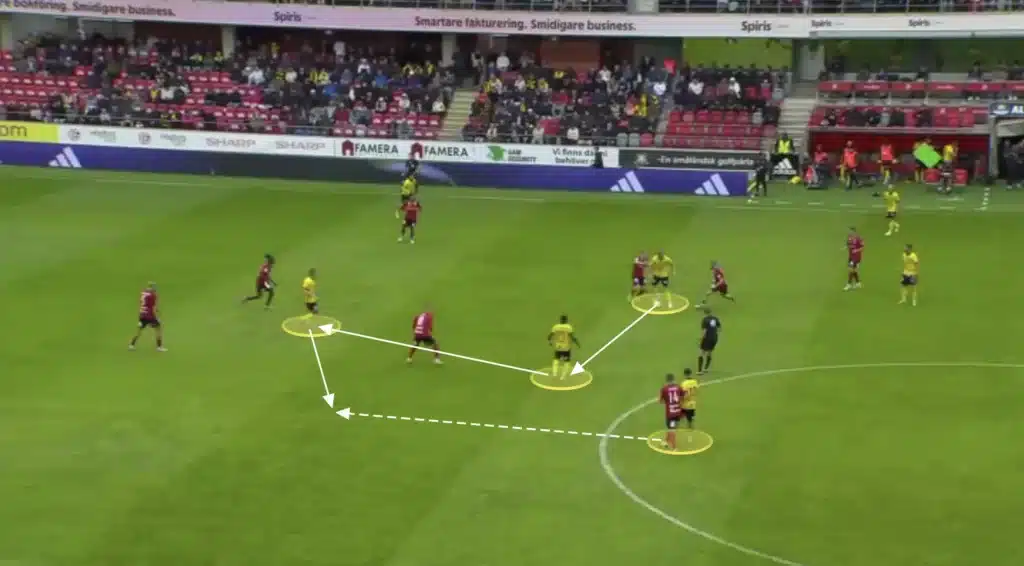
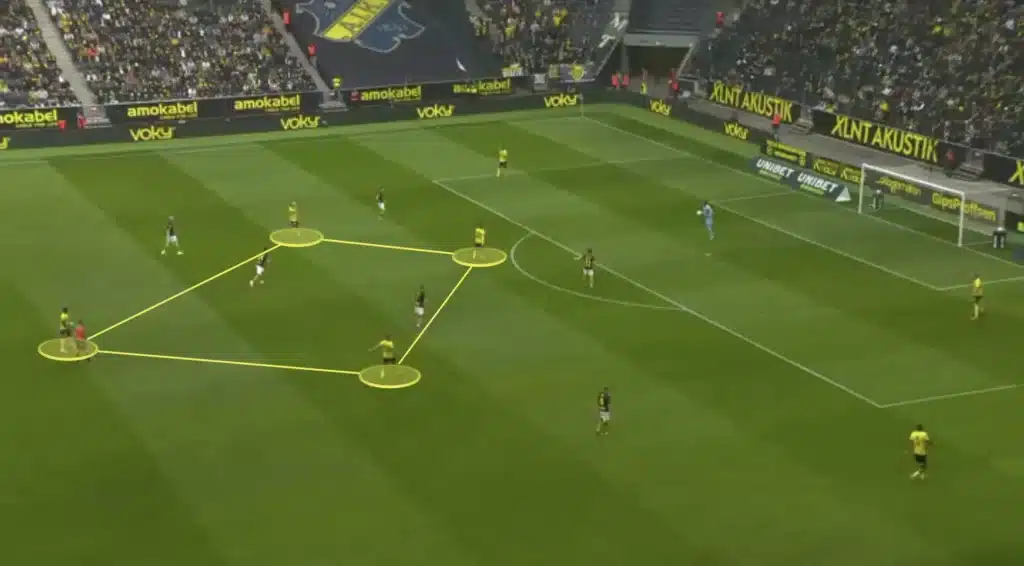
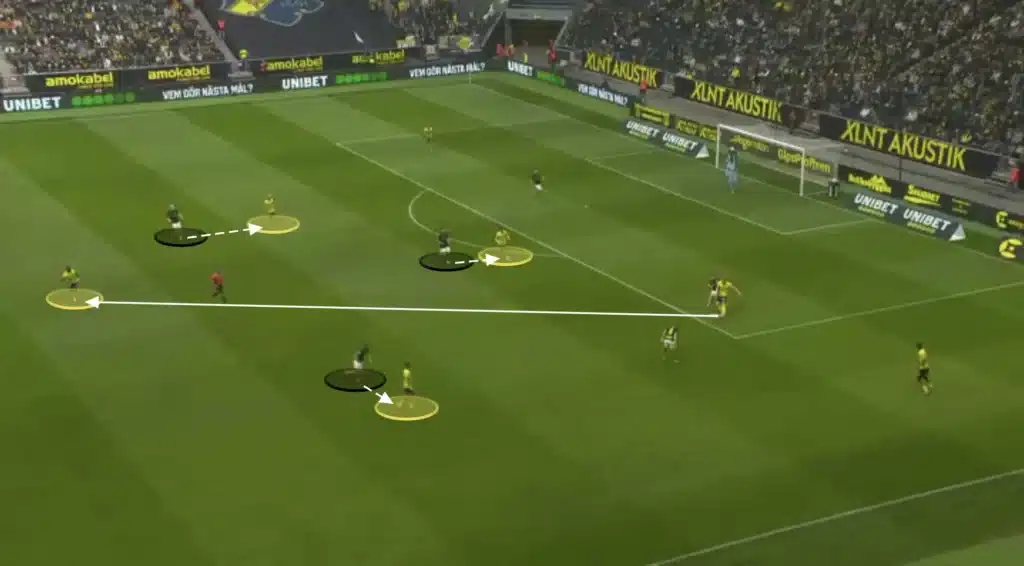
Another defining feature of Mjällby’s attack is their positional fluidity. The four central midfielders frequently interchange between box and diamond shapes depending on the opponent’s defensive structure. This constant movement creates confusion for markers and opens new passing lanes.
In this situation, for example, Mjällby play against a team with an aggressive three-man midfield that tries to man-mark their midfielders. They, therefore, shift from a box shape to a diamond shape and spread out to free up space for the attacking midfielder to receive a pass behind the opposition midfielders.
Finding the Pockets
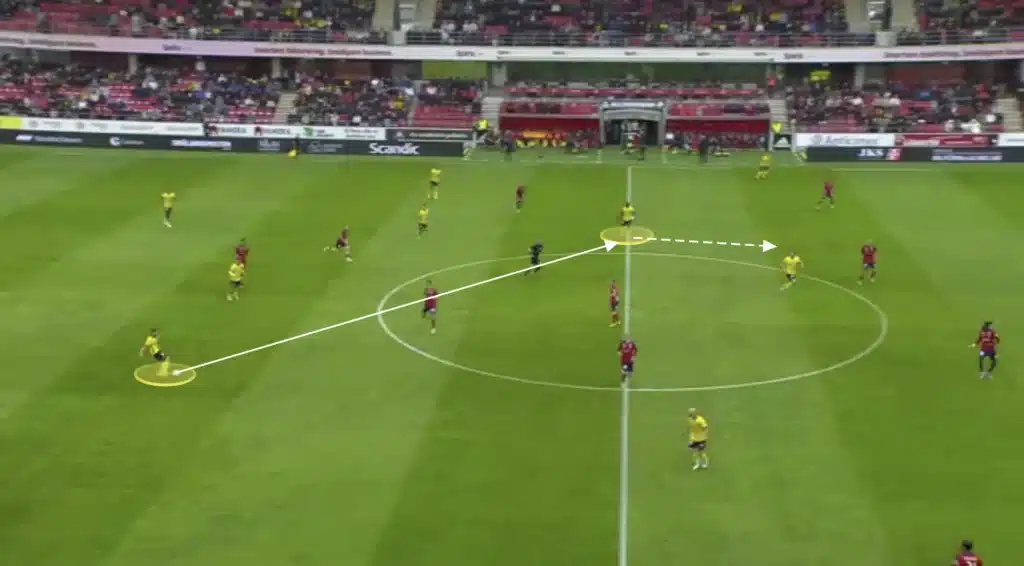
Mjällby’s attacking midfielders excel at receiving the ball in the pockets — the spaces between the opponent’s midfield and defensive lines. Once the ball reaches these zones, they can turn, drive forward, or play incisive passes to advancing runners.

Diagonal passing plays a key role in this process. By playing diagonal balls from deeper zones into the pockets, Mjällby force the opponent’s midfield and backline to adjust diagonally, which often disorganizes their defensive shape. A well-timed diagonal pass not only bypasses one or more defenders but also sets up forward-facing receivers who can immediately accelerate the attack.
Accelerating After Finding the Pocket
Once Mjällby successfully find an attacking midfielder in the pocket, the tempo changes immediately. These players are coached to turn quickly and look forward, triggering a wave of coordinated movement around them. The striker pins the opposition’s center-backs, while the wing-backs and opposite midfielder make aggressive forward runs to attack the space behind the backline.
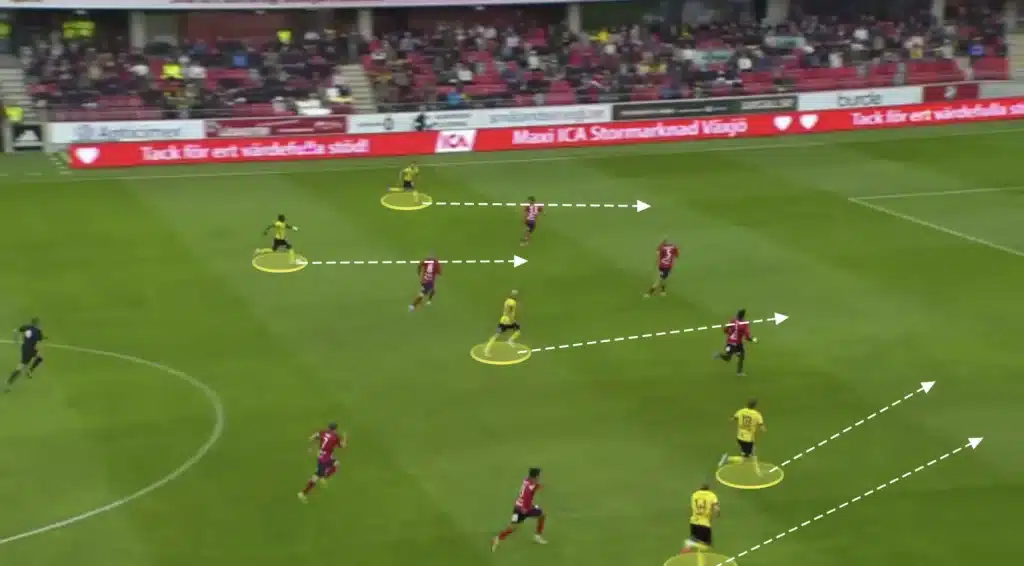
This rapid shift from controlled circulation to vertical penetration catches many opponents off guard. By flooding the last line with runners, Mjällby force defenders to make quick decisions — step forward to press the ball carrier or track the runners in behind. Either choice opens space, which Mjällby exploit with incisive passes or dribbles.
Wing-Backs as a Key Weapon
Mällby’s wing-backs, Elliot Stroud and Herman Johansson, are crucial to Mjällby’s ability to stretch the pitch. Both are strong, fast, and capable of covering the entire flank on their own. In addition to providing width, they frequently make penetrative runs behind the defensive line towards the center, giving Mjällby a direct route forward when needed.
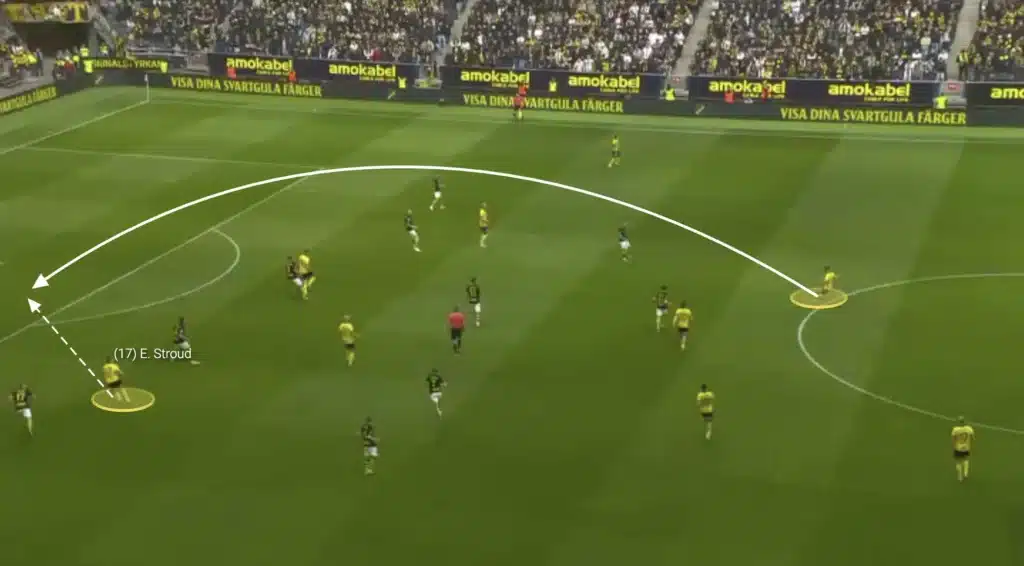
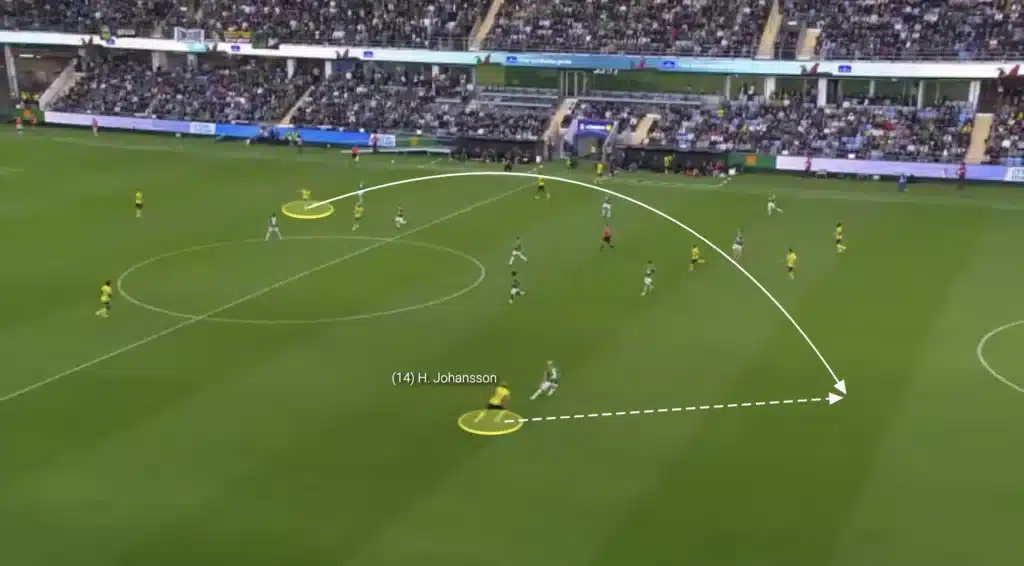
When Mjällby use their diagonal progression to lure opponents inside, the wing-backs are often left free in wide areas, allowing them to receive long, lofted passes or through balls in advanced positions.
Final Third Play: Overloads and Chaos
Once in the attacking third, Mjällby look to flood the box. The midfielders and forwards time their runs aggressively, often committing three or four players into scoring positions. This approach creates numerical overloads that defenders struggle to deal with, increasing the likelihood of winning second balls and connecting with crosses.

Mjällby’s wing-backs are frequent goal threats, especially at the back post. Because opposition fullbacks are often drawn inside to track attacking midfielders, space opens up for the wing-back to attack unmarked. Even if the first cross is not met, the wing-back is in position to finish rebounds or pick up loose balls.
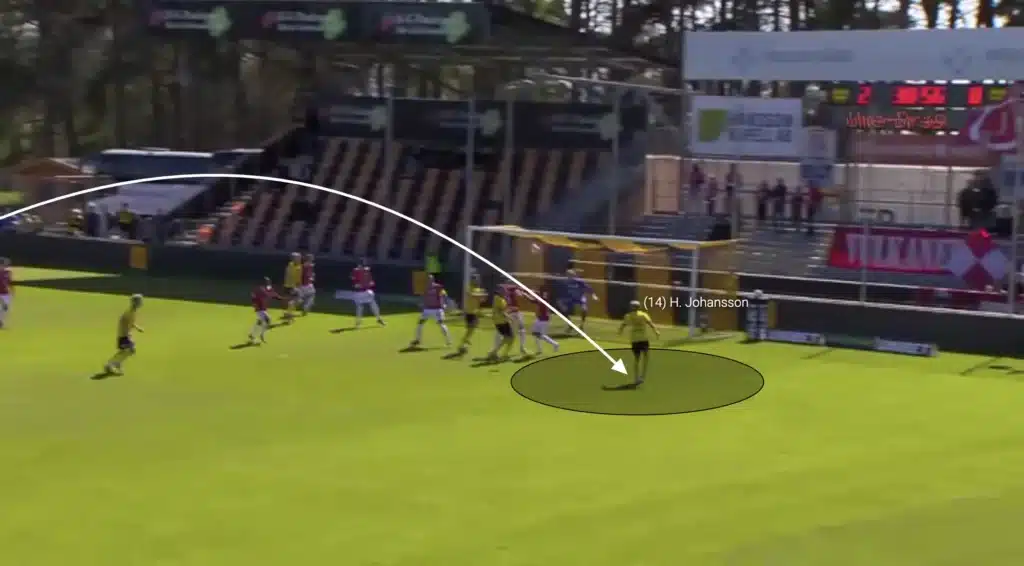
The combination of aggressive box occupation, quick diagonal deliveries, and wing-back runs makes Mjällby dangerous from both structured attacks and broken play.
Mjällby AIF’s Defensive Tactics
While their offensive compactness is crucial, Mjällby’s success is equally built on their ability to defend as a collective unit. Under Anders Torstensson, Mjällby are intensely aggressive without the ball, blending a high-energy press with a well-drilled mid-or low-block. Their defensive approach is proactive, not reactive — they defend to regain possession and turn it into immediate attacking opportunities.
High Press: Defending to Attack
Mjällby’s pressing game is one of the most aggressive in Sweden. Torstensson typically instructs his team to go man-to-man across the pitch, ensuring every opposition player is under constant pressure. This type of pressing denies the opponent easy passing options and forces them into rushed decisions, often leading to turnovers in dangerous areas.
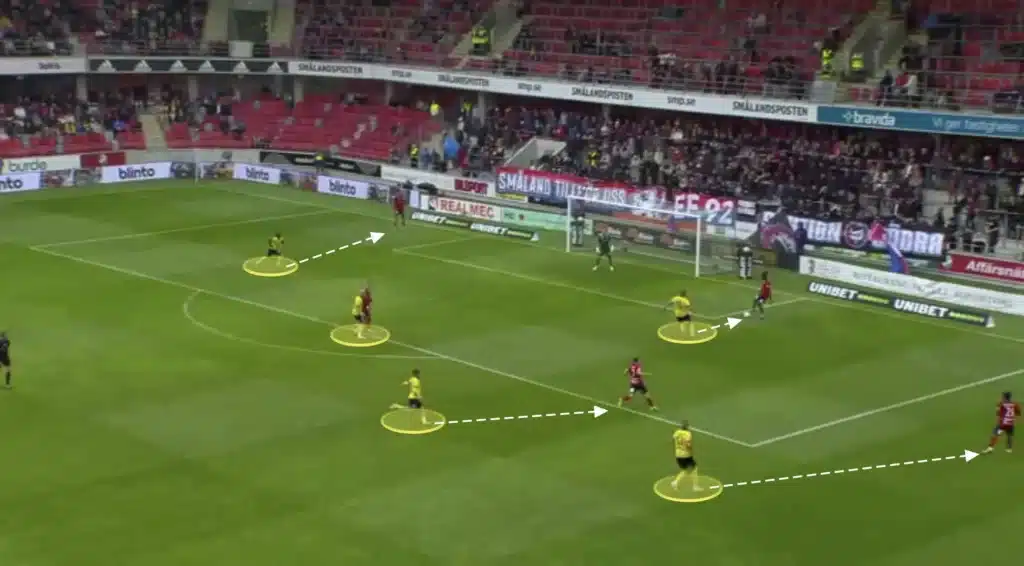
What makes Mjällby’s high press so effective is its attacking mindset. The moment they win the ball, they transition rapidly, looking to exploit open spaces — particularly on the far side, where the opponent is often unbalanced from their own build-up. Many of Mjällby’s goals have come from winning possession high and immediately creating a chance before the opponent can reorganize.

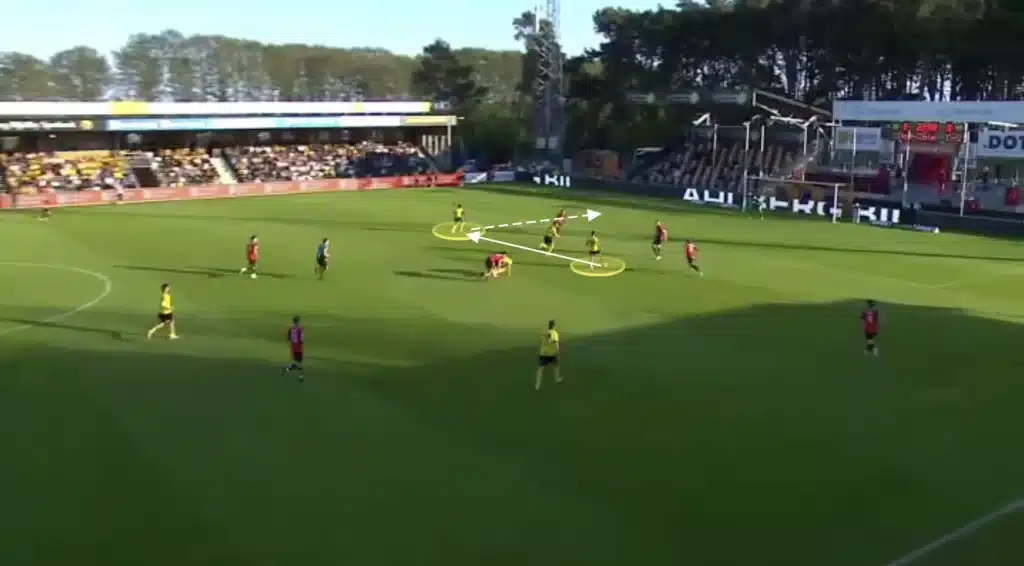
This approach is risky but calculated. Because of their compact structure in possession, they are already well-positioned to collapse on the ball when it is lost, making the press both efficient and difficult to bypass.
Mid-Block and Low Press: 5-2-3 Stability
When the high press is bypassed, Mjällby retreat into a compact 5-2-3 mid-or low-block. This structure is designed to deny space in central areas, funneling the opponent’s attacks toward the wings where they are less threatening.

The front three play a crucial role here — they stay narrow and block central passing lanes, while the two central midfielders sit just behind them to cover any gaps. This layered structure forces the opposition to play around rather than through Mjällby, slowing down their attacks and allowing the team to stay organized.

Aggressive Wide Center-Backs
One of Mjällby’s most distinctive defensive traits is the aggressiveness of their wide center-backs. Whenever an opposition midfielder receives the ball between the lines, the nearest wide center-back is quick to step out and close them down, preventing them from turning and progressing play, and often actually winning the ball.
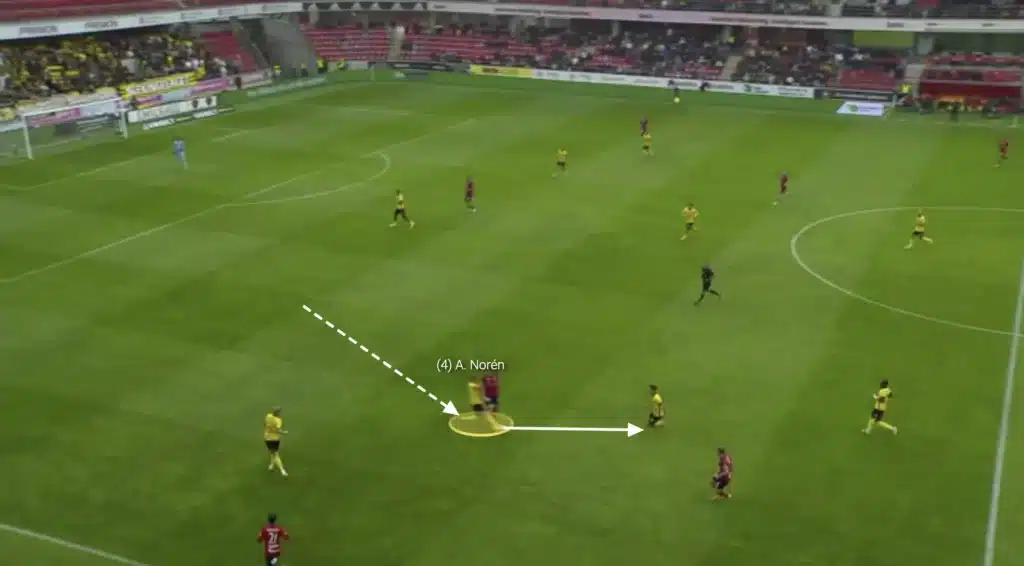
This aggressive stepping out can leave space behind, but Mjällby’s backline is excellent at reacting to this. When a center-back pushes forward, the rest of the defense slides across, momentarily forming a back four to cover the vacated space. This coordinated movement allows Mjällby to defend proactively without being exposed.
Squeezing the Pitch
Another key element of Mjällby’s defensive system is their constant effort to squeeze the pitch. Whenever the opposition plays a slow sideways pass or a back pass, Mjällby’s first pressing line steps higher, with the midfield and backline following in unison.

This step-by-step pressing approach gradually pushes the opponent further away from Mjällby’s goal, making it harder to create quality chances. It also increases the likelihood of winning the ball in advanced areas, effectively turning defense into a platform for attack.
Defensive Mentality and Discipline
Perhaps most importantly, Mjällby’s players buy into this defensive approach completely. They work tirelessly off the ball, maintain short distances between lines, and communicate constantly to stay organized. This level of discipline is crucial for a team that plays such an aggressive, man-oriented defensive style.
Conclusion: Why Mjällby AIF’s Tactical Model Works
Mjällby AIF’s rise to the top of Allsvenskan is no accident. It is the product of a clear, cohesive tactical identity executed to near perfection.
Offensively, their compact shape, smart rotations, and constant search for space allow them to progress the ball with purpose. They can build patiently through short passing or hit Jacob Bergström early and play off his hold-up play. This flexibility makes them unpredictable and hard to stop.
Defensively, their man-to-man press, aggressive center-backs, and compact defensive block suffocate opponents. They don’t just defend – they turn defense into attack, winning the ball high and punishing opponents before they can reset.
The key is compactness, intensity, and discipline. Players stay close together, step up aggressively, and flood the box with late runs. Every action follows a clear principle.
Mjällby are now eight points clear with eight matches to go. This feels less like a fairytale and more like the natural result of a team that knows exactly what it wants to do. They have shown that a small club with the right tactical approach can outthink and outfight bigger opponents. Whatever happens next, their 2025 campaign is already a masterclass in how strategy and collective work can drive a team to historic heights.