
Xabi Alonso’s first full season at the helm of Real Madrid has been marked by both promise and frustration. The Spanish tactician arrived with the intention of modernising Los Blancos’ approach, embedding his philosophy of structured pressing, vertical progression, and collective compactness.
The 2025/26 campaign has already highlighted the gap between his tactical ideals and the squad’s current execution. Against deep defensive blocks, Madrid continue to struggle, their reliance on moments of brilliance from individuals such as Kylian Mbappé and Vinícius Júnior masking systemic inefficiencies.
The Atlético Madrid clash offered a harsh reminder: despite going ahead through sheer individual quality, Alonso’s side were ultimately outplayed, unable to generate consistent attacking patterns or adapt to Simeone’s rigid defensive structure.
Coupled with the humbling defeat to Paris Saint-Germain at the Club World Cup earlier in the season, it is clear that while Alonso is attempting to instil a new identity, Real Madrid remain a side in tactical transition, searching for cohesion in the biggest matches.
Real Madrid’s Evolving Defensive Identity and High Turnovers under Xabi Alonso
One of the clearest tactical imprints Xabi Alonso has attempted to bring into this Real Madrid side is the refinement of their defensive structure through pressing and control of turnovers. Unlike previous seasons, when Madrid’s defensive reactions without the ball were often inconsistent and reactive, this campaign has already seen a noticeable shift.
Alonso has encouraged his players to adopt a more collective approach, pressing higher and with greater intent, ensuring that their defensive line is supported by a rest-defence that settles before attacks develop. This has reduced the volume of counter-attacks they face, forcing opponents to play longer, riskier passes rather than exploiting Madrid in transition.
Crucially, Madrid are no longer just neutralising danger, they are creating it. Their ability to convert high turnovers into meaningful attacking sequences has become a recurring theme, with an increasing number of shots now arriving from these moments. For Alonso, defending with the ball and defending through pressure are not separate concepts but part of the same philosophy, one that is beginning to reshape Madrid’s identity this season.
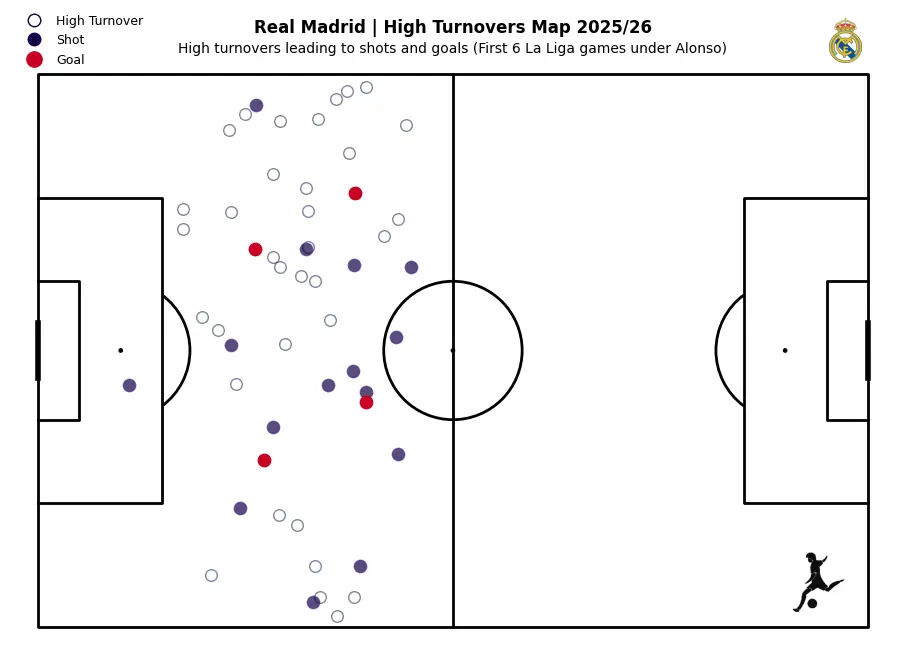
As shown in the graphic, Real Madrid have produced 53 high turnovers this season, 15 of which ended in shots and four resulting in goals. These numbers underline Alonso’s tactical emphasis: Madrid are no longer passive without the ball but actively turning defensive pressure into direct attacking opportunities.
Real Madrid’s Build-Up Dynamics under Alonso
One of the most distinctive patterns in Real Madrid’s build-up under Xabi Alonso this season has been the consistent use of the number six dropping between the centre-backs. This structural adjustment appears both in the first phase of play and during progression into midfield, creating a temporary back three that stretches the opposition’s pressing shape.
By positioning himself deeper, the holding midfielder attracts an opposing midfielder, pulling him away from his zone and destabilising the central block. Simultaneously, the winger drifts inside towards the second third, but positions himself wide enough to force the defending side into difficult decisions. If the opponent closes the passing lane to the winger, they inevitably leave space in central areas. Conversely, if they follow the dropping six, it opens up the half-spaces where Kylian Mbappé often thrives.
This dynamic was evident in a number of matches, particularly when Aurélien Tchouaméni slotted between the centre-backs to initiate build-up.
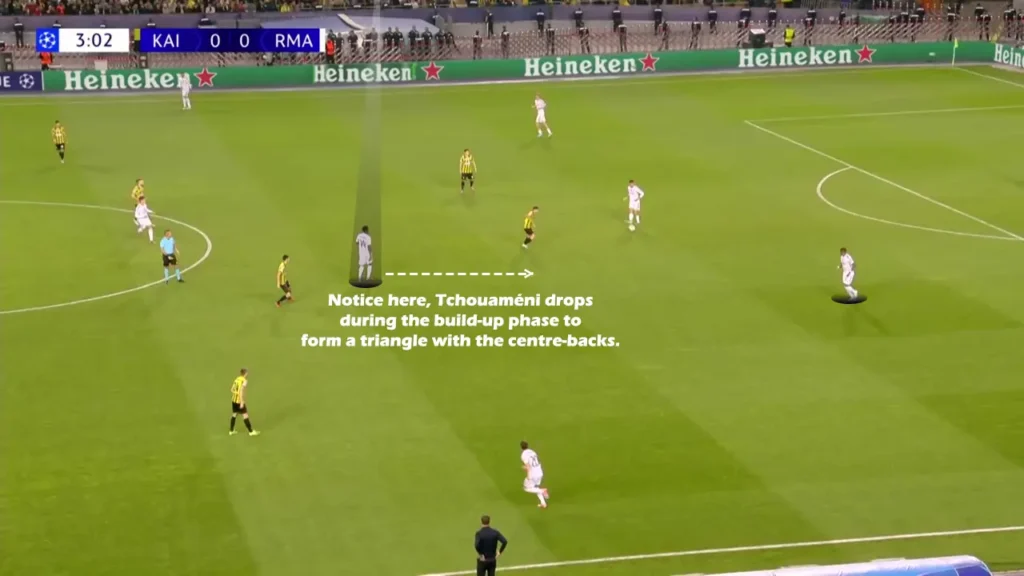
Vinícius Júnior, moving into the central midfield zone, expanded the pitch’s width while still offering an option inside.
Meanwhile, Federico Valverde pushed higher, engaging the full-back and further unsettling the defensive shape. The result was a clever manipulation of the opposition’s midfield line, forcing them to either step out to press or remain passive, both scenarios leaving exploitable gaps.
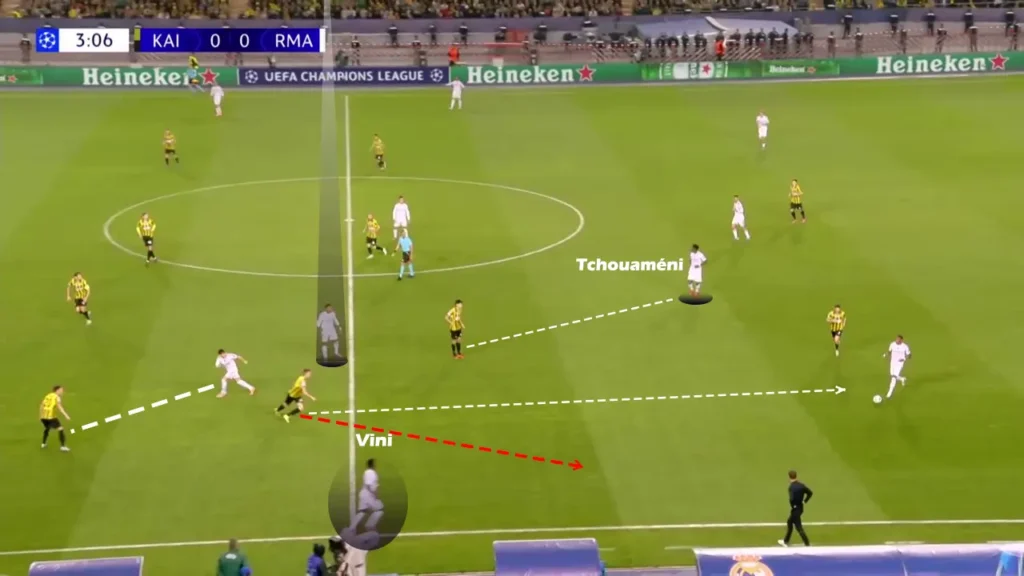
This exact mechanism created the pocket of space that Mbappé exploited, receiving in advanced central areas and driving the team into the final third.
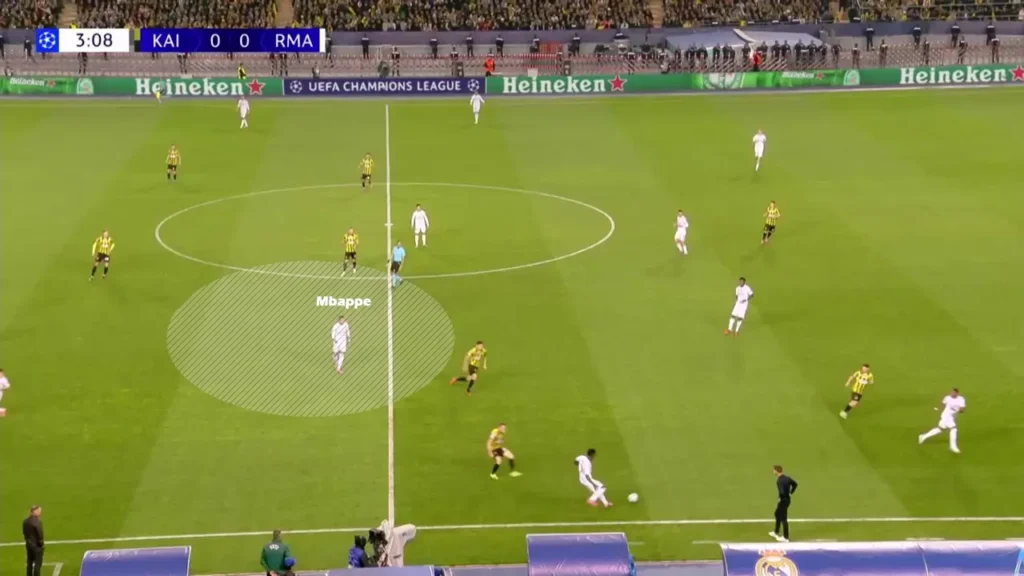
Ultimately, this illustrates Alonso’s wider philosophy: using positional rotations not just to retain possession but to actively provoke and dismantle opposition structures, giving Madrid a controlled yet dangerous route into attack.
Exploiting Space through the Third-Man Run: Alonso’s Offensive Mechanism
One of the most notable attacking mechanisms introduced by Xabi Alonso at Real Madrid this season has been the consistent use of the third-man run as a way to destabilise compact defensive blocks.
The principle is simple but tactically invaluable: instead of relying solely on direct passing combinations between two players, the involvement of a third runner adds a dynamic layer that forces defenders into uncomfortable decisions.
This mechanism allows Madrid to progress the ball more fluidly, find free men in advanced areas, and transform seemingly static phases of possession into threatening attacking moments. Its importance lies in how it creates access to zones that would otherwise remain closed, especially against disciplined defensive units.
A clear example came in the high-scoring Madrid derby, where Atlético emerged 5–2 winners, but Alonso’s side still displayed their intent to use this concept. Dani Carvajal played into Federico Valverde in the right half-space, before immediately starting his forward run.
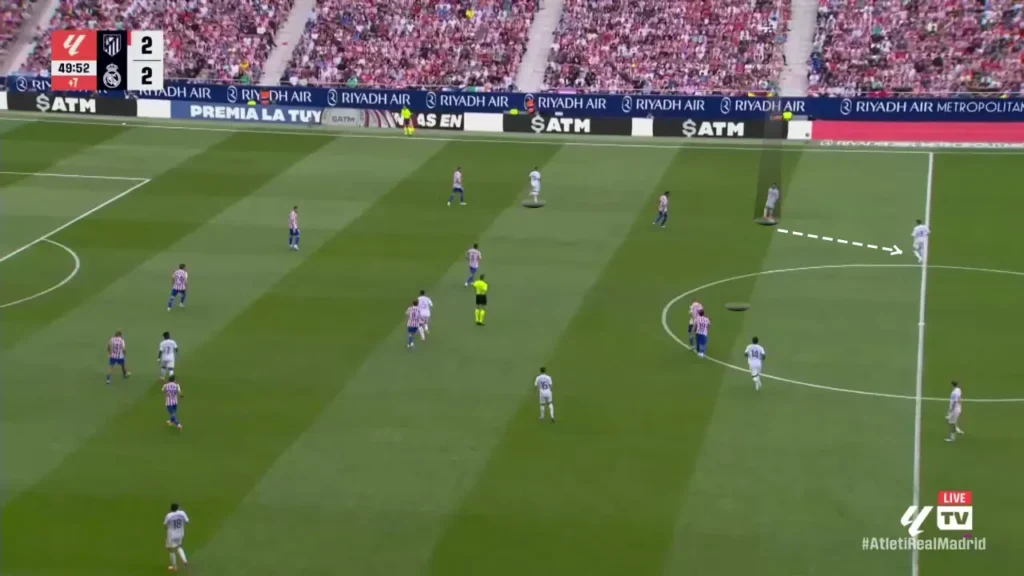
At the same time, Kylian Mbappé drifted wider on the right flank, attracting Atlético’s left-back and dragging him out of position. As Valverde then released the ball into Mbappé, the Frenchman effectively became the second link in the chain, with Carvajal emerging as the third man in the vacant channel.
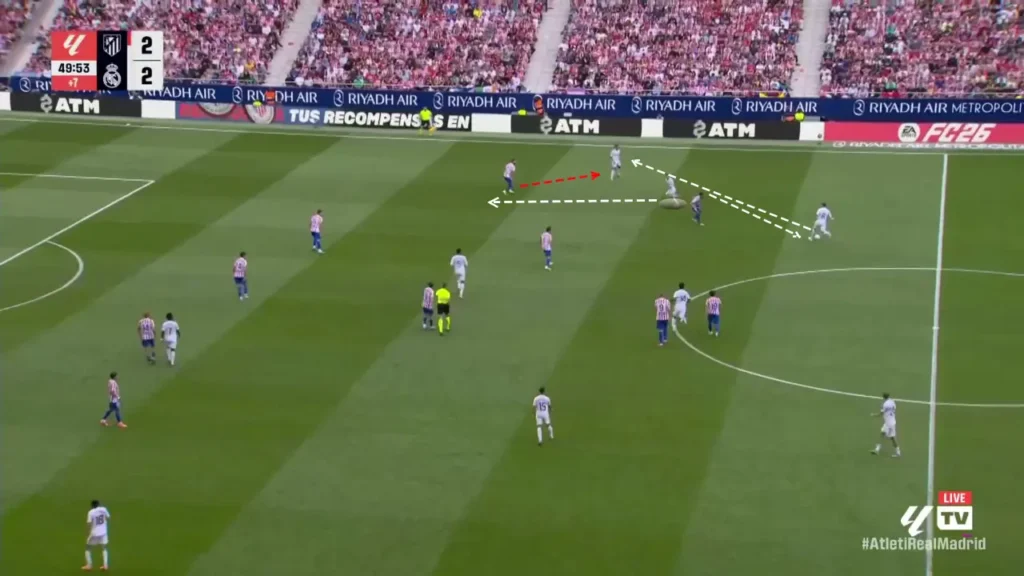
Suddenly, the right-back was free in an advanced position behind Atlético’s midfield line, offering an incisive passing option that cut through their compact defensive structure.
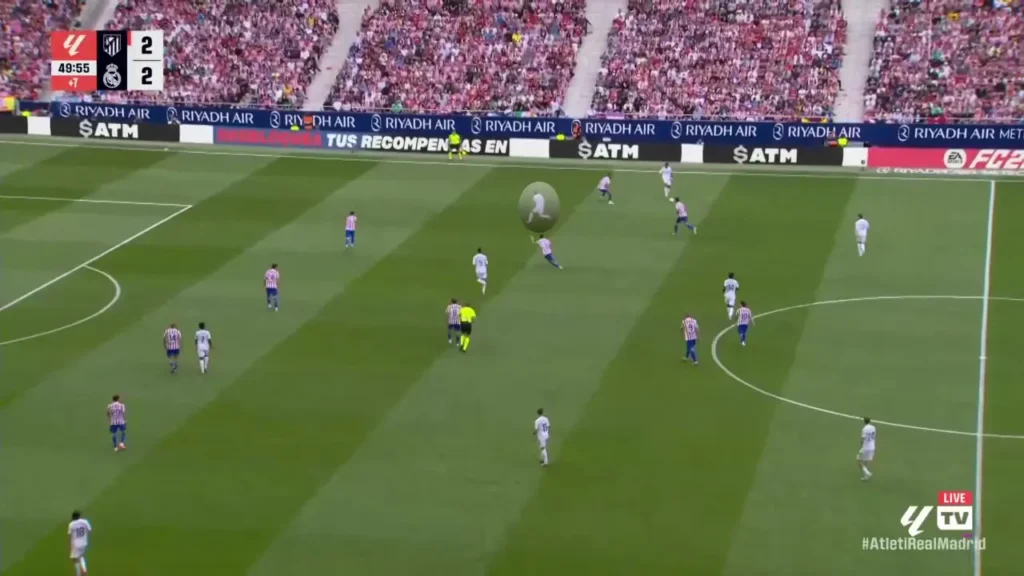
This sequence highlights Alonso’s intent: to make Madrid less predictable, encouraging players not only to circulate possession but to manipulate space with intelligent timing.
By embedding the third-man run into their attacking patterns, Madrid gain a mechanism that constantly stretches and tests the opposition, ensuring they always have a pathway into dangerous areas.
Vinícius Júnior’s Dynamic Role in Transitions under Alonso
One of the most intriguing tactical evolutions in Real Madrid’s attacking structure this season has been the way Xabi Alonso has redefined the role of Vinícius Júnior, particularly in transitional moments.
From Direct Outlet to Multifunctional Threat
Traditionally, Vinícius has been seen as the direct outlet in counter-attacks, the player who receives early, drives at defenders, and seeks to either shoot or create directly. However, the 2025 campaign has shown a more nuanced, dynamic role, where his influence extends beyond the ball itself.
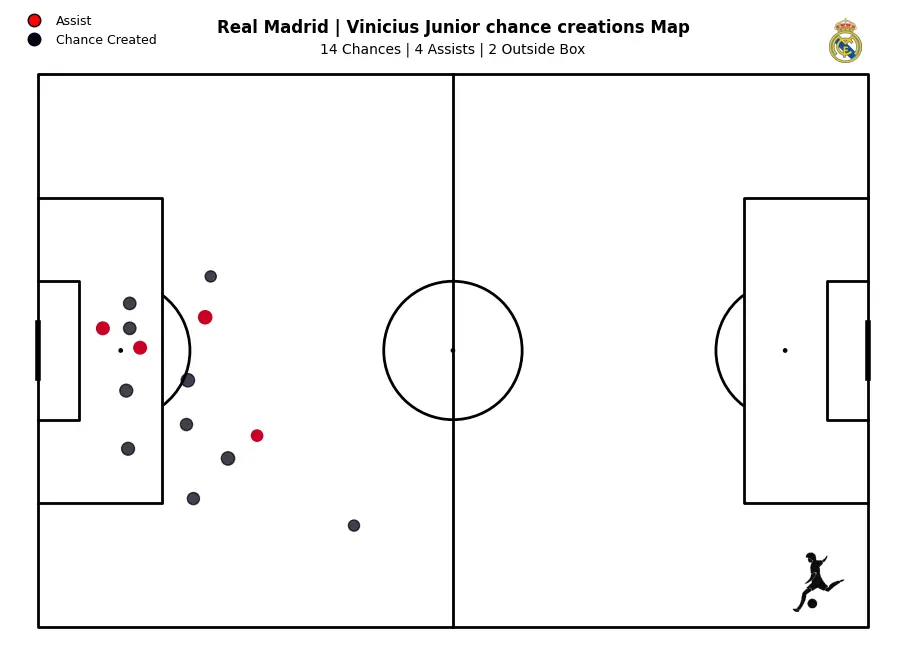
According to the early data in La Liga, Vinícius has already produced 14 shot-creating actions, four of which have directly led to goals in just five matches. These numbers highlight not only his creative impact but also his effectiveness in shaping attacking sequences at speed.
Intelligent Off-Ball Movements in Transition
What makes this season’s interpretation particularly significant is his work without the ball. Alonso has utilised his pace and dribbling threat as a decoy, deliberately positioning him to manipulate defensive lines.
In transitions, Vinícius often makes aggressive diagonal runs that drag multiple defenders towards him, opening spaces elsewhere for teammates to exploit.
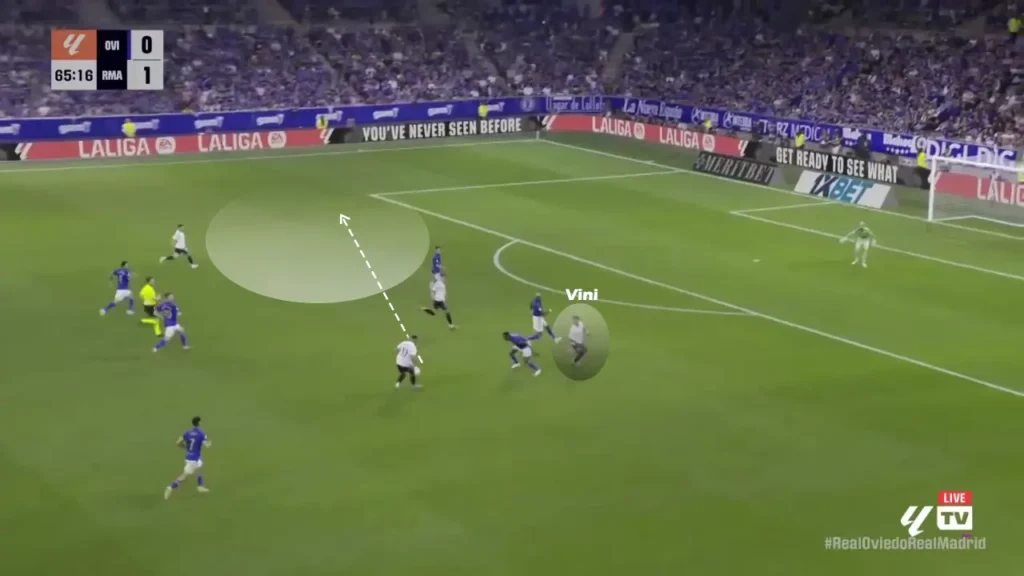
This mechanism was visible against Real Oviedo when Madrid were leading 1–0. As Kylian Mbappé drove forward in transition, four Madrid players surged into attacking positions. Instead of moving wide left as expected, Vinícius darted diagonally inside, pulling Oviedo defenders with him.
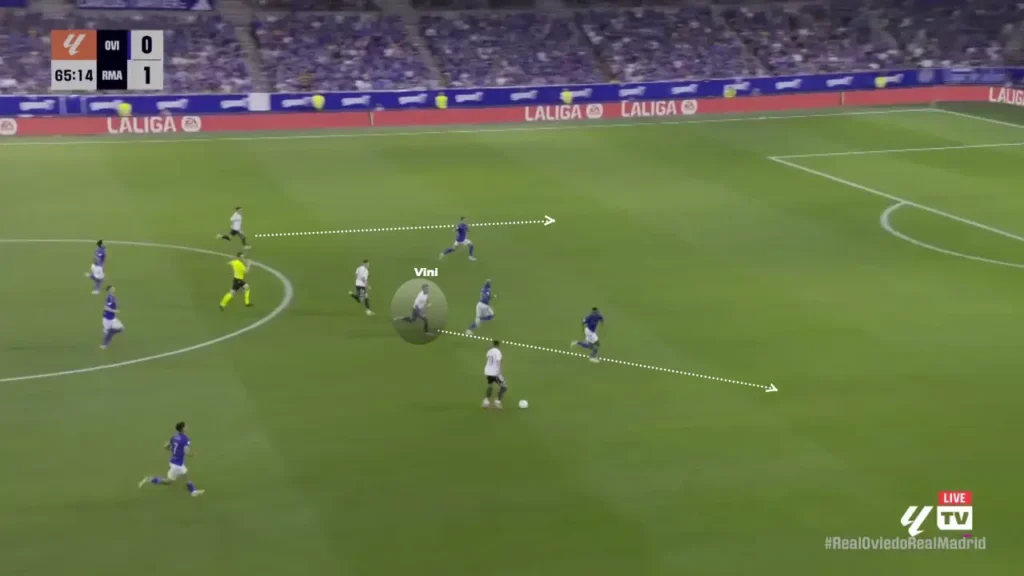
This deceptive movement created a clear passing lane for Mbappé to exploit on the far side, generating a dangerous chance.
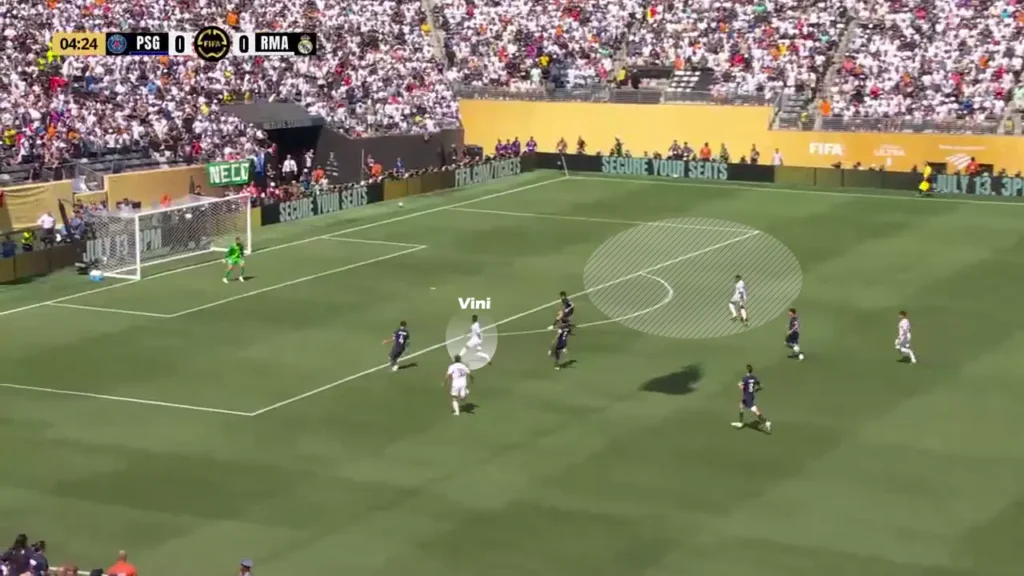
A similar example came earlier in the Club World Cup clash with Paris Saint-Germain. Positioned centrally against PSG’s defensive line, Vinícius delayed his movement before sharply shifting towards the left side upon noticing Aurélien Tchouaméni advancing from midfield.
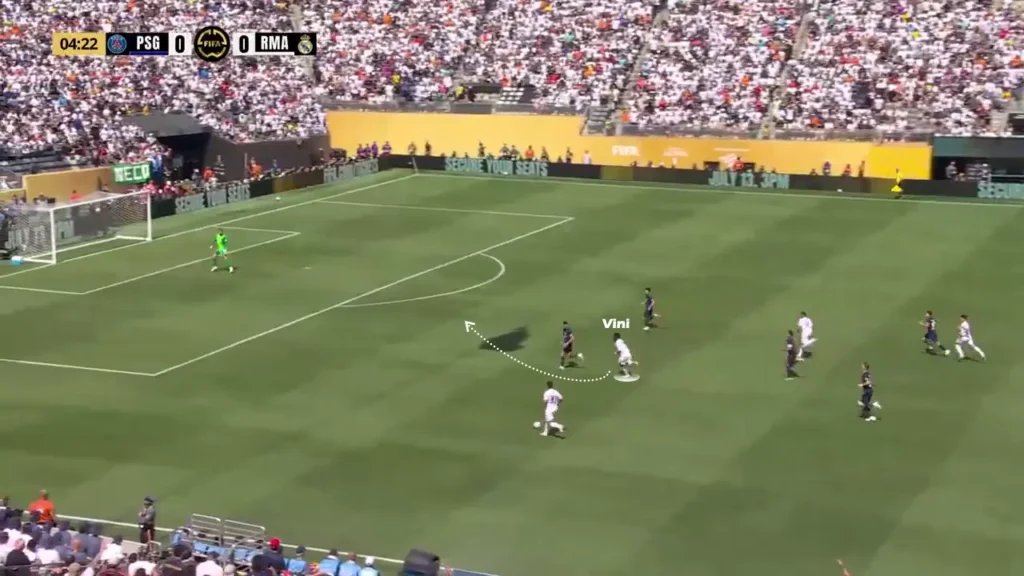
His run attracted both centre-backs, vacating a crucial pocket at the edge of the penalty area for Tchouaméni to occupy. This blend of intelligent off-ball movement, positional awareness, and timing underlines how Alonso is refining Vinícius’ attacking responsibilities.
Rather than being the sole end-point of Madrid’s counters, Vinícius has become a dynamic facilitator whose movements stretch, distract, and unsettle defensive blocks. By integrating him as both a direct and indirect weapon, Alonso ensures Madrid’s transitions are multi-layered, unpredictable, and far harder to contain.
The Attacking Contributions of Mbappé and Arda Güler
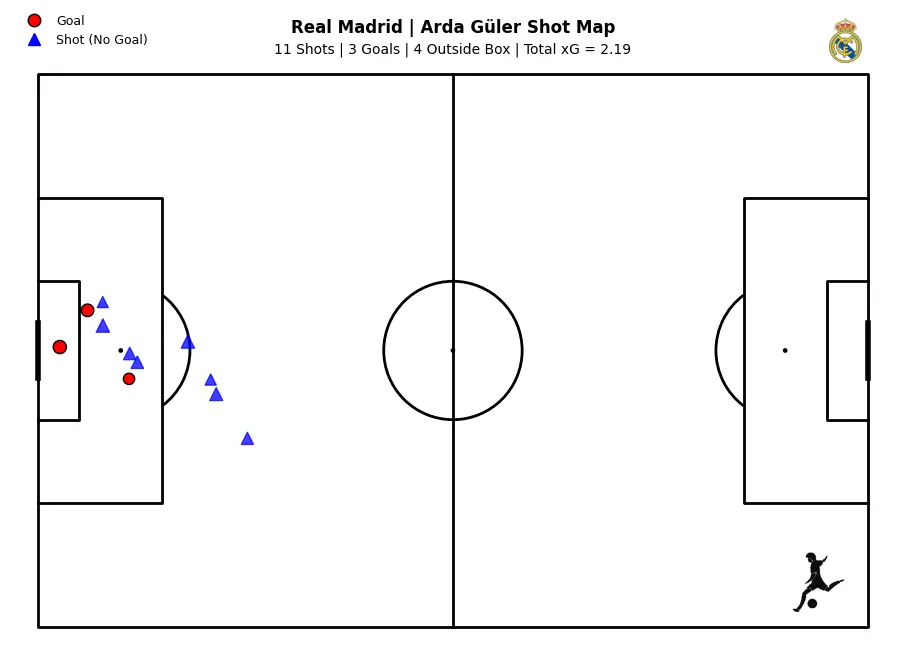
Arda Güler’s start to the 2025/26 campaign has been defined by intelligence and efficiency in the final third. The young midfielder has already created 21 chances, three of which have been converted into assists, highlighting his ability to unlock defensive lines with precision passing.
His shooting profile is equally impressive: 11 attempts, seven of them from inside the penalty area, producing three goals with a total xG of 2.19. These numbers reflect a player who combines decision-making with positional awareness, ensuring that when he arrives in dangerous zones, he does so with purpose.
For Alonso, Güler offers balance, a creative presence capable of both crafting opportunities and finishing them, ensuring Madrid’s attacks are not solely reliant on their star forwards.
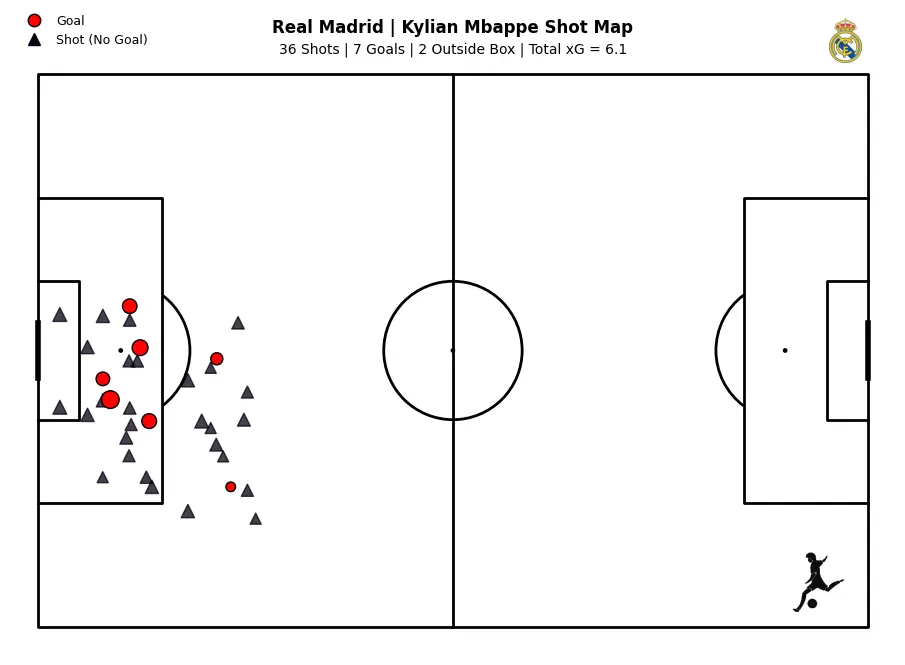
Kylian Mbappé, meanwhile, continues to showcase his world-class efficiency as Madrid’s primary goalscorer. Across 572 minutes, he has already scored seven goals from 36 shots, underpinned by a cumulative xG of 6.1. His xG per shot of 0.17 illustrates his knack for consistently finding high-quality chances rather than relying on speculative efforts.
Beyond the raw output, this efficiency speaks to his intelligent movement and understanding of Alonso’s attacking structure, where his runs stretch defences and his finishing provides a ruthless edge. For Madrid, Mbappé’s presence ensures that every attacking sequence carries a tangible threat, making him indispensable in turning tactical mechanisms into goals.
Alonso’s Use of Overloading to Manipulate Space
One of the defining tactical mechanisms Xabi Alonso has instilled in Real Madrid this season is the strategic use of overloading specific zones to create exploitable spaces elsewhere. The principle behind overloading is straightforward but tactically profound: by concentrating numbers in one area of the pitch, the opposition is forced to commit additional defenders, leaving other spaces less protected.
This manipulation of defensive attention not only destabilises the opponent’s structure but also opens up high-value areas for progression. For Alonso, this method fits seamlessly with his philosophy of provoking defensive responses rather than relying solely on spontaneous creativity.
A clear example emerged in the match against Espanyol. Madrid initially built an overload on the right half-space, drawing several Espanyol midfielders and defenders into a compressed area.
Meanwhile, Vinícius Júnior remained wide on the left, stretching the pitch horizontally and maintaining the threat of a switch.
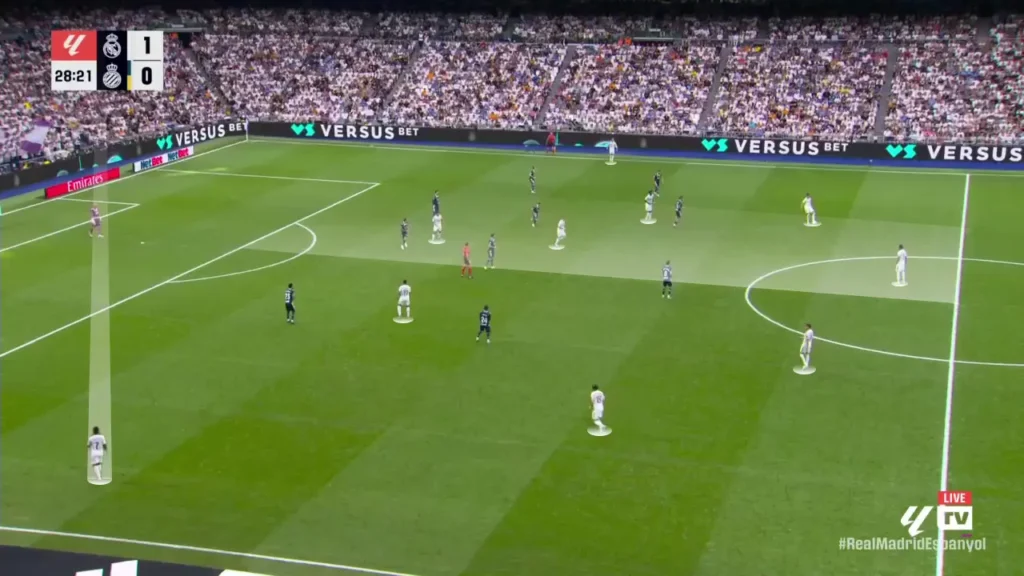
Following the initial overload, Madrid quickly shifted their attacking focus across to the left flank, effectively pulling Espanyol’s defensive block out of balance. This rapid change of emphasis created confusion, allowing a late-arriving Madrid player to exploit the vacated space in an advanced central position.
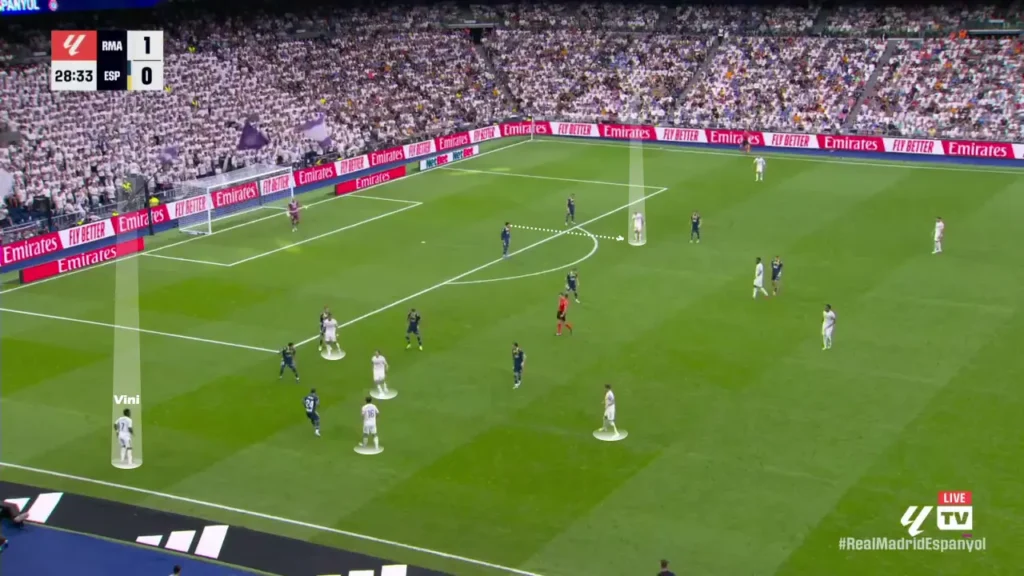
The tactical significance of such overloading lies in its double effect: it tests the opponent’s capacity to shift laterally at pace while simultaneously ensuring that Madrid’s runners from deeper zones can attack into gaps with minimal resistance.
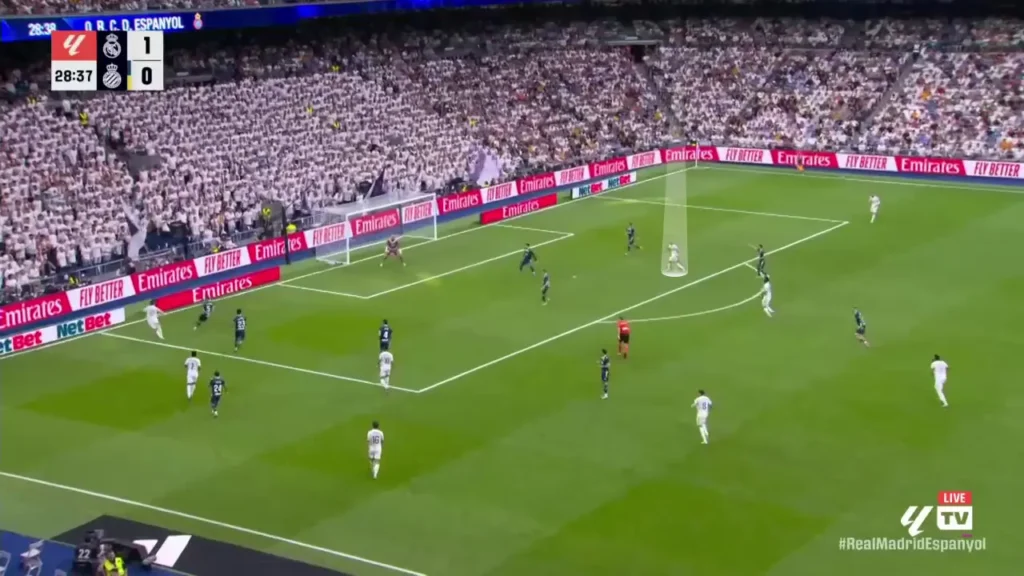
In Alonso’s scheme, overloading is not merely about numbers but about timing and intention, turning positional dominance into dangerous attacking opportunities.
Conclusion
Xabi Alonso’s attempt to redefine Real Madrid’s identity is still a work in progress, one that reflects both the potential of his tactical vision and the shortcomings of a squad caught between eras. The hallmarks of his philosophy, structured pressing, intelligent rotations in build-up, and the strategic manipulation of space, are already visible, offering glimpses of a side capable of playing with greater cohesion and modern tactical discipline.
The inconsistencies in execution, particularly in high-stakes encounters against well-drilled opponents, serve as reminders that this Madrid team remains far from a finished product.
Xabi Alonso has given them a clearer framework — one built on active defending, multi-layered transitions, and attacking mechanisms that provoke, stretch, and dismantle opposition structures.
The development of players such as Arda Güler, the tactical refinement of Vinícius Júnior, and the ruthless efficiency of Kylian Mbappé illustrate how individual brilliance can now operate within a more deliberate collective strategy.
Ultimately, Real Madrid under Alonso are a side in transition, bridging the gap between tradition and innovation, searching for a new identity that can sustain them at the highest level.
Whether this project matures into lasting success will depend not only on Alonso’s tactical ingenuity but also on the club’s ability to evolve its personnel and maintain patience. For now, what is clear is that Madrid are no longer defined solely by moments of individual genius but by an evolving blueprint that, if refined, could establish a new era of tactical maturity at the Bernabéu.