
Man-to-man defending is often described in simple terms — each defender marks an assigned opponent. But in modern football, a strict, constant, tight man-marking approach is rarely effective. The game is too fluid, the spaces too dynamic, and the positional rotations too complex for defenders to glue themselves blindly to an opponent.
Instead, elite defensive systems rely heavily on an intelligent principle in man-marking: distance-marking.
This concept determines how tight or loose a defender should be based on the opponent’s positioning, the location of the ball, and the overall threat level of the situation. When executed well, distance-marking allows teams to reap the benefits of man-to-man principles without losing structural balance.
What Is Distance-Marking?
Distance-marking is the idea that defenders change how tightly they mark their assigned opponent based on the evolving situation around the ball. Instead of following an opponent at a fixed distance everywhere, the defender constantly evaluates how immediately dangerous that opponent is.
In simple terms, distance-marking is about tight when it matters, loose when it doesn’t.
Defenders adjust their marking based on factors such as:
- How close the opponent is to the ball:
The nearer they are to the play, the greater the chance they can receive or influence the next action. - How dangerous their position is:
An attacker positioned between the lines or near goal demands tighter control than one standing wide and isolated. - The passing options around the ball:
If the ball-carrier has a clear line toward your direct opponent, you close the distance. If the pass is impossible or unlikely, you can afford to drop off. - Support and cover from teammates:
When teammates provide cover behind you, you can step closer. If cover is lacking, you may need a slightly larger buffer.
By adjusting their distance intelligently, defenders turn man-marking into a fluid, collective behavior rather than a rigid, one-to-one chase. This flexibility helps the team stay compact, create overloads near the ball, and protect key spaces—even while maintaining individual marking assignments.
Practical Example:
Imagine the opposition right-back has possession on your left side. The immediate threats are on that flank, so the defenders on the ball-near side must stay tight to their direct opponents to prevent simple passes.
On the opposite side, however, the situation changes. The opposition winger, fullback, and center-back on the far side are unlikely to receive the next pass due to distance, angles, and pressure. Because they are not immediate threats, the defenders on the far side can loosen their marking and tuck inside.
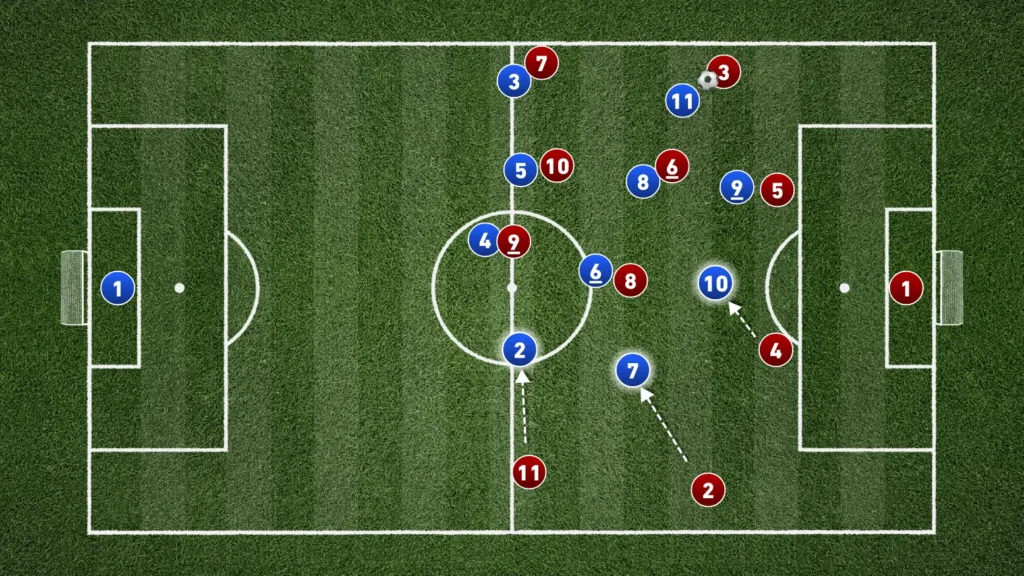
By shifting infield, they help create:
- Extra numbers around the ball
- A stronger defense in central zones
- Shorter distances for cover and pressure
If the ball eventually travels to the far side, those defenders simply adjust—closing the distance again as the threat increases.
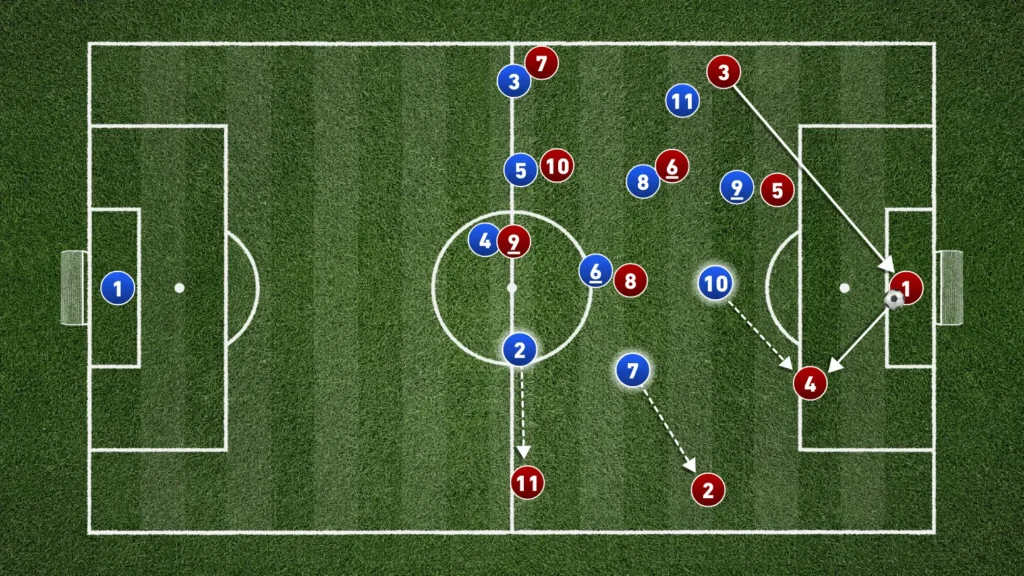
This dynamic adjustment is the essence of distance-marking: staying close when it matters, and smartly freeing yourself when it doesn’t.
The Core Principle: Distance Shrinks as the Threat Increases
A simple rule of thumb underpins the entire concept:
The closer your opponent is to the ball, the tighter your marking must be.
The further your opponent is from the ball, the looser your marking can be.
Why? Because not all opponents are equally likely to receive or influence the next action. When an opponent is far from the ball or marked out of the play, tight marking wastes defensive resources. Conversely, when play develops near an attacker, the margin for error disappears.
Distance-marking reallocates defensive attention toward the action without sacrificing man-marking responsibilities.
Why Distance-Marking Matters
Pure man-to-man systems carry two major risks:
- Players get dragged out of position as they follow their opponent everywhere.
- Large spaces open up for the opponent to exploit, especially between the lines.
Distance-marking solves these problems. By varying the marking distance, defenders can:
- Maintain compactness
- Provide cover for teammates
- Have more control over dangerous key zones
- Create numerical advantages around the ball
- Avoid overcommitting when the opponent is not a threat
It is a balance between marking the man and maintaining the team’s defensive shape.
Common Mistakes in Distance-Marking
- Marking too tight too early:
This leads to being dragged out of shape or beaten by simple movement. - Marking too loose too late:
Arriving late triggers dangerous receiving situations. - Ball-watching:
Forgetting to track the opponent’s movement while adjusting distance. - Miscommunication:
Tight and loose shifts must be collective, not individual improvisations.
Conclusion
Distance-marking is the modern, intelligent evolution of man-to-man defending. Instead of following opponents blindly, defenders adjust their proximity based on where the danger truly lies. The closer the ball, the tighter the marking; the further the ball, the more freedom the defender has to protect space or support teammates.
When executed as a collective system, distance-marking offers the best of both worlds:
- The pressure and accountability of man-marking,
- With the compactness and stability of zonal defending.
In a sport where space and timing decide everything, mastering distance-marking is essential for any team that wants to defend with both aggression and control.
The images and visuals in this article are made with Once Sport — a powerful and easy-to-use tactical analysis platform. It helps you annotate clips, visualize movements, and create professional analysis videos. Readers of The Football Analyst get 10% off plus one month free with the code TFA10 at checkout.
Before reading the last paragraph I was going to ask – does this approuch mix with zonal defending. Especially when key players are far from the ball?