
Counter-pressing is one of the most decisive behaviours in modern football. The moment possession is lost often determines whether a team can sustain pressure, control territory, or is forced into a long defensive phase. At the highest level, teams do not counter-press by instruction alone — they do it because their positioning, spacing, and collective habits make it the natural next action.
For coaches, this creates a challenge. Counter-pressing is not something that can be trained in isolation or through repeated sprinting toward the ball. It must emerge from how players are positioned before the ball is lost, how close they are to one another, and how quickly they recognise the transition.
The most effective counter-pressing drills therefore do not just train the press itself. They train possession structure, rest-defence, decision-making at the moment of loss, and the opponent’s attempt to escape. The drills below are designed with that in mind.
Drill 1: Positional Rondo With Immediate Counter-Press
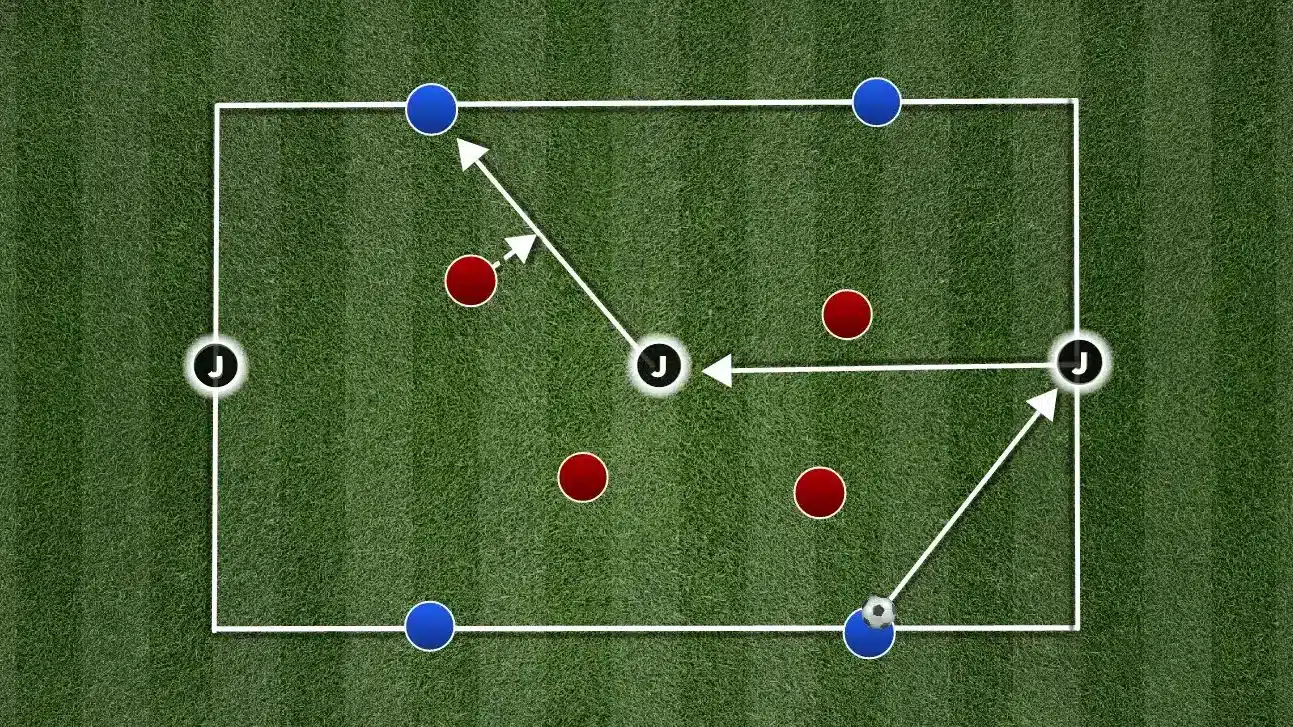
This drill is designed to replicate one of the most common counter-pressing situations in matches: losing the ball while spread across multiple lines, then reacting immediately to prevent the opponent from settling into possession.
Organisation
- Set up a rectangular area.
- Two teams of four players.
- One team of four starts on the outside, positioned on the long sides.
- One team of four starts inside the area, acting as the pressing team.
- Three neutrals:
- Two neutrals positioned on the short sides of the rectangle
- One neutral positioned inside the area
Rules
- When the outside team has possession, they circulate the ball using:
- Their four outside players
- The two neutral players on the short sides
- The neutral inside the area
- The inside team presses to win the ball.
- When the inside team wins possession:
- The former outside team must immediately step into the area and counter-press
- The team that won the ball must now find the neutrals and reorganise into the outside positions

What the Drill Trains
This drill forces players to:
- React instantly to the moment of loss
- Collapse distances quickly toward the ball
- Press collectively rather than individually
- Understand that counter-pressing is about preventing the opponent from settling, not necessarily winning the ball immediately
Because both teams constantly switch roles between pressing, counter-pressing, and possession, players experience repeated transitions without resets. The drill naturally teaches awareness, orientation, and reaction speed — without the coach needing to demand intensity verbally.
Drill 2: Possession Game With Escape Incentive
One of the clearest ways to train counter-pressing is to reward the opponent for escaping pressure. If escaping leads to points, the attacking team immediately understands why counter-pressing must be fast, coordinated, and aggressive.
Organisation
- Medium-sized possession area.
- Two teams (e.g. 6v6 or 7v7).
- One team starts in possession.
- Define an “escape zone” outside the main area.
Rules
- Normal possession play inside the area.
- When the defending team wins the ball, they have a few seconds (for example 5) to carry the ball into the escape zone (usually just outside the area).
- If they escape successfully, they score a point.
- If the attacking team wins the ball back before the escape, play continues and possession is retained.


What the Drill Trains
This drill makes the consequences of poor counter-pressing very clear:
- Slow reactions lead to points conceded.
- Disorganised pressing opens clear escape routes.
- Good counter-pressing denies time, space, and direction.
At the same time, it trains the defending team to recognise the best escape option quickly, making the transition realistic for both sides. The counter-pressing team is not just chasing the ball — they are defending space and direction.
Drill 3: Attack vs Defence With Counter-Attack Trigger
This drill links counter-pressing directly to attacking structure and rest-defence, which is where most counter-pressing problems actually begin.
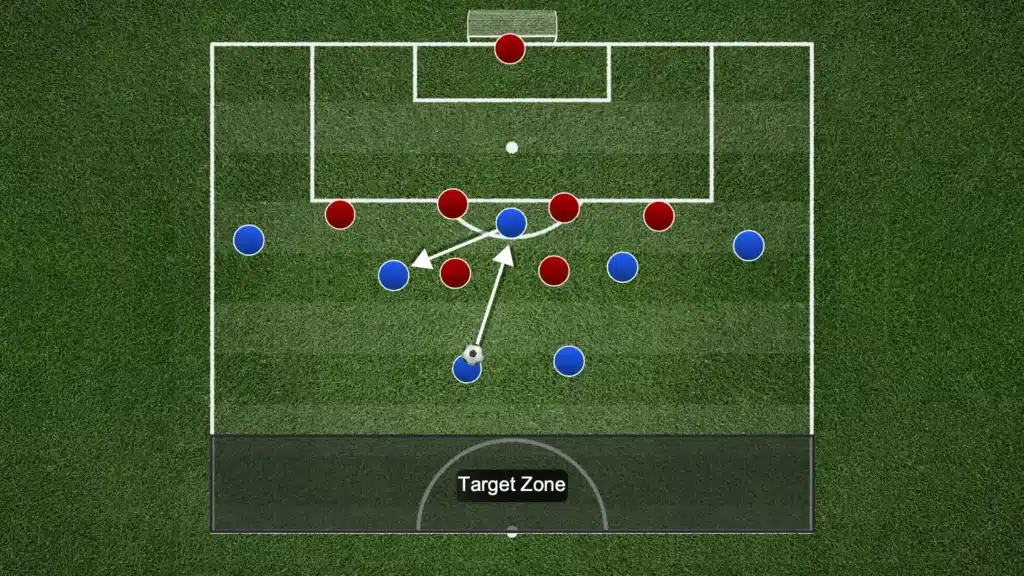
Organisation
- One team attacks a defensive block and a goal.
- The defending team is set up compactly.
- Define a target zone or small goals higher up the pitch for the defending team to counter-attack into.
Rules
- The attacking team tries to create chances and score.
- When the defending team wins the ball, their immediate objective is to counter-attack into the target zone.
- The attacking team must counter-press instantly to prevent progression.

What the Drill Trains
This drill highlights:
- How attacking spacing affects counter-pressing success
- The importance of rest-defence positioning
- The need to close central space immediately after loss
- The connection between attack and defence
If the attacking team commits too many players forward without structure, counter-pressing becomes impossible. Players learn this not through instruction, but through repeated failure and adjustment.
Drill 4: Continuous Transition Game
This drill focuses on endurance, decision-making, and collective behaviour under fatigue — all critical factors in real counter-pressing situations.
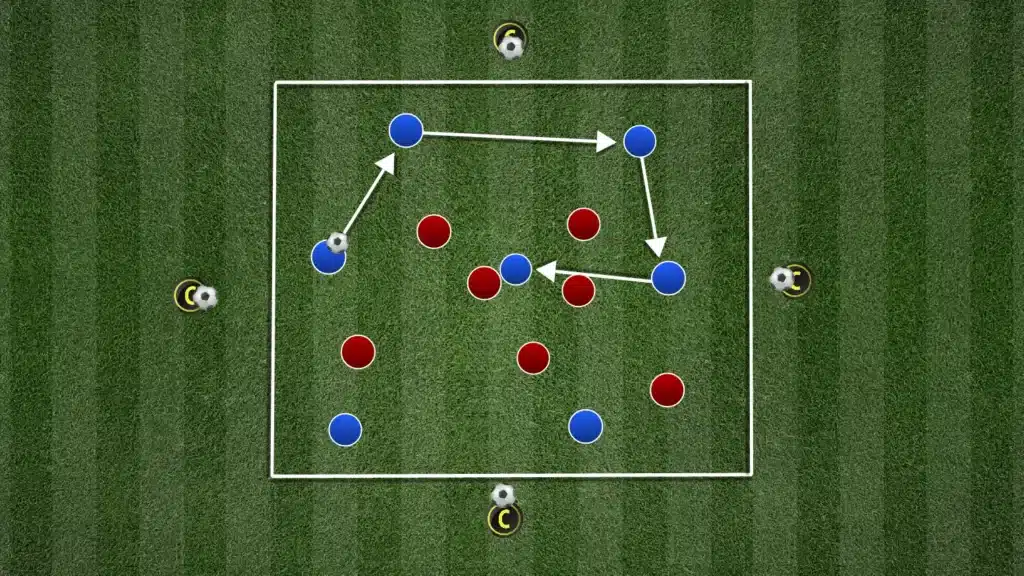
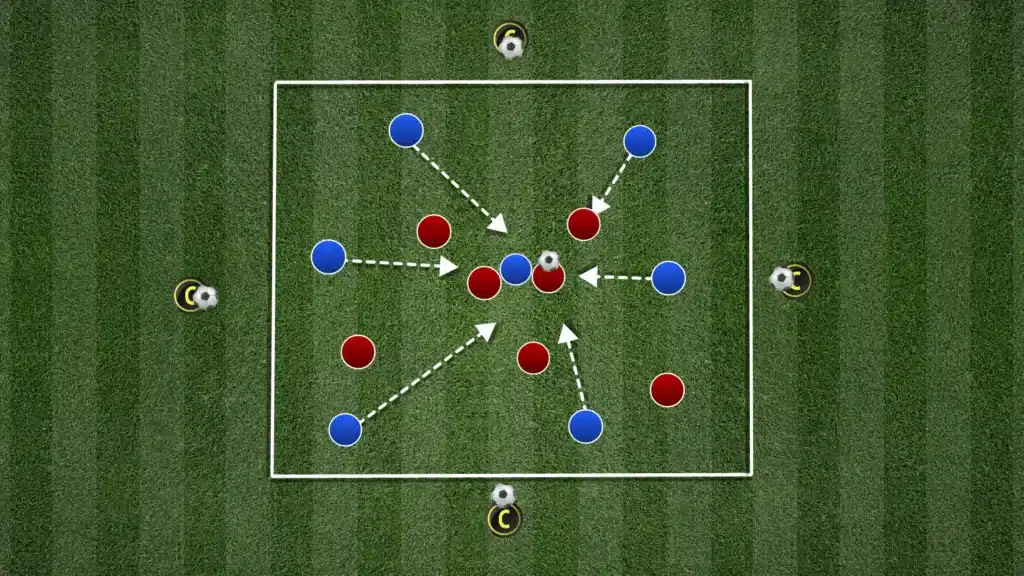
Organisation
- Two teams in a continuous possession game.
- No fixed restarts.
- Multiple balls available to keep the game flowing.
Rules
- Every turnover must be followed by an immediate pressing action.
- Play continues regardless of success or failure.
- Coaches allow the game to run for extended periods.
What the Drill Trains
As fatigue increases, players are forced to:
- Prioritise pressing actions
- Communicate more efficiently
- Recognise when to step out and when to delay
- Maintain compactness under stress
This drill does not reward constant sprinting. Instead, it exposes poor structure and poor decisions, while rewarding teams that manage distances and roles intelligently.
Why These Drills Work
What links all of these drills is not intensity, but context. Counter-pressing is trained as part of possession, positioning, and transitions — not as a standalone behaviour.
Players learn that:
- Counter-pressing starts before the ball is lost
- Distance and structure matter just as much as speed
- Denying the opponent time and direction is often enough
- Winning the ball back is a consequence, not the primary goal
Over time, counter-pressing becomes a habit rather than a command.
Conclusion
The best counter-pressing drills do not look dramatic. They look like football. They include possession, transitions, mistakes, escapes, and fatigue — because that is where counter-pressing actually lives.
By designing training environments that repeatedly expose players to realistic moments of loss and recovery, coaches allow counter-pressing behaviour to emerge naturally. The goal is not to teach players to press harder, but to help them understand when, where, and how pressing works as part of the collective.
When that understanding is in place, counter-pressing stops being something players are told to do — and becomes something they do instinctively.
All images and visuals in this article are made with Once Sport — a powerful and easy-to-use tactical analysis platform. It helps you annotate clips, visualize movements, and create professional analysis videos. Readers of The Football Analyst get 10% off plus one month free with the code TFA10 at checkout.