
The 5-4-1 has become one of the most reliable low-block defensive systems in modern football. Once dismissed as an overly conservative shape, it is now used by ambitious and pragmatic teams alike, offering stability, compactness, and clear defensive reference points. Whether deployed by underdogs trying to survive pressure or dominant sides securing a lead, the 5-4-1 prioritizes control of central spaces, a reinforced defensive line, and collective discipline.
Fundamentally, the structure provides coaches with a stable defensive base: five defenders in the last line, four midfielders ahead, and a single striker initiating the first wave of pressure. The efficiency of this system depends not simply on the formation itself but on the timing, coordination, and compactness with which the team moves.

Core Principles of the 5-4-1 Defensive Block
1. Horizontal Compactness
The defining strength of the 5-4-1 is its ability to remain compact across the width of the pitch.
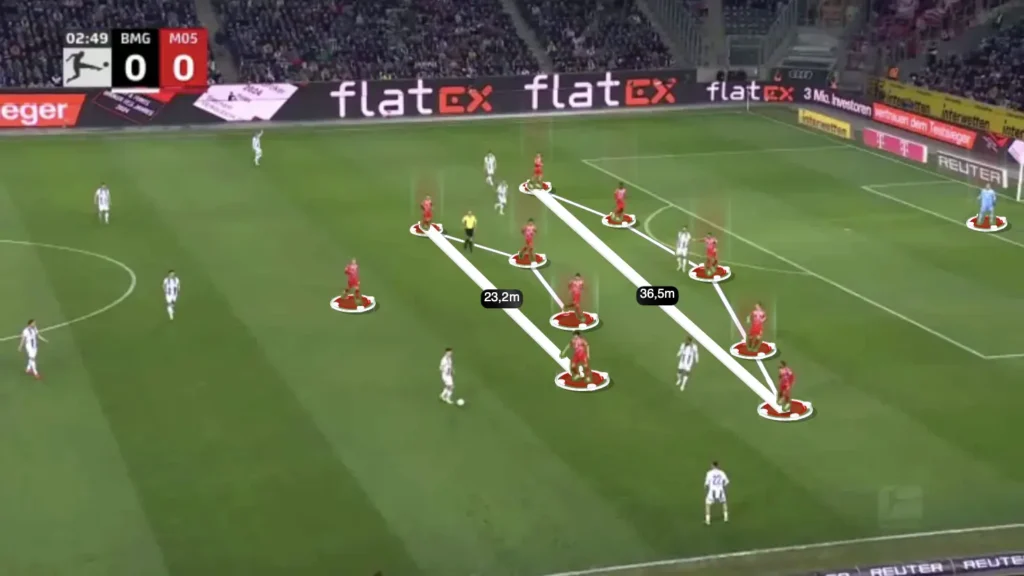
With three center-backs and two wing-backs forming the last line, the team can shift from side to side and cover the entire width without stretching too far apart. This reduces gaps, enhances protection of the half-spaces, and forces opponents toward the flanks.
Because the midfield four shift tightly in front of them, the block becomes extremely difficult to break with diagonal or vertical passes. Opponents are consistently steered into predictable wide areas, where the 5-4-1 naturally has solutions.
2. Vertical Compactness
Vertical distances between the striker, midfield, and defensive line are kept intentionally short. The goal is simple: deny space between the lines.
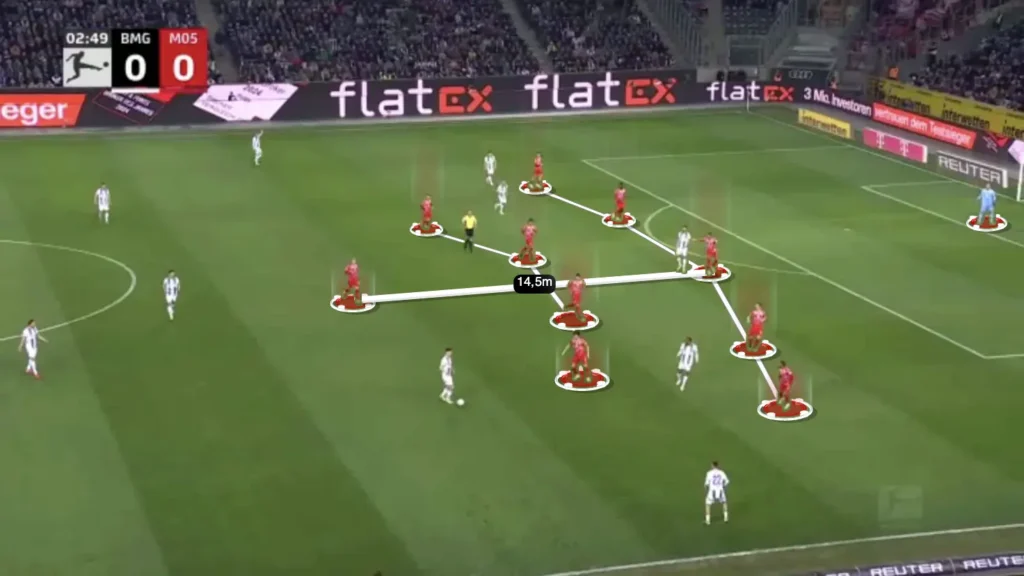
To achieve this:
- The striker screens central pivots rather than pressing wildly.
- The midfield line stays tightly connected.
- The defensive line steps up collectively when opponents receive to feet.
Teams using the 5-4-1 often speak about moving as if “connected by a rope,” ensuring no line becomes detached from another.
Roles Within the 5-4-1 Block
The Lone Striker
The forward is less of a presser and more of a controller. His job is to:
- Block central access
- Guide the opponent toward one side
- Prevent easy passes into the midfielders
He sets the direction of the opponent’s build-up rather than trying to win the ball alone.
The Midfield Four
The midfield line is the engine of the 5-4-1. Their responsibilities include:
- Protecting zone 14
- Blocking direct passes into the pockets
- Shifting laterally as a tight unit
- Doubling wide to support the wing-back
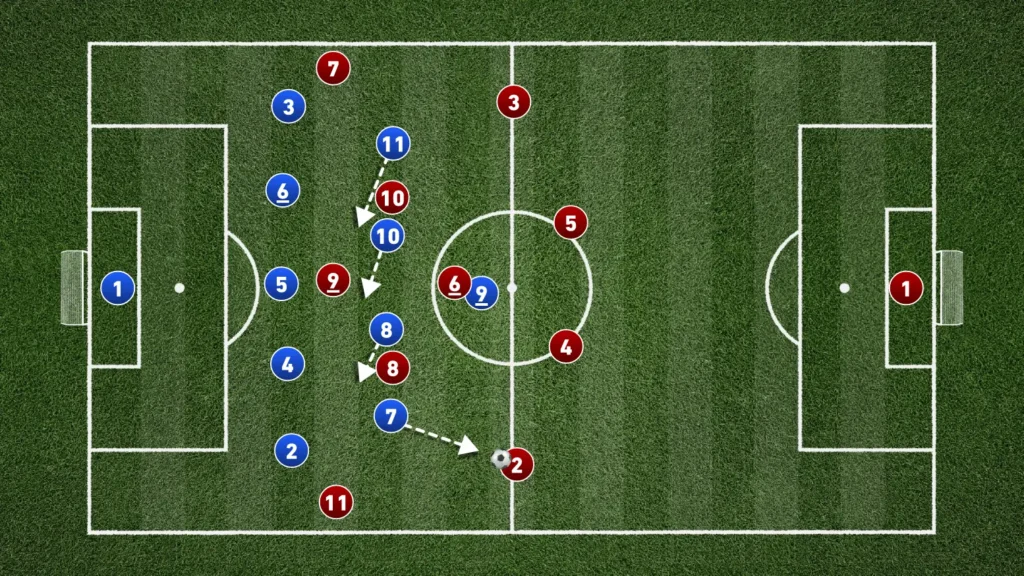
The ball-side wide midfielder steps toward the ball to close inside channels, while the far-side midfielders tuck in to reinforce central control.
The Back Five
The last line provides the structure coaches value most:
- Three center-backs protect the penalty area
- Wing-backs can press wide players aggressively
- Outside center-backs cover behind them if beaten
This allows a team to defend the wide channels without sacrificing central compactness — a key advantage over a traditional back four.
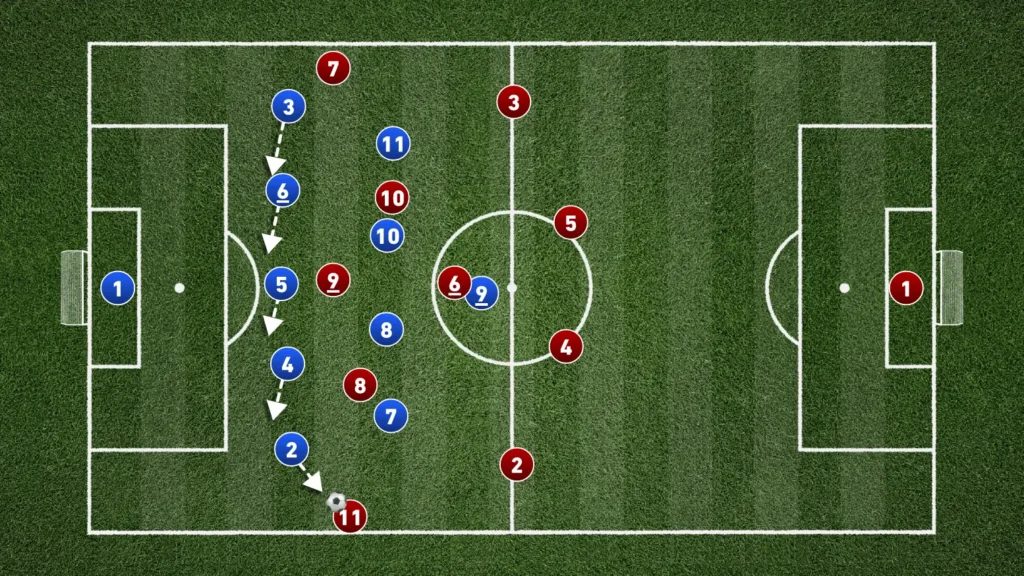
Additionally, the back five gives a major advantage against modern attacking structures.
Many teams now push five attackers onto the last line. In a back four, this forces defenders into difficult marking decisions and often leaves attackers open.
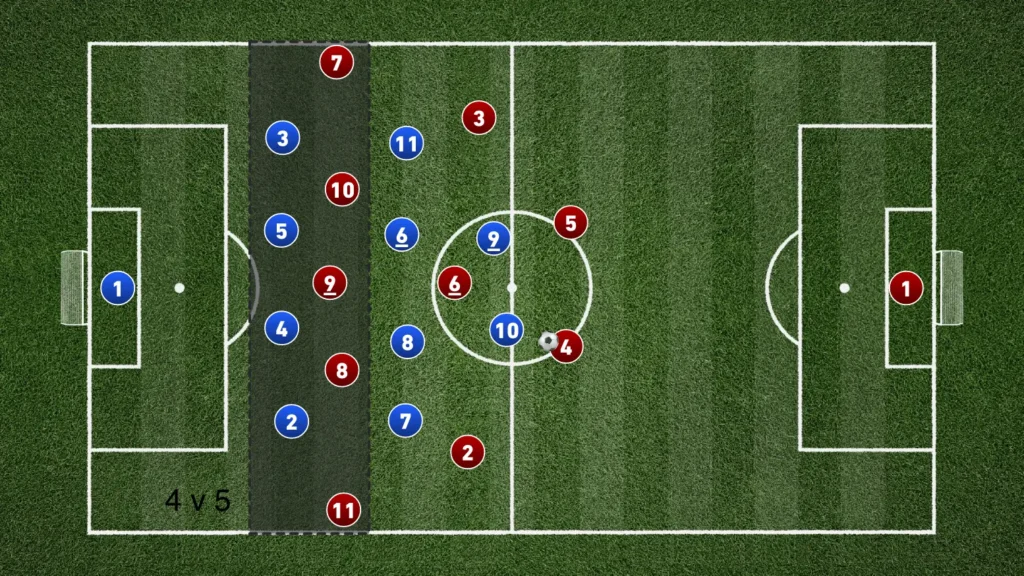
In a 5-4-1, the last line can become more man-oriented, allowing defenders to track attackers more tightly without losing shape.
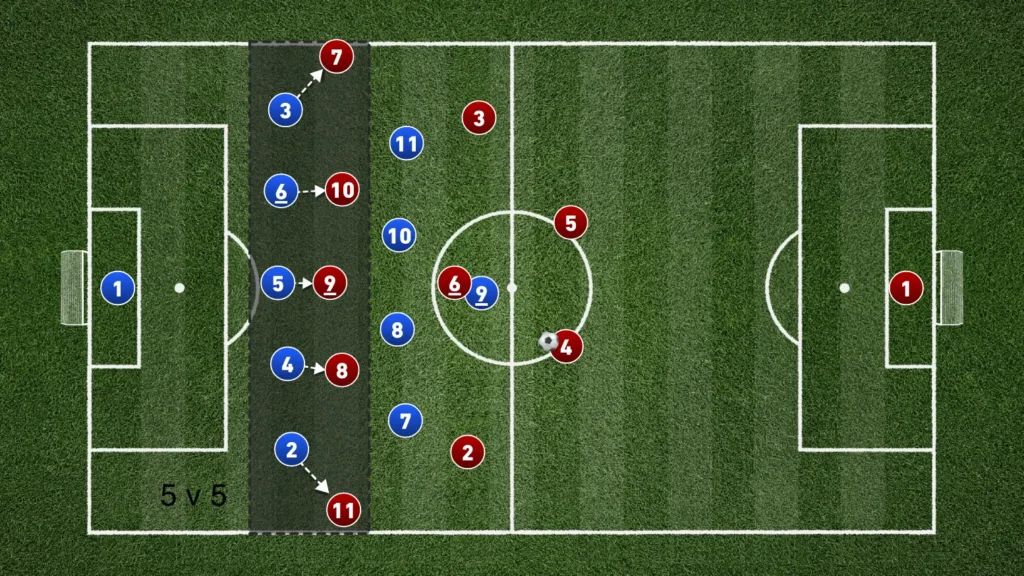
For this to work, the wide center-backs must be aggressive. When an opposition midfielder occupies the half-space between the lines, the wide center-back can step out to engage him. As he steps up, the remaining defenders slide across to close the gap he leaves, maintaining stability.
Controlling the Wide Areas
Attacks against a 5-4-1 typically target the flanks. The formation is specifically designed to meet this challenge.
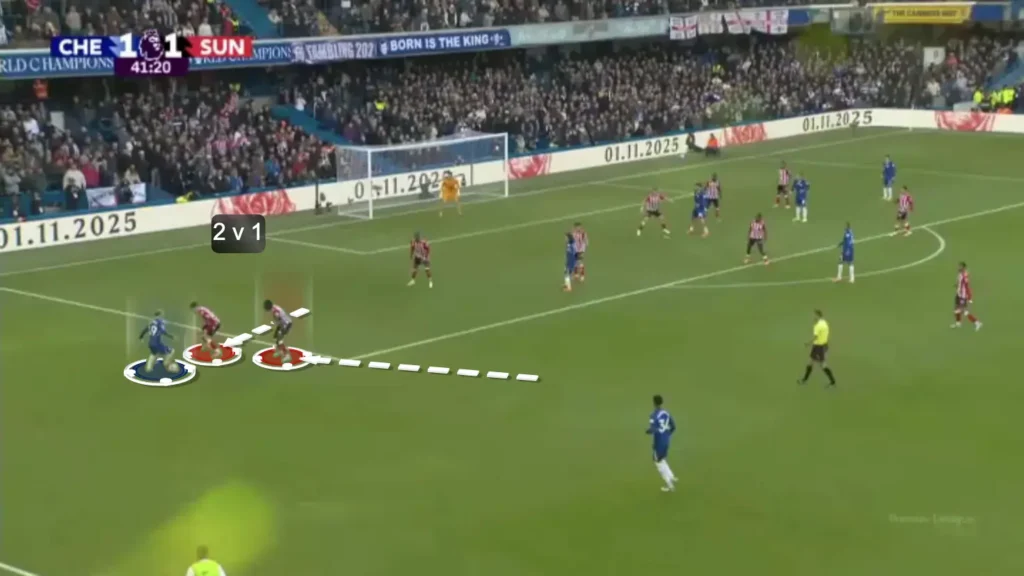
Wing-back Engagement:
The wing-back steps to the wide ball-carrier early, preventing easy dribbles or uncontested deliveries.
Outside Center-Back Support:
If the wing-back is beaten or bypassed, the outside center-back shifts across to protect the channel and delay penetration.
Midfield Support:
The ball-side midfielder slides over, blocking passes inside and ensuring no isolation occurs.
The result is a natural 2v1 or 3v2 defensive superiority in wide areas while maintaining security in the center.
Shutting Down Central Progression
One of the greatest strengths of the 5-4-1 is how effectively it eliminates direct central access.
Key mechanisms include:
- The striker blocking the pivot
- The midfield four screening vertical lanes
- The defensive line stepping up sharply on receiving forwards
- The far-side midfielder pinching in to close gaps
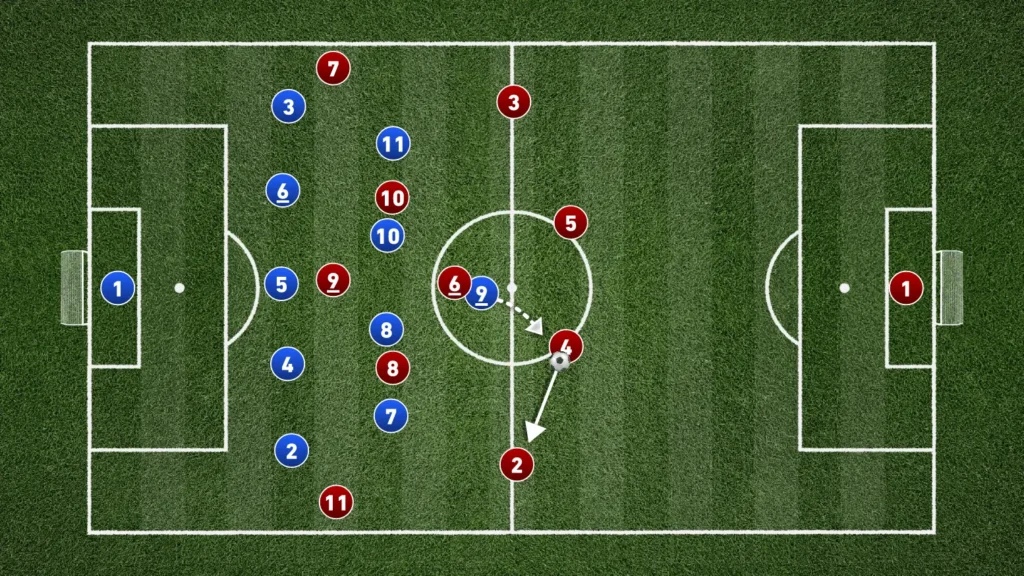
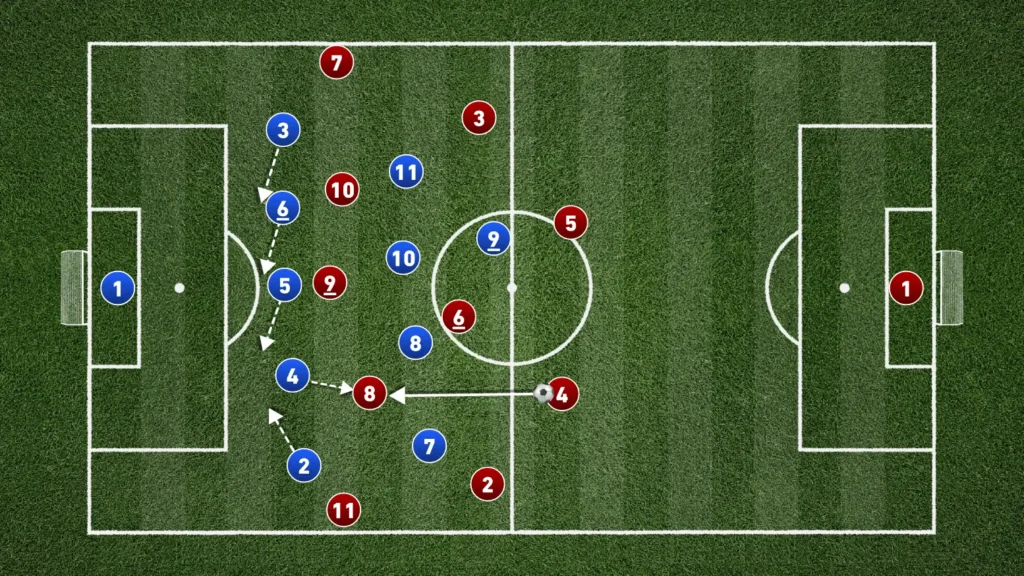
However, a common challenge emerges when the lone striker is up against two opposition center-backs.
If he presses one center-back, the ball can be moved across to the other, who may then be able to drive forward freely.
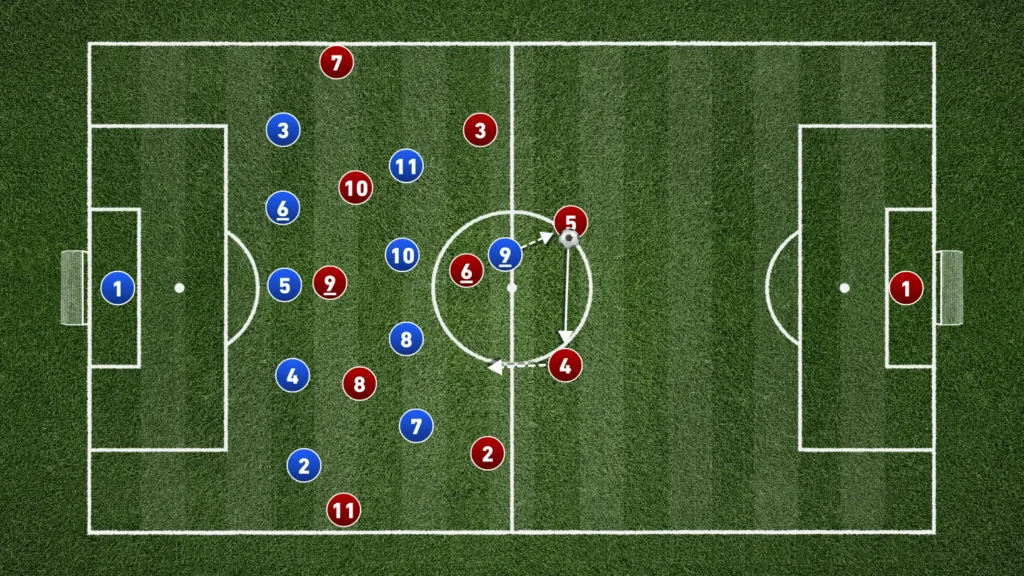
To stop the center-back from advancing the ball too far:
- A central midfielder steps up to engage the advancing center-back.
- This leaves space behind him, but the remaining midfielders slide inward to protect the pocket.
- Meanwhile, the wide center-back behind the midfielder steps up to mark any opponent dropping into that space.
- The remaining defenders slide across to keep the line compact.
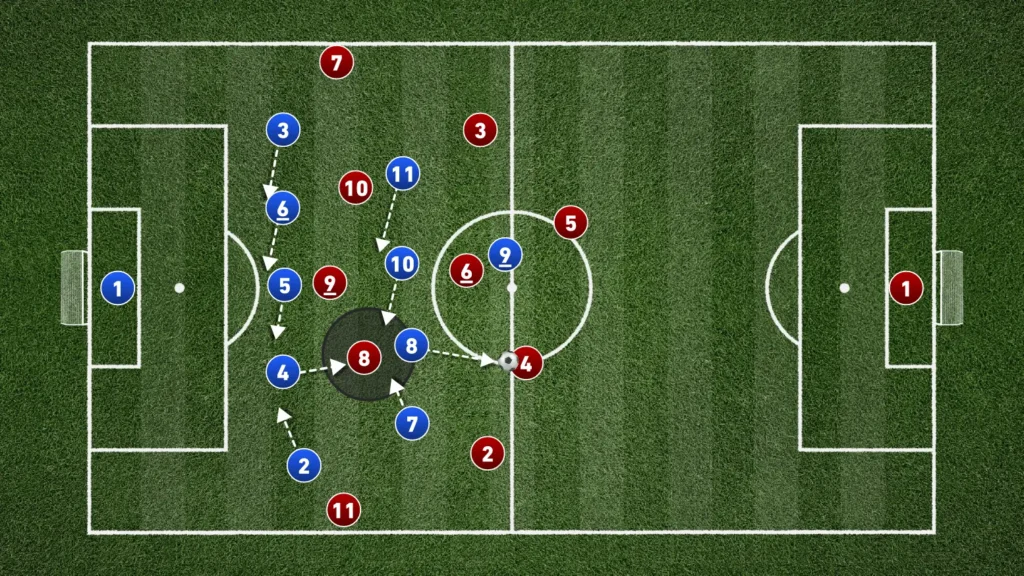
This coordinated movement ensures the block stays compact even when pressure is applied higher.
Many well-executed 5-4-1 systems will show seven or eight players compactly occupying the central block, making it nearly impossible for opponents to break the lines without extraordinary precision.
Weaknesses of the 5-4-1 (and Common Solutions)
Even well-drilled 5-4-1 setups come with tactical risks.
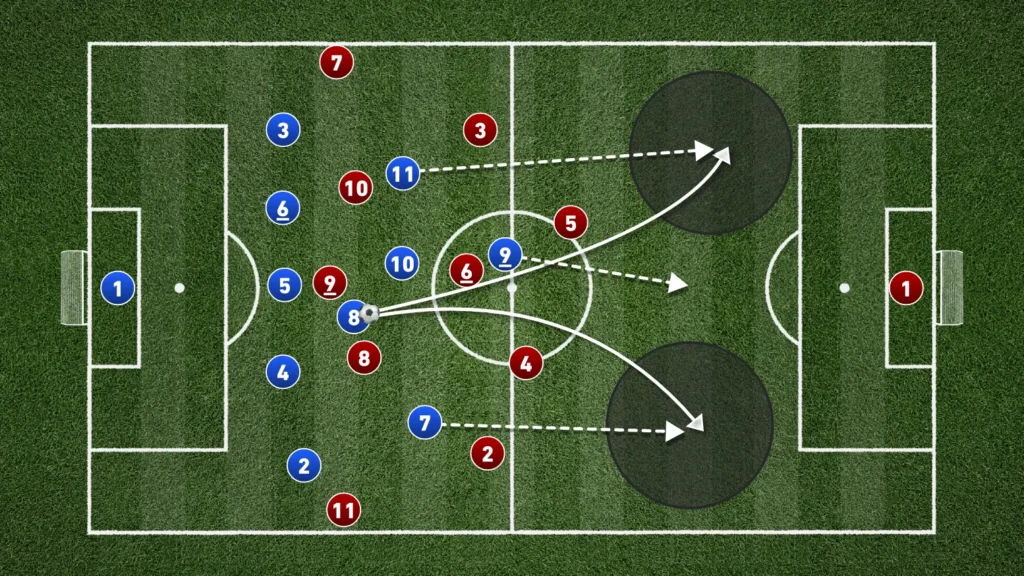
1. The Lone Striker Can Become Isolated
When the block becomes too deep, counterattacking outlets disappear.
Coaches address this by:
- Asking a midfielder to support transitions
- Preparing rehearsed “exit routes” after regaining possession
2. Sustained Wing-back Overload
Opponents may attempt rotations that force the wing-back to defend multiple threats simultaneously.
Solutions include:
- Early shifts from the outside center-back
- Wide midfielder comes down to help the wing-back on the inside
- Central midfielder collapsing into the channel
3. Fatigue in Deep Blocks
Defending for long periods demands intense concentration. Even small lapses can be punished.
To manage this, some teams:
- Push the line 10–15 meters higher after clearances
- Use the striker to delay opposition build-up
- Maintain strict communication between lines
Conclusion
The 5-4-1 is far more than a defensive fallback shape — it is a highly structured system built around compactness, clarity of responsibility, and spatial control. With a reinforced last line, strong central congestion, and natural mechanisms to defend wide areas, it offers teams a reliable way to limit high-quality chances and protect their penalty area.
While it carries risks — particularly regarding the isolation of the lone striker and the physical demands on wingbacks — teams that execute the shape with discipline and coordinated movement can reduce opponents to predictable, low-value attacks.
In the modern game, where detailed defensive organization is often the difference between stability and chaos, the 5-4-1 remains one of the most efficient and effective systems for controlling space and shutting down dangerous central progression.
All images and visuals in this article are made with Once Sport — a powerful and easy-to-use tactical analysis platform. It helps you annotate clips, visualize movements, and create professional analysis videos. Readers of The Football Analyst get 10% off plus one month free with the code TFA10 at checkout.
Great article! And I much more like the tactics graphs than just a screenshot from a game. I started to follow this blog for a several weeks ago, and I keep coming everyday and I enjoy it a lot, because the articles are not too long, yet they tell every aspect of the content with clear and short sentences. If you can make more content like this with such images would be even more awesome!
Thank you for your support and the feedback!